Robert E. Stake - Böcker
3 516 kr
Skickas inom 3-6 vardagar
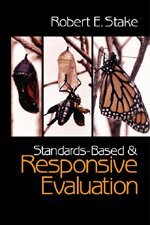
"We can be grateful that Dr. Stake decided to cap his distinguished career by sharing his ideas in writing. This is a book that evaluators will want to have in their personal library. It tells us a lot about our field, highlights contrasting ways of evaluating without pitting one against the other, and manages to remind us why many of us chose this line of work in the first place."--EVALUATION AND PROGRAM PLANNINGAuthored by a master writer and evaluator, Standards-Based and Responsive Evaluation explores the many conceptual choices an evaluator needs to make when doing an evaluation, devoting attention to stakeholders, weighing ethical risks, and writing a useful report.
The book begins with the main strategic choices an evaluator needs to make between approaches: quantitatively,by explicating criteria, needs, standards, and performances, or qualitatively, by studying the activity, aspirations, problems, and accomplishments of the participants and critical observers. After reading the text, students will have a better appreciation of evaluation as a process that needs to be custom-fit to the situation. Throughout the book, Stake presents evaluation as a series of choices for the reader:
- To remain independent or to join with program staff or stakeholders- To value personal experience as evidence or to shun it as biased- To aid development formatively or to assess the existing program summatively- To use issues, goals, gains, efficiency, or problem solving as the key conceptual structure- To invest small or large in trying out and validating data-gathering procedures- To support the standards and ethical codes of professional associations
Standards-Based and Responsive Evaluation will prove an essential text for program evaluation courses in education, nursing, social work, psychology, sociology, communication, and anthropology. Experienced researchers and professional evaluators will also find this an invaluable reference for a more experiential, interpretive approach to evaluation work and policy setting.
Key Features:
- Provides readers with the tools they need to make choices while practicing evaluation- Employs quotations, poetry, and cartoons to help the reader "experience" the concepts of evaluation - Includes boxed examples from a variety of cases, giving readers the opportunity to compare an actual evaluation situation with one in which they may be engaged- Allows readers to access extensive examples of evaluation reports, coding excerpts, and more, through a complementary Web site appendix
1 822 kr
Skickas
"We can be grateful that Dr. Stake decided to cap his distinguished career by sharing his ideas in writing. This is a book that evaluators will want to have in their personal library. It tells us a lot about our field, highlights contrasting ways of evaluating without pitting one against the other, and manages to remind us why many of us chose this line of work in the first place."--EVALUATION AND PROGRAM PLANNINGAuthored by a master writer and evaluator, Standards-Based and Responsive Evaluation explores the many conceptual choices an evaluator needs to make when doing an evaluation, devoting attention to stakeholders, weighing ethical risks, and writing a useful report.
The book begins with the main strategic choices an evaluator needs to make between approaches: quantitatively,by explicating criteria, needs, standards, and performances, or qualitatively, by studying the activity, aspirations, problems, and accomplishments of the participants and critical observers. After reading the text, students will have a better appreciation of evaluation as a process that needs to be custom-fit to the situation. Throughout the book, Stake presents evaluation as a series of choices for the reader:
- To remain independent or to join with program staff or stakeholders- To value personal experience as evidence or to shun it as biased- To aid development formatively or to assess the existing program summatively- To use issues, goals, gains, efficiency, or problem solving as the key conceptual structure- To invest small or large in trying out and validating data-gathering procedures- To support the standards and ethical codes of professional associations
Standards-Based and Responsive Evaluation will prove an essential text for program evaluation courses in education, nursing, social work, psychology, sociology, communication, and anthropology. Experienced researchers and professional evaluators will also find this an invaluable reference for a more experiential, interpretive approach to evaluation work and policy setting.
Key Features:
- Provides readers with the tools they need to make choices while practicing evaluation- Employs quotations, poetry, and cartoons to help the reader "experience" the concepts of evaluation - Includes boxed examples from a variety of cases, giving readers the opportunity to compare an actual evaluation situation with one in which they may be engaged- Allows readers to access extensive examples of evaluation reports, coding excerpts, and more, through a complementary Web site appendix
Telling Tales
On Evaluation and Narrative
1 691 kr
Skickas inom 5-8 vardagar
2 699 kr
Skickas inom 3-6 vardagar
"The book is a concise and very readable guide to case study research. It includes a good introduction to the theoretical principles underlying qualitative research, and discusses a wide range of qualitative approaches, namely naturalistic, holistic, ethnographic, phenomenological and biographic research methods. . . . Stake offers some useful practical advice, for example, on how to conduct in-depth interviews, how to analyze qualitative data and on report writing. . . . Stake writes in a rather unusual and very personal style but this makes the text very readable. The author's obvious passion for research makes the text even more enjoyable and stimulating. . . . the book. . . seems particularly appropriate for those undertaking this type of research in the fields of education and social policy."
--Ivana La Valle in Social Research Association News
"It is gratifying to encounter a text so cogently advocating the case study method (aka: naturalistic fieldwork) as a legitimate knowledge-enhancing endeavor."
--Sala Horowitz in Academic Library Book Review
"I have just finished a qualitative case study based almost entirely on interviews with engineering students. The two sources on which I depended most heavily were Robert E. Stake's The Art of Case Study Research and Harry F. Wolcott's Writing Up Qualitative Research. I have heard others sing the praises of different works and I have referred to them, but favor the two mentioned."
--Terry C. Hall, Ed.D., Independent Scholar
"This volume consolidates and elaborates ideas Robert E. Stake articulated in earlier journal articles and chapters in a form that is useful and readily accessible to both practitioners and students of educational research methods. His unusually personal presentation style and innovative format for sharing practical tips through authentic examples add to the main treasure of his new book: an incomparable sophistication about research epistemology and practice. . . . His vast experience in the field and in the classroom and his intimate knowledge of the literature intersect, providing the reader with an unusually comprehensive portrayal of a specialized field. . . . The Art of Case Study Research is a significant contribution to research methodology literature and will undoubtedly assume quick popularity as a text."
--Linda Mabry, Indiana University, Bloomington
"A concise and readable primer for doing case study research, the fruit of many years of experience and wisdom. Robert E. Stake's book is also valuable as a genuine attempt to integrate, rather than pick arguments with, the best there is of contending approaches to qualitative inquiry."
--A. Michael Huberman, Harvard University and The Network, Inc.
"The Art of Case Study Research is most useful to novices in qualitative inquiry. I could see using it in combination with other texts or readings in an introductory course to qualitative research methods or in a research methods survey course. Because of its readable style and wellspring of examples and helpful suggestions, both graduate and undergraduate students will find the book useful. Researchers seeking to more fully understand the case study approach as perceived by one of the leaders in case study work will also pick up this book. Researchers and policymakers in social service agencies may also be interested because case studies are increasingly part of evaluation strategies."
--Corrine Glesne, University of Vermont
Unique in his approach and style, Robert E. Stake draws from naturalistic, holistic, ethnographic, phenomenological, and biographic methods to present a disciplined, qualitative exploration of case study methods. In his exploration, Stake uses and annotates an actual case, at Harper School, to demonstrate to readers how to resolve some of the major issues of case study research; for example, how to select the case (or cases) that will maximize learning, how to generalize what is learned from one case to another, and how to interpret what is learned from a case. Uniquely, this book legitimizes direct interpretation as a case research method. It covers such topics as the differences between quantitative and qualitative approaches to case study; data gathering, including document review; coding, sorting, and pattern analysis; the roles of the researcher, triangulation; and reporting a case study. Also provided are end-of-chapter "workshops" that help students focus on new concepts.
Written with the inspired and thought-provoking style of a master storyteller, The Art of Case Study Research helps readers chart their way through the labyrinth of case study research.
715 kr
Skickas inom 7-10 vardagar
597 kr
Skickas inom 7-10 vardagar
938 kr
Tillfälligt slut