Robert F. Lorch, Jr. - Böcker
Visar alla böcker från författaren Robert F. Lorch, Jr.. Handla med fri frakt och snabb leverans.
6 produkter
6 produkter
1 082 kr
Skickas inom 10-15 vardagar
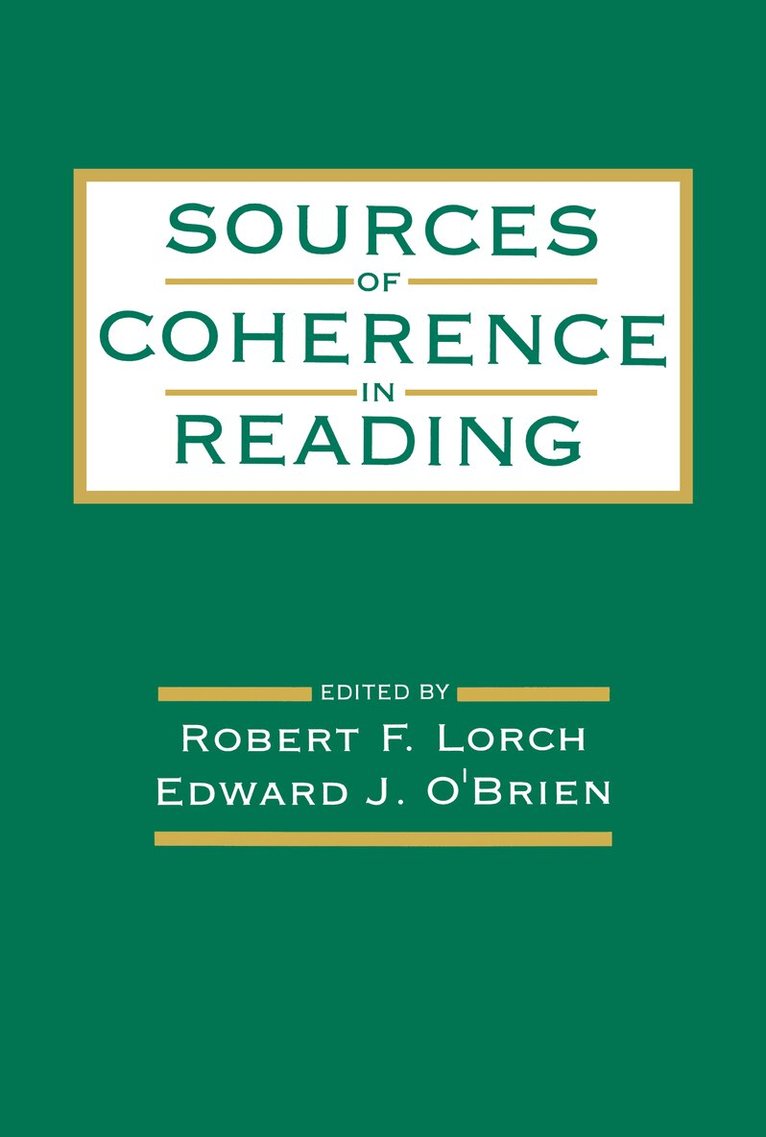
During the last 20 years, there has been an enormous amount of research examining sources of coherence in reading. A major tenet of this work has been the distinction between two major sources of coherence. "Text-based" sources of coherence are contained within the text itself -- use of headings to indicate aspects of a text's macrostructure; "reader-based" sources of coherence encompass the information and strategies that the reader brings to the comprehension process. Many early models of reading comprehension emphasized text-based sources of coherence as a way of understanding how a representation of the text is constructed in memory. However, during the last decade, there has been a clear shift of theoretical perspective away from viewing reading comprehension as a process of representing a text to viewing comprehension as a process of representing what a text is about. This has led to a greater emphasis on reader-based sources of coherence. The purpose of this book is to bring together the large body of evidence addressing the roles of text-based and reader-based sources of coherence in reading comprehension. The contributors present the current state of cognitive theory and research on comprehension of discourse.
1 263 kr
Tillfälligt slut
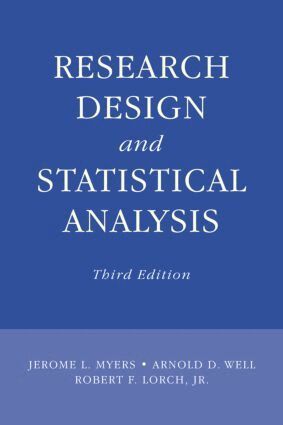
Research Design and Statistical Analysis provides comprehensive coverage of the design principles and statistical concepts necessary to make sense of real data. The book’s goal is to provide a strong conceptual foundation to enable readers to generalize concepts to new research situations. Emphasis is placed on the underlying logic and assumptions of the analysis and what it tells the researcher, the limitations of the analysis, and the consequences of violating assumptions. Sampling, design efficiency, and statistical models are emphasized throughout. As per APA recommendations, emphasis is also placed on data exploration, effect size measures, confidence intervals, and using power analyses to determine sample size. "Real-world" data sets are used to illustrate data exploration, analysis, and interpretation. The book offers a rare blend of the underlying statistical assumptions, the consequences of their violations, and practical advice on dealing with them.Changes in the New Edition:Each section of the book concludes with a chapter that provides an integrated example of how to apply the concepts and procedures covered in the chapters of the section. In addition, the advantages and disadvantages of alternative designs are discussed.A new chapter (1) reviews the major steps in planning and executing a study, and the implications of those decisions for subsequent analyses and interpretations.A new chapter (13) compares experimental designs to reinforce the connection between design and analysis and to help readers achieve the most efficient research study.A new chapter (27) on common errors in data analysis and interpretation.Increased emphasis on power analyses to determine sample size using the G*Power 3 program.Many new data sets and problems.More examples of the use of SPSS (PASW) Version 17, although the analyses exemplified are readily carried out by any of the major statistical software packages.A companion website with the data used in the text and the exercises in SPSS and Excel formats; SPSS syntax files for performing analyses; extra material on logistic and multiple regression; technical notes that develop some of the formulas; and a solutions manual and the text figures and tables for instructors only.Part 1 reviews research planning, data exploration, and basic concepts in statistics including sampling, hypothesis testing, measures of effect size, estimators, and confidence intervals. Part 2 presents between-subject designs. The statistical models underlying the analysis of variance for these designs are emphasized, along with the role of expected mean squares in estimating effects of variables, the interpretation of nteractions, and procedures for testing contrasts and controlling error rates. Part 3 focuses on repeated-measures designs and considers the advantages and disadvantages of different mixed designs. Part 4 presents detailed coverage of correlation and bivariate and multiple regression with emphasis on interpretation and common errors, and discusses the usefulness and limitations of these procedures as tools for prediction and for developing theory.This is one of the few books with coverage sufficient for a 2-semester course sequence in experimental design and statistics as taught in psychology, education, and other behavioral, social, and health sciences. Incorporating the analyses of both experimental and observational data provides continuity of concepts and notation. Prerequisites include courses on basic research methods and statistics. The book is also an excellent resource for practicing researchers.
2 029 kr
Skickas inom 10-15 vardagar
This fully updated fourth edition of Research Design and Statistical Analysis provides comprehensive coverage of the design principles and statistical concepts necessary to make sense of real data. The guiding philosophy is to provide a strong conceptual foundation so that readers can generalize to new situations they encounter in their research, including new developments in data analysis.Key features include:Emphasis on basic concepts such as sampling distributions, design efficiency, and expected mean squares, relating the research designs and data analyses to the statistical models that underlie the analyses.Detailed instructions on performing analysis using both R and SPSS.Pedagogical exercises mapped to key topic areas to support students as they review their understanding and strive to reach their higher learning goals.Incorporating the analyses of both experimental and observational data, and with coverage that is broad and deep enough to serve a two-semester sequence, this textbook is suitable for researchers, graduate students and advanced undergraduates in psychology, education, and other behavioral, social, and health sciences.The book is supported by a robust set of digital resources, including data files and exercises from the book in an Excel format for easy import into R or SPSS; R scripts for running example analysis and generating figures; and a solutions manual.For student resources, view the Support Material tab
1 074 kr
Skickas inom 10-15 vardagar
This fully updated fourth edition of Research Design and Statistical Analysis provides comprehensive coverage of the design principles and statistical concepts necessary to make sense of real data. The guiding philosophy is to provide a strong conceptual foundation so that readers can generalize to new situations they encounter in their research, including new developments in data analysis.Key features include:Emphasis on basic concepts such as sampling distributions, design efficiency, and expected mean squares, relating the research designs and data analyses to the statistical models that underlie the analyses.Detailed instructions on performing analysis using both R and SPSS.Pedagogical exercises mapped to key topic areas to support students as they review their understanding and strive to reach their higher learning goals.Incorporating the analyses of both experimental and observational data, and with coverage that is broad and deep enough to serve a two-semester sequence, this textbook is suitable for researchers, graduate students and advanced undergraduates in psychology, education, and other behavioral, social, and health sciences.The book is supported by a robust set of digital resources, including data files and exercises from the book in an Excel format for easy import into R or SPSS; R scripts for running example analysis and generating figures; and a solutions manual.For student resources, view the Support Material tab
1 466 kr
Skickas inom 7-10 vardagar
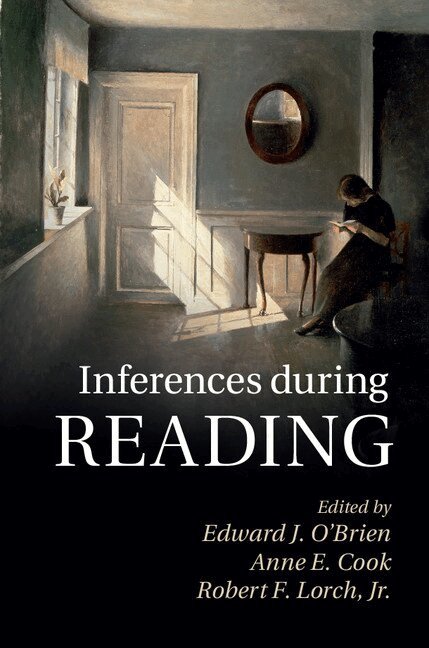
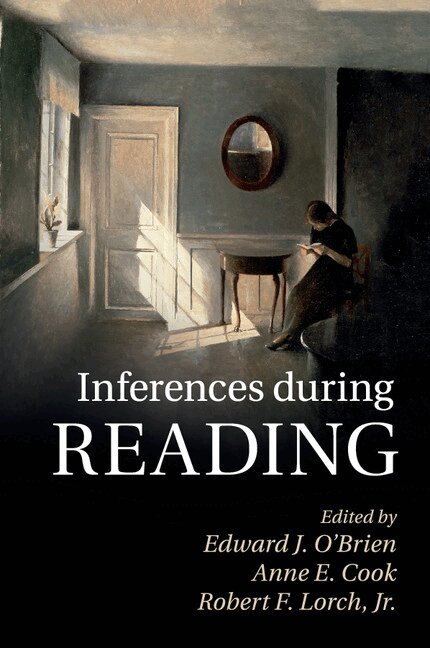
Inferencing is defined as 'the act of deriving logical conclusions from premises known or assumed to be true', and it is one of the most important processes necessary for successful comprehension during reading. This volume features contributions by distinguished researchers in cognitive psychology, educational psychology, and neuroscience on topics central to our understanding of the inferential process during reading. The chapters cover aspects of inferencing that range from the fundamental bottom-up processes that form the basis for an inference to occur, to the more strategic processes that transpire when a reader is engaged in literary understanding of a text. Basic activation mechanisms, word-level inferencing, methodological considerations, inference validation, causal inferencing, emotion, development of inferences processes as a skill, embodiment, contributions from neuroscience, and applications to naturalistic text are all covered as well as expository text, online learning materials, and literary immersion.
493 kr
Skickas inom 7-10 vardagar
Inferencing is defined as 'the act of deriving logical conclusions from premises known or assumed to be true', and it is one of the most important processes necessary for successful comprehension during reading. This volume features contributions by distinguished researchers in cognitive psychology, educational psychology, and neuroscience on topics central to our understanding of the inferential process during reading. The chapters cover aspects of inferencing that range from the fundamental bottom-up processes that form the basis for an inference to occur, to the more strategic processes that transpire when a reader is engaged in literary understanding of a text. Basic activation mechanisms, word-level inferencing, methodological considerations, inference validation, causal inferencing, emotion, development of inferences processes as a skill, embodiment, contributions from neuroscience, and applications to naturalistic text are all covered as well as expository text, online learning materials, and literary immersion.