Robert G. Tardiff – författare
Visar alla böcker från författaren Robert G. Tardiff. Handla med fri frakt och snabb leverans.
4 produkter
4 produkter
E-bok
PDF, Engelska, 20121 367 kr
Läs direkt efter köp
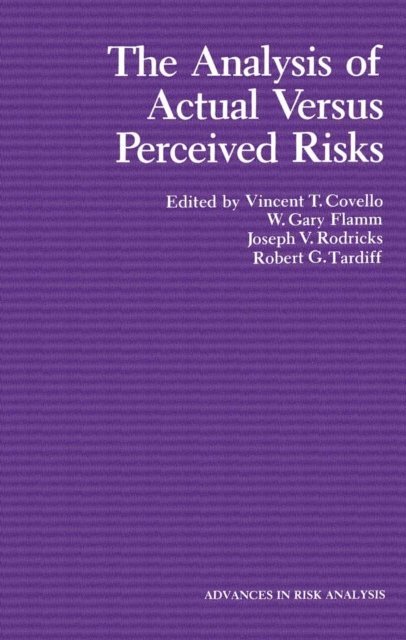
In 1980, a group of scientists from national laboratories, universities, and other research organizations gathered informally in a series of meetings to consider the state of research on risks to health, safety, and the environment. Each scientist had conducted research on the subject. All felt that the traditional disciplines and professional societies to which they belonged were neither ade quate nor appropriate for addressing the extraordinarily complex problems of assessing the risks inherent in modern society. The con sensus of the group was that a new society was needed to address these problems in a scientific and objective way. From these initial meetings, the Society for Risk Analysis was formed The major aims of the Society for Risk Analysis, as stated in its constitution, are • to promote knowledge and understanding of risk analysis techniques and their applications; • to promote communication and interaction among those engaged in risk analysis; and • to disseminate risk analysis information and promote the advancement of all aspects of risk analysis. Members of the Society are drawn from a variety of disciplines, including the health sciences, engineering, the physical sciences, the humanities, and the behavioral and social sciences. An import ant function of the Society is the annual meeting, at which var ious aspects of risk analysis are discussed. The first annual meet ing, represented by this volume, was the International Workshop on the Analysis of Actual vs.
Häftad, Engelska, 2011
1 082 kr
Skickas inom 10-15 vardagar
In 1980, a group of scientists from national laboratories, universities, and other research organizations gathered informally in a series of meetings to consider the state of research on risks to health, safety, and the environment. Each scientist had conducted research on the subject. All felt that the traditional disciplines and professional societies to which they belonged were neither ade quate nor appropriate for addressing the extraordinarily complex problems of assessing the risks inherent in modern society. The con sensus of the group was that a new society was needed to address these problems in a scientific and objective way. From these initial meetings, the Society for Risk Analysis was formed The major aims of the Society for Risk Analysis, as stated in its constitution, are • to promote knowledge and understanding of risk analysis techniques and their applications; • to promote communication and interaction among those engaged in risk analysis; and • to disseminate risk analysis information and promote the advancement of all aspects of risk analysis. Members of the Society are drawn from a variety of disciplines, including the health sciences, engineering, the physical sciences, the humanities, and the behavioral and social sciences. An import ant function of the Society is the annual meeting, at which var ious aspects of risk analysis are discussed. The first annual meet ing, represented by this volume, was the International Workshop on the Analysis of Actual vs.
E-bok
PDF, Engelska, 2013687 kr
Läs direkt efter köp
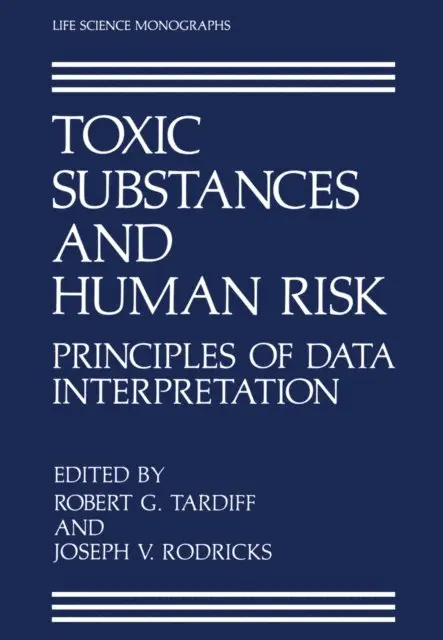
As society has become increasingly aware of the potential threats to human health due to exposures to toxic chemicals in the environment and the workplace and in consumer products, it has placed increased demands upon the still-fledgling science of toxicology. As is often the case when science is called upon to supply firm answers when pertinent information and fundamental knowledge are lack ing, both the scientific and the social issues become confused and new tensions develop. One of the major purposes of this book is to focus on those aspects of the science of toxicology that pertain most to social issues-namely, analysis of risk for purposes of human health protection. Although it is apparent that the discipline of toxicology is not yet prepared to provide firm answers to many questions concerning human risk, it is important that the rigorously derived information be used in the most objective and logical way to yield the closest approximation to the truth. This book is designed to sup ply as much guidance for such tasks as is permitted by the current state of our knowledge. Its emphasis is thus placed on interpretation of toxicity data (broadly defined) for assessing risks to human health. In this way, it differs from other basic toxicology texts, most of which emphasize methods for performing studies or describe various toxicological endpoints and classes of toxic agents.
Häftad, Engelska, 2012
544 kr
Skickas inom 10-15 vardagar
As society has become increasingly aware of the potential threats to human health due to exposures to toxic chemicals in the environment and the workplace and in consumer products, it has placed increased demands upon the still-fledgling science of toxicology. As is often the case when science is called upon to supply firm answers when pertinent information and fundamental knowledge are lack ing, both the scientific and the social issues become confused and new tensions develop. One of the major purposes of this book is to focus on those aspects of the science of toxicology that pertain most to social issues-namely, analysis of risk for purposes of human health protection. Although it is apparent that the discipline of toxicology is not yet prepared to provide firm answers to many questions concerning human risk, it is important that the rigorously derived information be used in the most objective and logical way to yield the closest approximation to the truth. This book is designed to sup ply as much guidance for such tasks as is permitted by the current state of our knowledge. Its emphasis is thus placed on interpretation of toxicity data (broadly defined) for assessing risks to human health. In this way, it differs from other basic toxicology texts, most of which emphasize methods for performing studies or describe various toxicological endpoints and classes of toxic agents.