Robert Henning – författare
Visar alla böcker från författaren Robert Henning. Handla med fri frakt och snabb leverans.
6 produkter
6 produkter
E-bok
Engelska10 kr
Läs direkt efter köp
E-bok
Engelska10 kr
Läs direkt efter köp
E-bok
Engelska10 kr
Läs direkt efter köp
Häftad, Engelska, 2026
495 kr
Skickas inom 5-8 vardagar
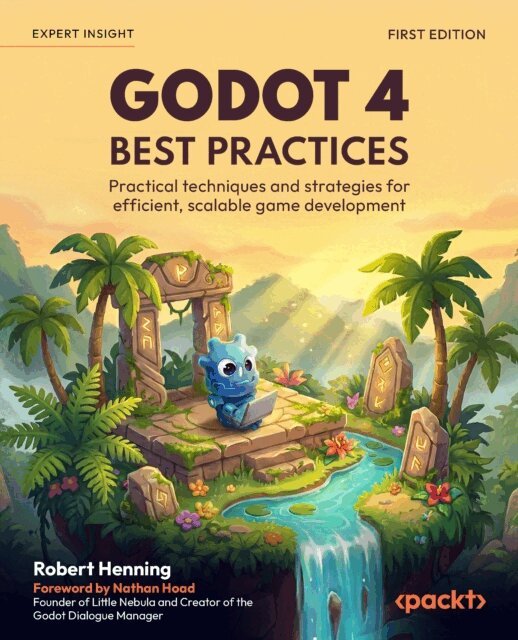
Elevate your Godot 4 development skills with SOLID principles, game architecture patterns, and scalable workflows. Learn to create maintainable systems, organize projects, and build release-ready games that grow beyond prototypesFree with your book: DRM-free PDF version + access to Packt's next-gen Reader*Key FeaturesApply SOLID principles and proven design patterns in Godot 4Build scalable game architecture using components, events, and servicesRefactor prototypes into maintainable, production-ready projectsBook DescriptionMany Godot projects start as quick prototypes but become difficult to maintain as they grow. Deep node hierarchies, tightly coupled scripts, and expanding gameplay systems can slow development and make it harder to add features, fix bugs, and ship with confidence. Godot 4 Best Practices addresses those challenges by focusing on architectural practices that help projects stay scalable and maintainable.You’ll start by applying the SOLID principles to Godot’s node and script model, learning when to choose scenes or scripts, how to keep hierarchies shallow, and when data-driven Resources are a better fit than extra nodes. Next, you’ll implement core design patterns, including signals and notifications for decoupling, state machines, strategy-based AI, and swapping deep inheritance for modular components. You’ll also apply Factories, Builders, Commands, and Services with clear Godot examples, so systems stay flexible and testable. Finally, you’ll structure larger projects with data-driven saves and preferences, as well as layered gameplay architecture to avoid God classes.By the end, you’ll write cleaner GDScript, organize large scenes with confidence, and build systems that are easier to test, maintain, and extend. No hype—just proven practices for building Godot projects that scale.*Email sign-up and proof of purchase requiredWhat you will learnApply SOLID principles in Godot's node and script systemDecide when to use scenes, scripts, or Resources for logicUse signals, State, and Strategy patterns for gameplay logicBuild modular, component-based systems over inheritanceAutomate instancing with Factory and Builder patternsDecouple input, audio, and saves with Command and Service patternsSeparate logic from data with Resources and data-driven designStructure gameplay systems using scalable architectural patternsWho this book is forThis book is ideal for intermediate and advanced Godot developers who already know how to make simple games but want to adopt professional practices for larger, more complex projects. It is especially useful for indie developers, technical leads, and small teams who need scalable workflows, as well as educators and advanced students who want to learn how to apply SOLID principles and design patterns in Godot. If you’ve ever struggled with messy prototypes, monolithic scripts, or unscalable Scene Trees, this book will show you how to organize, refactor, and future-proof your projects.
E-bok
Engelska, 2026413 kr
Läs direkt efter köp
Elevate your Godot 4 development skills with SOLID principles, game architecture patterns, and scalable workflows. Learn to create maintainable systems, organize projects, and build release-ready games that grow beyond prototypesFree with your book: DRM-free PDF version + access to Packt's next-gen Reader*Key FeaturesApply SOLID principles and proven design patterns in Godot 4Build scalable game architecture using components, events, and servicesRefactor prototypes into maintainable, production-ready projectsBook DescriptionMany Godot projects start as quick prototypes but become difficult to maintain as they grow. Deep node hierarchies, tightly coupled scripts, and expanding gameplay systems can slow development and make it harder to add features, fix bugs, and ship with confidence. Godot 4 Best Practices addresses those challenges by focusing on architectural practices that help projects stay scalable and maintainable. You ll start by applying the SOLID principles to Godot s node and script model, learning when to choose scenes or scripts, how to keep hierarchies shallow, and when data-driven Resources are a better fit than extra nodes. Next, you ll implement core design patterns, including signals and notifications for decoupling, state machines, strategy-based AI, and swapping deep inheritance for modular components. You ll also apply Factories, Builders, Commands, and Services with clear Godot examples, so systems stay flexible and testable. Finally, you ll structure larger projects with data-driven saves and preferences, as well as layered gameplay architecture to avoid God classes. By the end, you ll write cleaner GDScript, organize large scenes with confidence, and build systems that are easier to test, maintain, and extend. No hype just proven practices for building Godot projects that scale. *Email sign-up and proof of purchase requiredWhat you will learnApply SOLID principles in Godot's node and script systemDecide when to use scenes, scripts, or Resources for logicUse signals, State, and Strategy patterns for gameplay logicBuild modular, component-based systems over inheritanceAutomate instancing with Factory and Builder patternsDecouple input, audio, and saves with Command and Service patternsSeparate logic from data with Resources and data-driven designStructure gameplay systems using scalable architectural patternsWho this book is forThis book is ideal for intermediate and advanced Godot developers who already know how to make simple games but want to adopt professional practices for larger, more complex projects. It is especially useful for indie developers, technical leads, and small teams who need scalable workflows, as well as educators and advanced students who want to learn how to apply SOLID principles and design patterns in Godot. If you ve ever struggled with messy prototypes, monolithic scripts, or unscalable Scene Trees, this book will show you how to organize, refactor, and future-proof your projects.
Häftad, Engelska, 2025
634 kr
Skickas inom 5-8 vardagar
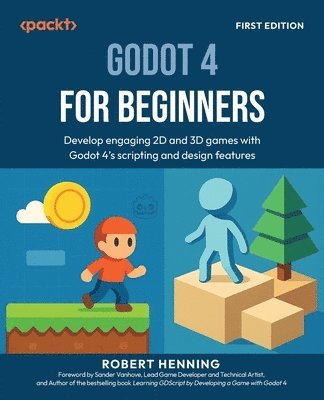
Kickstart your game development journey with Godot 4 and create your own indie games from scratch in this part-color guideFree with your book: DRM-free PDF version + access to Packt's next-gen Reader*Key FeaturesImplement custom scripts to control game logic and interactionsLearn coding, design, and game mechanics tailored for beginners in 2D and 3DBuild and release your own indie games, from concept to publicationBook DescriptionJumping into Godot 4 as a beginner can be overwhelming. You’re wrestling with a new interface, trying to wrap your head around how nodes and scenes work, and learning GDScript all at once. After years of teaching game development and creating YouTube tutorials, Robert Henning knows exactly where you’re likely to have those “wait, what?” moments. He’s built this guide to systematically address those challenges head-on, breaking down complex concepts into digestible steps.You’ll start by setting up Godot 4 and understanding its interface and tools. Then, you’ll dive into nodes and scenes, Godot’s way of organizing everything, which sounds intimidating but is actually quite intuitive. From there, you’ll explore both 2D and 3D game creation, adding key elements such as players, enemies, collectibles, and lighting effects that make your game pop visually. You’ll also get hands-on with Godot’s scripting language, GDScript, to bring your game ideas to life.By the end of this Godot 4 book, you’ll have the skills to build complete 2D and 3D games from scratch, covering everything from level design and game state management to score tracking and more. Whether you’re just getting started or are ready to level up, this book will help you turn your ideas into fully playable games.*Email sign-up and proof of purchase requiredWhat you will learnNavigate and master the Godot 4 interface effectivelyUtilize nodes and scenes for structured game developmentCreate dynamic 2D and immersive 3D game environmentsManipulate lighting to enhance game visualsScript game mechanics using GDScriptImplement key elements such as players, enemies, and collectiblesDesign engaging levels and manage game statesWho this book is forThis book is for anyone who is new to game development or wants to explore the powerful Godot engine. Whether you're an aspiring game developer, an indie creator, a student, or an artist, this book will provide you with a solid foundation.Basic computer skills, including installing and running software and navigating the operating system, are required. While a rudimentary understanding of programming concepts such as variables, loops, and conditional statements can be helpful, it is not essential, as all necessary programming basics are thoroughly explained in the book.