Robert Kramer – författare
Visar alla böcker från författaren Robert Kramer. Handla med fri frakt och snabb leverans.
21 produkter
Letters of Sigmund Freud and Otto Rank
Inside Psychoanalysis
Av E. James Lieberman, E. James Lieberman m. fl.
Inbunden, 2012
664 kr
Lägg i varukorg
Sigmund Freud's relationship with Otto Rank was the most constant, close, and significant of his professional life. Freud considered Rank to be the most brilliant of his disciples. The two collaborated on psychoanalytic writing, practice, and politics; Rank was the managing director of Freud's …
Otto Rank and the Creation of Modern Psychotherapy
Inbunden, 2025
375 kr
Lägg i varukorg
Once considered Sigmund Freud's designated heir, Otto Rank was an interdisciplinary thinker and prodigious author of twenty-two books. After being expelled from Freud's inner circle in 1926--due to Freud's opposition to the pre-Oedipal thesis of The Trauma of Birth (1924)--Rank had a highly …
Otto Rank and the Creation of Modern Psychotherapy
E-bok, 2025
364 kr
Lägg i varukorg
Once considered Sigmund Freud's designated heir, Otto Rank was an interdisciplinary thinker and prodigious author of twenty-two books. After being expelled from Freud's inner circle in 1926--due to Freud's opposition to the pre-Oedipal thesis of The Trauma of Birth (1924)--Rank had a highly …
Otto Rank and the Creation of Modern Psychotherapy
E-bok, 2025
356 kr
Lägg i varukorg
Once considered Sigmund Freud's designated heir, Otto Rank was an interdisciplinary thinker and prodigious author of twenty-two books. After being expelled from Freud's inner circle in 1926--due to Freud's opposition to the pre-Oedipal thesis of The Trauma of Birth (1924)--Rank had a highly …
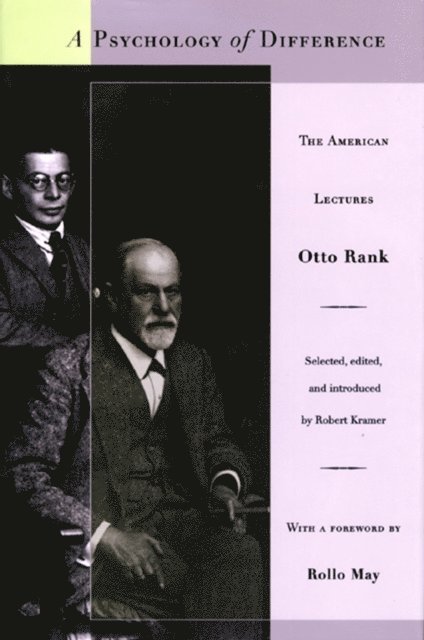
Psychology of Difference
The American Lectures
Inbunden, 1996
1409 kr
Lägg i varukorg
A leading disciple and confidant of Freud, Otto Rank revolutionized the field of psychoanalytic theory in The Trauma of Birth (1924). In this book, Rank proposed that the child's pre-Oedipal relationship to the mother was the prototype of the therapeutic relationship between analyst and patient. …
Psychology of Difference
The American Lectures
E-bok, 2020
1857 kr
Lägg i varukorg
A leading disciple and confidant of Freud, Otto Rank revolutionized the field of psychoanalytic theory in The Trauma of Birth (1924). In this book, Rank proposed that the child''s pre-Oedipal relationship to the mother was the prototype of the therapeutic relationship between analyst and patient. …
Send Me A Copy: A Compilation of Some of the Best Messages Ever Sent Through the Workplace (2009-2012)
Häftad
232 kr
Lägg i varukorg
Revolutionary Retailing
The Complete "Wise Guys" Guide to Small Business Management and Marketing
Häftad, 2004
166 kr
Lägg i varukorg
Management and Leadership Skills for Medical Faculty
A Practical Handbook
Av Anthony J. Viera, Robert Kramer
Häftad, 2016
1240 kr
Lägg i varukorg
Recognizing that medical faculty face different questions or issues in different stages of their careers, this handy, practical title offers a comprehensive roadmap and range of solutions to common challenges in the complex and changing Academic Medical Center (AMC). With critical insights and …
Management and Leadership Skills for Medical Faculty
A Practical Handbook
Av Robert Kramer, Anthony J. Viera
E-bok, 2016
1670 kr
Lägg i varukorg
Recognizing that medical faculty face different questions or issues in different stages of their careers, this handy, practical title offers a comprehensive roadmap and range of solutions to common challenges in the complex and changing Academic Medical Center (AMC). With critical insights and …
Die lumbale Spinalkanalstenose
Av Jurgen Kramer, Theodoros Theodoridis m. fl.
E-bok, 2011
920 kr
Lägg i varukorg
Was versteht man unter einer dekompensierten LSS ? Wann ist eine minimalinvasive Therapie indiziert und wann wird operiert? Welche konservativen und operativen Therapien gibt es? Antworten auf alle Fragen zur degenerativen lumbalen Spinalkanalstenose finden Sie hier – umfassend und …
Vergleichende Werbung für die Positionierung neuer Marken
Untersuchung der Werbewirkung mittels Strukturgleichungsanalyse
Häftad, 2016
636 kr
Lägg i varukorg
Anhand einer Strukturgleichungsanalyse zeigt der Autor auf, wie vergleichende Werbung durch die Rezipienten verarbeitet wird und in welchen Fällen Vorteile durch den Einsatz zu erwarten sind. Dabei untersucht er die Wirkung auf die Konsumenten in drei verschiedenen Produktkategorien und für …
Vergleichende Werbung für die Positionierung neuer Marken
Untersuchung der Werbewirkung mittels Strukturgleichungsanalyse
E-bok, 2016
657 kr
Lägg i varukorg
Anhand einer Strukturgleichungsanalyse zeigt der Autor auf, wie vergleichende Werbung durch die Rezipienten verarbeitet wird und in welchen Fällen Vorteile durch den Einsatz zu erwarten sind. Dabei untersucht er die Wirkung auf die Konsumenten in drei verschiedenen Produktkategorien und für …
Starting Places
A Conversation with Robert Kramer
Av Bernard Eisenschitz, Robert Kramer m. fl.
Häftad, 2025
270 kr
Lägg i varukorg
In summer 1997, French film critic and historian Bernard Eisenschitz met with Robert Kramer three times to speak in detail about Kramer's life and work, covering thirty years of filmmaking. The exchange between friends starts with his early, activist years and his involvement with the Newsreel …
Innere Führung in Zahlen
Streitkräftebefragung 2013
Av Angelika Dörfler-Dierken, Robert Kramer
Häftad, 2014
299 kr
Lägg i varukorg
Dream That Interprets Itself
Häftad, 2023
256 kr
Tillfälligt slut
Sigmund Freud hired Otto Rank as his secretary and funded Rank’s PhD in literature at the University of Vienna. In 1910, at age 26, Rank published ‘A Dream That Interprets Itself’. Freud could not praise the essay highly enough; impressed by Rank’s erudition, Freud invited his protégé to contribute …