Robert Sottilare - Böcker
Visar alla böcker från författaren Robert Sottilare. Handla med fri frakt och snabb leverans.
3 produkter
3 produkter
835 kr
Skickas inom 10-15 vardagar
Defense forces have always invested a great deal of their resources in training. In recent times, changes in the complexity and intensity of operations have reaffirmed the importance of ensuring that warfighters are adequately prepared for the environments in which they are required to work. The emergence of new operational drivers such as asymmetric threats, urban operations, joint and coalition operations and the widespread use of military communications and information technology networks has highlighted the importance of providing warfighters with the competencies required to act in a coordinated, adaptable fashion, and to make effective decisions in environments characterized by large amounts of sometimes ambiguous information. While investment in new technologies can make available new opportunities for action, it is only through effective training that personnel can be made ready to apply their tools in the most decisive and discriminating fashion. There are many factors which can have an impact on the efficacy of training and many issues to consider when designing and implementing training strategies. These issues are often complex and nuanced, and in order to grasp them fully a significant investment of time and energy is required. However, the requirement to respond quickly to ever-changing technology, a high operational tempo and minimal staffing may preclude many in today's defense forces from seeking out all such resources on their own. This edited collection provides brief, easy-to-understand summaries of the key issues in defense training and simulation, as well as guidance for further reading. It consists of a collection of short essays, each of which addresses a fundamental issue in defense training and simulation, and features an up-to-date reference list to enable the reader to undertake further investigation of the issues addressed. In essence, this book provides the optimum starting point, or first resource, for readers to come to terms with the important issues associated with defense training and simulation. The contributions are written by leading scholars from military research institutions in the US, UK, Canada, Australia and New Zealand, as well as selected researchers from academic and private sector research institutions.
2 306 kr
Skickas inom 10-15 vardagar
Defense forces have always invested a great deal of their resources in training. In recent times, changes in the complexity and intensity of operations have reaffirmed the importance of ensuring that warfighters are adequately prepared for the environments in which they are required to work. The emergence of new operational drivers such as asymmetric threats, urban operations, joint and coalition operations and the widespread use of military communications and information technology networks has highlighted the importance of providing warfighters with the competencies required to act in a coordinated, adaptable fashion, and to make effective decisions in environments characterized by large amounts of sometimes ambiguous information. While investment in new technologies can make available new opportunities for action, it is only through effective training that personnel can be made ready to apply their tools in the most decisive and discriminating fashion. There are many factors which can have an impact on the efficacy of training and many issues to consider when designing and implementing training strategies. These issues are often complex and nuanced, and in order to grasp them fully a significant investment of time and energy is required. However, the requirement to respond quickly to ever-changing technology, a high operational tempo and minimal staffing may preclude many in today's defense forces from seeking out all such resources on their own. This edited collection provides brief, easy-to-understand summaries of the key issues in defense training and simulation, as well as guidance for further reading. It consists of a collection of short essays, each of which addresses a fundamental issue in defense training and simulation, and features an up-to-date reference list to enable the reader to undertake further investigation of the issues addressed. In essence, this book provides the optimum starting point, or first resource, for readers to come to terms with the important issues associated with defense training and simulation. The contributions are written by leading scholars from military research institutions in the US, UK, Canada, Australia and New Zealand, as well as selected researchers from academic and private sector research institutions.
Del 19 - Research on Managing Groups and Teams
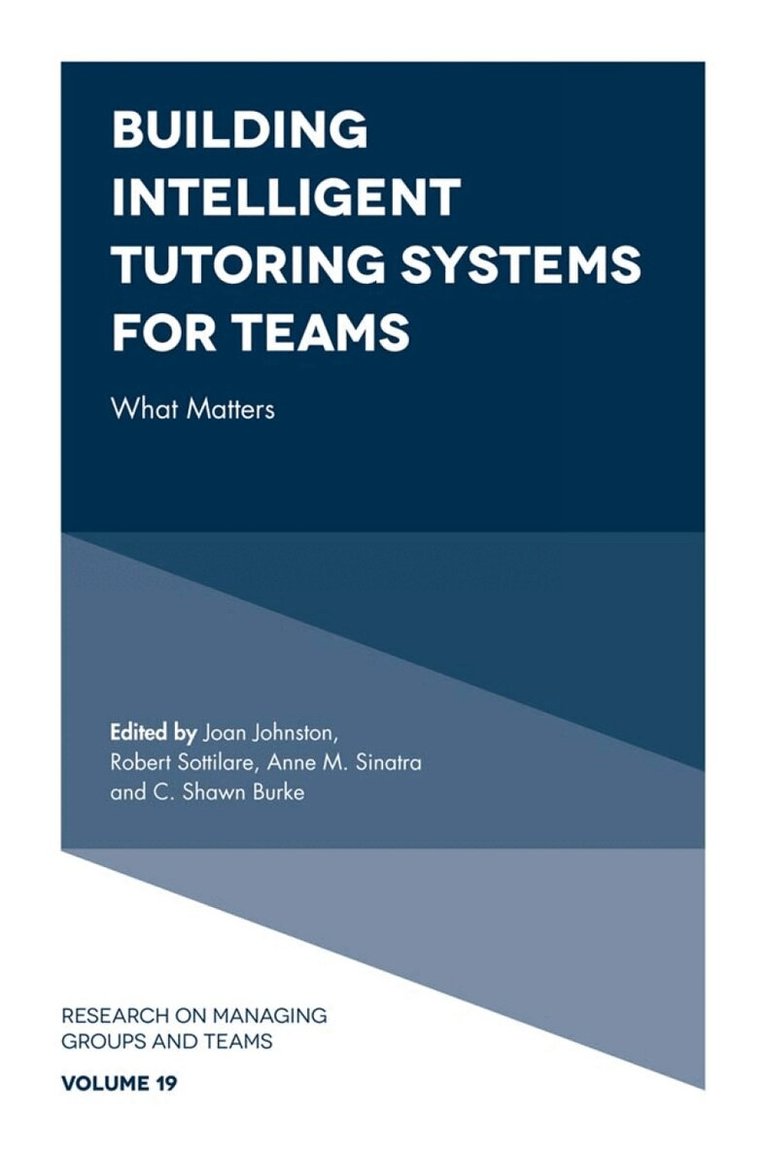
Building Intelligent Tutoring Systems for Teams
What Matters
Inbunden, Engelska, 2018
1 255 kr
Skickas inom 7-10 vardagar
This volume presents multidisciplinary perspectives from leading scholars in the science of teams and intelligent tutoring systems (ITSs) on research needed to advance the state of the art of team ITSs. Our esteemed authors provide lessons learned to guide future research that will produce the technical capabilities needed to support team skills development. The introduction by Drs. Robert Sottilare and Eduardo Salas, who are leaders in the field of ITSs and team science, discusses the challenges and approaches to building ITSs for teams. The volume’s first section introduces concepts for understanding team training such as team task analysis, team macrocognition, measurement strategies for dynamic processes, and effective team training methods to provide insights into ITS design. Section two presents recent advances in team assessment and feedback through unobtrusive assessments, modeling dynamic team interactions, neurodynamic scaffolding, and collaborative tutoring strategies. In the Volume’s third section authors discuss lessons learned from past research, provide a discourse on the five disciplinary perspectives of engineering, learning sciences, team research, data analysis, and human computer interaction to create a framework for guiding team ITS developers, and examine the team ITS requirements for long term space travel. The final chapter summarizes and integrates lessons learned and provides recommendations for future research and development.