Roberta Greene - Böcker
Visar alla böcker från författaren Roberta Greene. Handla med fri frakt och snabb leverans.
8 produkter
8 produkter
1 069 kr
Tillfälligt slut
In recent years, advocates for civil rights for minorities, women, and gays and lesbians have become more informed consumers of mental health services. As a result, social work practitioners need to prepare themselves to serve diverse constituencies for who previously held behavioral and cultural assumptions have proven not to be universally applicable. The purpose of Greene's book is to help students and practitioners better understand how social workers have used human behavior theories to more competently address variations in group and community membership within the social worker-client encounter.The book's approach is largely thematic. Most of the chapters explore how particular assumptions of a human behavior theory--psychoanalytic theory, psychodynamic/ego psychology theory, systems theory, behavioral theory, symbolic interaction theory, feminist theory, constructionist theory, small group theory, and an ecological perspective --have been used to answer issues related to cultural diversity. The challenges and limitations of each theory's applications across varying client constituencies are discussed throughout. What sorts of new conceptual issues for the practitioner of family services are raised in work with minority families, for example, or with lesbian families? How does a specific theory help, or not help, in group-specific interventions and evaluations?Intended as a companion volume to the widely adopted human behavior text by Greene and Ephross, Greene's new book fills the need for a wide, synthetic reading of the recent literature.
652 kr
Skickas inom 10-15 vardagar
In recent years, advocates for civil rights for minorities, women, and gays and lesbians have become more informed consumers of mental health services. As a result, social work practitioners need to prepare themselves to serve diverse constituencies for who previously held behavioral and cultural assumptions have proven not to be universally applicable. The purpose of Greene's book is to help students and practitioners better understand how social workers have used human behavior theories to more competently address variations in group and community membership within the social worker-client encounter.The book's approach is largely thematic. Most of the chapters explore how particular assumptions of a human behavior theory--psychoanalytic theory, psychodynamic/ego psychology theory, systems theory, behavioral theory, symbolic interaction theory, feminist theory, constructionist theory, small group theory, and an ecological perspective --have been used to answer issues related to cultural diversity. The challenges and limitations of each theory's applications across varying client constituencies are discussed throughout. What sorts of new conceptual issues for the practitioner of family services are raised in work with minority families, for example, or with lesbian families? How does a specific theory help, or not help, in group-specific interventions and evaluations?Intended as a companion volume to the widely adopted human behavior text by Greene and Ephross, Greene's new book fills the need for a wide, synthetic reading of the recent literature.
652 kr
Skickas inom 10-15 vardagar
As American society becomes increasingly diverse, social workers must use a variety of human behavior frameworks to understand their clients' culturally complex concerns. This text applies specific human behavior theories to diversity practice. They show how human behavior theory can be employed in interventions in the life problems of diverse client populations at the individual, group, social network, and societal levels.Several groups are examined. They include: minority groups; ethnic groups; women; older adults; members of certain social classes affected by economic and educational (dis)advantage, especially those living in poverty; people with developmental disabilities, people of varying sexual and gender orientations, and religious groups.Case studies that illustrate social work practice in the area are highlighted. The case studies include Social Work Practice within a Diversity Framework; The Social Work Interview; Symbolic Interactionism: Social Work Assessment, Meaning, and Language; Erikson's Eight Stages of Development; Role Theory and Social Work Practice; A Constructionist Approach; Risk, Resilience and Resettlement; Addressing Diverse Family Forms; Small Group Theory; Natural Social Networks; Power Factors in Social Work Practice. This volume will be a fundament resource for practitioners and an essential tool for training.
Resilience-Enhancing Stress Model
A Social Work Multisystemic Practice Approach
Inbunden, Engelska, 2022
1 205 kr
Skickas inom 10-15 vardagar
Social work practice has evolved to meet the needs of the time, the problems that are present, and the knowledge and skills available. Given the more recent rapidly changing stressful environments, political, economic, demographic, sociocultural, and ideological change has affected how practice is defined. Now it is even more essential for there to be innovative theoretical concepts and intervention strategies to support current practice. This textbook addresses today’s context of social work practice that needs to deal with the complexity of personal and social relationships, the continuing historical flux of the times, and the constant anxiety or "threats and pulls" of daily life. The text is based on the idea that social work practice requires a research and theoretical base that allows practitioners to build on a client's ability to persist in the face of life's challenges and to proceed positively with life events. The Resilience-Enhancing Stress Model (RESM) is an outgrowth of the profession’s interest in strength-based person-environment approaches — grounded in generalist social work practice that offers a range of intervention practice methods with diverse individuals, families, groups, organizations, and communities. RESM was developed to provide the skill set for working with clients and constituencies across the individual-family-community configuration during times of distress. It also can be a welcomed addition to social work practice with people undertaking life transitions and overcoming disruption to individual, family, and community function. Topics explored include:An Evolving Resilience-Enhancing Stress ModelInterviewing to Promote Resilience Among Marginalized PopulationsCo-creating a Grand Narrative: The Intersection of Individual, Family, and Community PracticeConnecting Communal Living, Ecology, and ResilienceA Resilience-Enhancing Stress Model: A Social Work Multisystemic Practice Approach is a timely text for human behavior and practice methods at the generalist or advanced generalist levels in social work. It can also be used at the doctoral level of social work education depending on the professor’s attention to the depth of theoretical concepts. Practitioners in the field may find the contents useful to their professional enrichment.
Resilience-Enhancing Stress Model
A Social Work Multisystemic Practice Approach
Häftad, Engelska, 2023
878 kr
Skickas inom 10-15 vardagar
Social work practice has evolved to meet the needs of the time, the problems that are present, and the knowledge and skills available. Given the more recent rapidly changing stressful environments, political, economic, demographic, sociocultural, and ideological change has affected how practice is defined. Now it is even more essential for there to be innovative theoretical concepts and intervention strategies to support current practice. This textbook addresses today’s context of social work practice that needs to deal with the complexity of personal and social relationships, the continuing historical flux of the times, and the constant anxiety or "threats and pulls" of daily life. The text is based on the idea that social work practice requires a research and theoretical base that allows practitioners to build on a client's ability to persist in the face of life's challenges and to proceed positively with life events. The Resilience-Enhancing Stress Model (RESM) is an outgrowth of the profession’s interest in strength-based person-environment approaches — grounded in generalist social work practice that offers a range of intervention practice methods with diverse individuals, families, groups, organizations, and communities. RESM was developed to provide the skill set for working with clients and constituencies across the individual-family-community configuration during times of distress. It also can be a welcomed addition to social work practice with people undertaking life transitions and overcoming disruption to individual, family, and community function. Topics explored include:An Evolving Resilience-Enhancing Stress ModelInterviewing to Promote Resilience Among Marginalized PopulationsCo-creating a Grand Narrative: The Intersection of Individual, Family, and Community PracticeConnecting Communal Living, Ecology, and ResilienceA Resilience-Enhancing Stress Model: A Social Work Multisystemic Practice Approach is a timely text for human behavior and practice methods at the generalist or advanced generalist levels in social work. It can also be used at the doctoral level of social work education depending on the professor’s attention to the depth of theoretical concepts. Practitioners in the field may find the contents useful to their professional enrichment.
Resilience Enhancement in Social Work Practice
Anti-Oppressive Social Work Skills and Techniques
Inbunden, Engelska, 2023
1 205 kr
Skickas inom 10-15 vardagar
As people around the globe experience more civil unrest and environmental disruption, the difficulties social workers face in their practice are becoming increasingly complex. This textbook deepens and expands the resilience-enhancing stress model (RESM) skill set and techniques so that social workers can more effectively serve clients and constituencies who are trying to overcome the stress of difficult life transitions and challenging environmental demands. It is designed as a companion piece to A Resilience-Enhancing Stress Model: A Social Work Multisystemic Practice Approach (Springer, 2022). The intent of the RESM is to further expand social workers' practice skill sets with additional concepts from the anti-oppressive practice (AOP) and coaching literature that aligns with the Educational Policy and Accreditation Standards from the Council on Social Work Education (CSWE). The book's 12 chapters are organized around life transitions and illustrate skills, techniques, and interviews important to the enhancement of resilience. Among the topics covered:The Resilience-Enhancing Stress Model: Articulating Anti-Oppressive PracticeExploring the Role of Cultural Diversity in Resilient Social Functioning: Theory and SkillsCountering Human Rights Violations During Life TransitionsFacilitating Community Development Following DisruptionResilience Enhancement in Social Work Practice: Anti-Oppressive Social Work Skills and Techniques uniquely offers practitioners a knowledge base to exponentiate their efficacy in identifying and fortifying resilience in a time in history when it appears to be imperative. It is written for a student social work audience at the generalist or advanced generalist level for practice across a range of populations and settings. It contains traditional and contemporary human behavior content that supports a social work narrative methodology and a life course perspective. It could be taught with its predecessor across one or two semesters. Practitioners in the field who are new to this content could also find the text a valuable resource.
Resilience Enhancement in Social Work Practice
Anti-Oppressive Social Work Skills and Techniques
Häftad, Engelska, 2024
878 kr
Skickas inom 10-15 vardagar
As people around the globe experience more civil unrest and environmental disruption, the difficulties social workers face in their practice are becoming increasingly complex. This textbook deepens and expands the resilience-enhancing stress model (RESM) skill set and techniques so that social workers can more effectively serve clients and constituencies who are trying to overcome the stress of difficult life transitions and challenging environmental demands. It is designed as a companion piece to A Resilience-Enhancing Stress Model: A Social Work Multisystemic Practice Approach (Springer, 2022). The intent of the RESM is to further expand social workers' practice skill sets with additional concepts from the anti-oppressive practice (AOP) and coaching literature that aligns with the Educational Policy and Accreditation Standards from the Council on Social Work Education (CSWE). The book's 12 chapters are organized around life transitions and illustrate skills, techniques, and interviews important to the enhancement of resilience. Among the topics covered:The Resilience-Enhancing Stress Model: Articulating Anti-Oppressive PracticeExploring the Role of Cultural Diversity in Resilient Social Functioning: Theory and SkillsCountering Human Rights Violations During Life TransitionsFacilitating Community Development Following DisruptionResilience Enhancement in Social Work Practice: Anti-Oppressive Social Work Skills and Techniques uniquely offers practitioners a knowledge base to exponentiate their efficacy in identifying and fortifying resilience in a time in history when it appears to be imperative. It is written for a student social work audience at the generalist or advanced generalist level for practice across a range of populations and settings. It contains traditional and contemporary human behavior content that supports a social work narrative methodology and a life course perspective. It could be taught with its predecessor across one or two semesters. Practitioners in the field who are new to this content could also find the text a valuable resource.
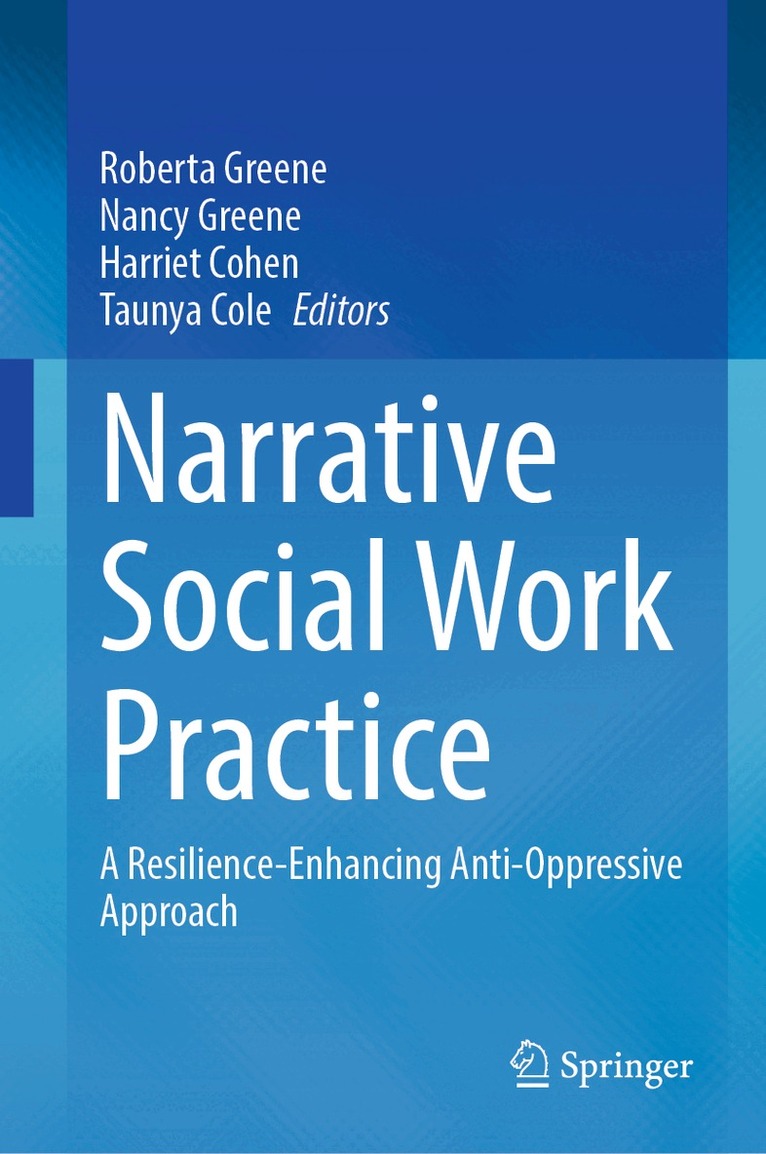
Narrative Social Work Practice
A Resilience-Enhancing Anti-Oppressive Approach
Inbunden, Engelska, 2025
1 096 kr
Skickas inom 10-15 vardagar
This book highlights the co-creation of the narrative interview and explains how the narrative method can be used to promote competence and wellness, resist oppression, and ultimately liberate clients from their problems. The person-in-environment concept brings together a wide range of personal and societal micro to macro influences that allow practitioners to engage in an effective helping process with diverse individuals, families, groups, organizations, and communities.The textbook has been written at a time of pronounced sociocultural and historical flux, uncertainty, and civil strife that threaten to disrupt the social fabric of the United States. Consequently, the book augments the resilience-enhancing stress model (RESM) approach to the narrative methodology. Each chapter of the text describes a client or constituency undergoing a life transition and the associated risks (stressors) and protective factors surrounding them. Among the topics covered are:Adopting RESM Anti-Oppressive Social Work Strategies: A Micro to Macro ApproachCo-creating a Narrative: Forming Personal IdentityMacrolevel Narrative Skills and TechniquesProactive Resilience Social Work PracticeTime, Place, and ResilienceThe ultimate purpose of the book is for social workers to develop the ability to enhance clients' and constituencies' optimal resilient social functioning in a just and equitable world that embraces diversity, equity, and inclusion. Although narrative social work practice is not yet widely applied, the text elucidates how storytelling can break new ground in achieving asset-based, resilience-enhancing social work practice as well as redress social, economic, and political injustice.Narrative Social Work Practice: A Resilience-Enhancing Anti-Oppressive Approach is the third in a series of texts that defines risk and resilience theory and its offshoot—the RESM. The book is intended primarily for generalists and advanced students as well as practitioners in the social work field.