Roelof A.A. Oldeman – författare
Visar alla böcker från författaren . Handla med fri frakt och snabb leverans.
5 produkter
5 produkter
E-bok
PDF, Engelska, 20121 416 kr
Läs direkt efter köp
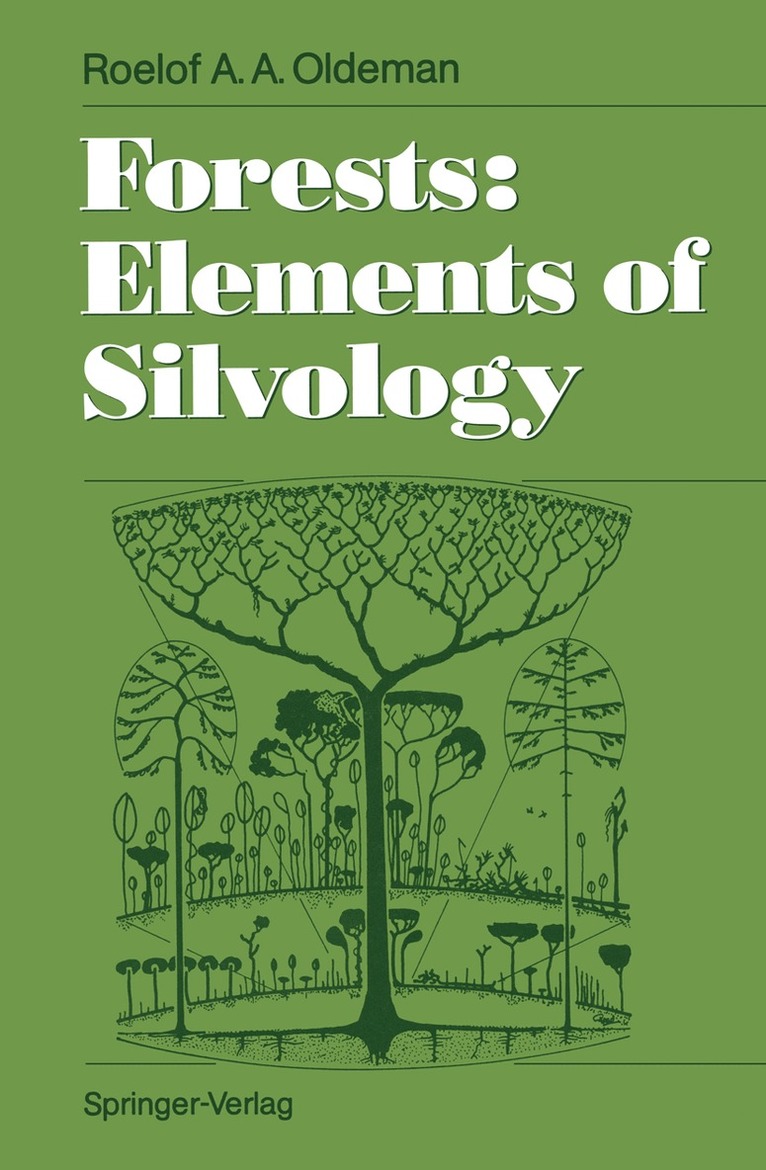
Silvology is the general science of forest ecosystems, without the usual division between Man and Nature. This systematic treatment of forests intends to integrate and harmonize existing approaches with the help of systems modeling in a hierarchy of close system levels, according to criteria of biological architecture, biomass production and species composition. Scientists and practitioners will appreciate this synoptic treatment of forests and their ecology, allowing the balance of holistic and reductionist viewpoints, and the placement of phenomena and techniques. Topics covered include: - introduction of the methods, - sections on forest organisms, - a special chapter on trees, - eco-units, i.e. forest ecosystems developing after some zero-event like fire, storm or waterlogging, - silvatic mosaics built by the eco-units of different size, architecture and species composition, - a summary of silvological rules determining system''s behaviour at every level, e.g. fragmentation and fusion, transfer of functions, irreversibility and process oscillation.
Häftad, Engelska, 2014
1 082 kr
Skickas inom 10-15 vardagar
Silvology is the general science of forest ecosystems, without the usual division between Man and Nature. This systematic treatment of forests intends to integrate and harmonize existing approaches with the help of systems modeling in a hierarchy of close system levels, according to criteria of biological architecture, biomass production and species composition. Scientists and practitioners will appreciate this synoptic treatment of forests and their ecology, allowing the balance of holistic and reductionist viewpoints, and the placement of phenomena and techniques. Topics covered include: - introduction of the methods, - sections on forest organisms, - a special chapter on trees, - eco-units, i.e. forest ecosystems developing after some zero-event like fire, storm or waterlogging, - silvatic mosaics built by the eco-units of different size, architecture and species composition, - a summary of silvological rules determining system's behaviour at every level, e.g. fragmentation and fusion, transfer of functions, irreversibility and process oscillation.
Inbunden, Engelska, 1982
4 846 kr
Skickas inom 10-15 vardagar
Roelof A. A. Oldeman Tropical hardwoods are one of the essential cogs in the complex socio-economic machinery keeping alive an ever-increasing humanity with steadily rising claims upon a finite-resource environment. Their position in this context at first sight seems to be analogous to that of other commodities, such as rubber, metals, mineral oil, tropical fruits and many more. Looking closer, however, tropical hardwoods occupy a special place. Their vast majority, unlike tropical crops, still comes forth from natural forests being exploited by man. This exploitation straight from the natural resource is something they have in common with oil and metals, but the fact that they grow in living systems places them closer to crops. Natural forest ecosystems are not renewable. Timber producing trees, however, can be made into a renewable resource on condition that ways and means are found to cultivate them as a crop. be understood as a socio-economic The tropical hardwood situation can best chain, with the resource base at one end, the consumer community at the other and everything that has to do with the market in the middle. Now, at the resource side, the economics of tropical hardwood extraction barely got out of the primeval ways of wood-gathering by hand and by axe, which were still predominant in the nineteen-forties. There, the offer of natural products was so immense and so near to hand that no care had to be taken of the resource.
Häftad, Engelska, 2010
4 846 kr
Skickas inom 10-15 vardagar
Roelof A. A. Oldeman Tropical hardwoods are one of the essential cogs in the complex socio-economic machinery keeping alive an ever-increasing humanity with steadily rising claims upon a finite-resource environment. Their position in this context at first sight seems to be analogous to that of other commodities, such as rubber, metals, mineral oil, tropical fruits and many more. Looking closer, however, tropical hardwoods occupy a special place. Their vast majority, unlike tropical crops, still comes forth from natural forests being exploited by man. This exploitation straight from the natural resource is something they have in common with oil and metals, but the fact that they grow in living systems places them closer to crops. Natural forest ecosystems are not renewable. Timber producing trees, however, can be made into a renewable resource on condition that ways and means are found to cultivate them as a crop. be understood as a socio-economic The tropical hardwood situation can best chain, with the resource base at one end, the consumer community at the other and everything that has to do with the market in the middle. Now, at the resource side, the economics of tropical hardwood extraction barely got out of the primeval ways of wood-gathering by hand and by axe, which were still predominant in the nineteen-forties. There, the offer of natural products was so immense and so near to hand that no care had to be taken of the resource.
E-bok
PDF, Engelska, 20136 099 kr
Läs direkt efter köp
Roelof A. A. Oldeman Tropical hardwoods are one of the essential cogs in the complex socio-economic machinery keeping alive an ever-increasing humanity with steadily rising claims upon a finite-resource environment. Their position in this context at first sight seems to be analogous to that of other commodities, such as rubber, metals, mineral oil, tropical fruits and many more. Looking closer, however, tropical hardwoods occupy a special place. Their vast majority, unlike tropical crops, still comes forth from natural forests being exploited by man. This exploitation straight from the natural resource is something they have in common with oil and metals, but the fact that they grow in living systems places them closer to crops. Natural forest ecosystems are not renewable. Timber producing trees, however, can be made into a renewable resource on condition that ways and means are found to cultivate them as a crop. be understood as a socio-economic The tropical hardwood situation can best chain, with the resource base at one end, the consumer community at the other and everything that has to do with the market in the middle. Now, at the resource side, the economics of tropical hardwood extraction barely got out of the primeval ways of wood-gathering by hand and by axe, which were still predominant in the nineteen-forties. There, the offer of natural products was so immense and so near to hand that no care had to be taken of the resource.