Roger Kreuz – författare
264 kr
Läs direkt efter köp
How adult learners can draw upon skills and knowledge honed over a lifetime to master a foreign language.
Adults who want to learn a foreign language are often discouraged because they believe they cannot acquire a language as easily as children. Once they begin to learn a language, adults may be further discouraged when they find the methods used to teach children don''t seem to work for them. What is an adult language learner to do? In this book, Richard Roberts and Roger Kreuz draw on insights from psychology and cognitive science to show that adults can master a foreign language if they bring to bear the skills and knowledge they have honed over a lifetime. Adults shouldn''t try to learn as children do; they should learn like adults.
Roberts and Kreuz report evidence that adults can learn new languages even more easily than children. Children appear to have only two advantages over adults in learning a language: they acquire a native accent more easily, and they do not suffer from self-defeating anxiety about learning a language. Adults, on the other hand, have the greater advantages—gained from experience—of an understanding of their own mental processes and knowing how to use language to do things. Adults have an especially advantageous grasp of pragmatics, the social use of language, and Roberts and Kreuz show how to leverage this metalinguistic ability in learning a new language.
Learning a language takes effort. But if adult learners apply the tools acquired over a lifetime, it can be enjoyable and rewarding.
205 kr
Läs direkt efter köp
Understanding how culture affects the ways we communicate—how we tell jokes, greet, ask questions, hedge, apologize, compliment, and so much more.
We can learn to speak other languages, but do we truly understand what we are saying? How much detail should we offer when someone asks how we are? How close should we stand to our conversational partners? Is an invitation genuine or just pro forma? So much of communication depends on culture and context. In Getting Through, Roger Kreuz and Richard Roberts offer a guide to understanding and being understood in different cultures. Drawing on research from psychology, linguistics, sociology, and other fields, as well as personal experience, anecdotes, and popular culture, Kreuz and Roberts describe cross-cultural communication in terms of pragmatics—exploring how language is used and not just what words mean.
Sometimes this is easy to figure out. If someone hisses “I''m fine!” though clenched teeth, we can assume that she''s not really fine. But sometimes the context, cultural or otherwise, is more nuanced. For example, a visitor from another country might be taken aback when an American offers a complaint (“Cold out today!”) as a greeting. And should you apologize the same way in Tokyo as you would in Toledo? Kreuz and Roberts help us navigate such subtleties. It''s a fascinating way to think about human interaction, but it''s not purely academic: The more we understand one another, the better we can communicate, and the better we can communicate, the more we can avoid conflict.
187 kr
Läs direkt efter köp
Why language ability remains resilient and how it shapes our lives.
We acquire our native language, seemingly without effort, in infancy and early childhood. Language is our constant companion throughout our lifetime, even as we age. Indeed, compared with other aspects of cognition, language seems to be fairly resilient through the process of aging. In Changing Minds, Roger Kreuz and Richard Roberts examine how aging affects language—and how language affects aging.
Kreuz and Roberts report that what appear to be changes in an older person''s language ability are actually produced by declines in such other cognitive processes as memory and perception. Some language abilities, including vocabulary size and writing ability, may even improve with age. And certain language activities—including reading fiction and engaging in conversation—may even help us live fuller and healthier lives.
Kreuz and Roberts explain the cognitive processes underlying our language ability, exploring in particular how changes in these processes lead to changes in listening, speaking, reading, and writing. They consider, among other things, the inability to produce a word that''s on the tip of your tongue—and suggest that the increasing incidence of this with age may be the result of a surfeit of world knowledge. For example, older people can be better storytellers, and (something to remember at a family reunion) their perceived tendency toward off-topic verbosity may actually reflect communicative goals.
185 kr
Läs direkt efter köp
A biography of two troublesome words.
Isn''t it ironic? Or is it? Never mind, I''m just being sarcastic (or am I?). Irony and sarcasm are two of the most misused, misapplied, and misunderstood words in our conversational lexicon. In this volume in the MIT Press Essential Knowledge series, psycholinguist Roger Kreuz offers an enlightening and concise overview of the life and times of these two terms, mapping their evolution from Greek philosophy and Roman rhetoric to modern literary criticism to emojis.
Kreuz describes eight different ways that irony has been used through the centuries, proceeding from Socratic to dramatic to cosmic irony. He explains that verbal irony—irony as it is traditionally understood—refers to statements that mean something different (frequently the opposite) of what is literally intended, and defines sarcasm as a type of verbal irony. Kreuz outlines the prerequisites for irony and sarcasm (one of which is a shared frame of reference); clarifies what irony is not (coincidence, paradox, satire) and what it can be (among other things, a socially acceptable way to express hostility); recounts ways that people can signal their ironic intentions; and considers the difficulties of online irony. Finally, he wonders if, because irony refers to so many different phenomena, people may gradually stop using the word, with sarcasm taking over its verbal duties.
213 kr
Skickas
302 kr
Skickas inom 7-10 vardagar
371 kr
Läs direkt efter köp
237 kr
Lyssna direkt efter köp
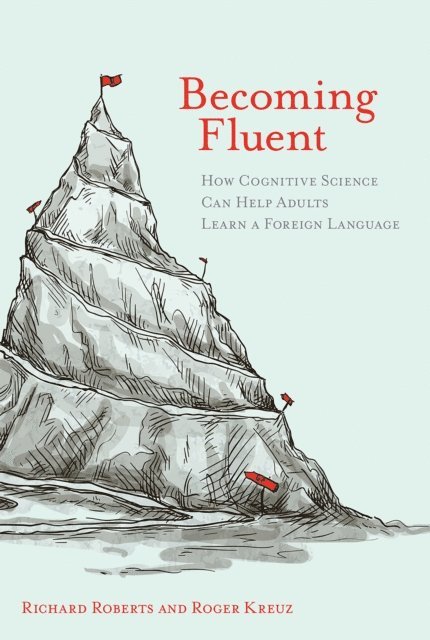
Adults who want to learn a foreign language are often discouraged because they believe they cannot acquire a language as easily as children. Once they begin to learn a language, students may be further discouraged when they find the methods used to teach children don’t seem to work for them. What is an adult language learner to do?
In Becoming Fluent, Richard Roberts and Roger Kreuz draw on insights from psychology and cognitive science to show that adults can master a foreign language if they bring to bear the skills and knowledge they have honed over a lifetime. Adults shouldn’t try to learn as children do; they should learn like adults. Roberts and Kreuz report evidence that adults can learn new languages even more easily than children. Children appear to have only two advantages over adults in learning a language: they acquire a native accent more easily, and they do not suffer from self-defeating anxiety about learning a language. Adults, on the other hand, have the greater advantages—gained from experience—of an understanding of their own mental processes and knowing how to use language to do things. Adults have an especially advantageous grasp of pragmatics, the social use of language, and Roberts and Kreuz show how to leverage this metalinguistic ability in learning a new language.
Learning a language takes effort. But if adult learners apply the tools acquired over a lifetime, it can be enjoyable and rewarding.
855 kr
Läs direkt efter köp
“Why didn’t they understand me? I was as clear as I could be.” Everyone has had this thought at one time or another. Research from the fields of psychology and cognitive science can provide concrete answers to these questions. In Failing to Communicate, Dr. Roger Kreuz explores the answers to these questions
We are exposed to the dangers of miscommunication early in life. As children, we play the Telephone Game and learn an important lesson about the fragility of long communication chains. And as adults, we are constantly on the lookout for misunderstanding. People interrupt each other, on average, about every ninety seconds in order to check their understanding. Despite such vigilance, however, a great deal of what is said and written is not understood as intended.
Miscommunication has led to military defeats, the loss of spacecraft, and even more tragically, accidents that cost human lives. It plays a role in road rage and social media feuds. It haunts the courtroom, the boardroom, and the singles bar. Failing to Communicate includes dozens of such examples and explains them in light of what researchers have discovered about how communication works—and why it so often fails.
Research from psychology and cognitive science has revealed a host of specific factors that contribute to misunderstanding. Some of these have to do with how our minds make sense of what we hear and read, while others are the result of cognitive, social, and cultural factors. The very structure of a given language can be problematic as well. In short, there is no one reason for miscommunication: there are a host of underlying causes.
Issues of misunderstanding have only multiplied as new mediums for communication have arisen. Emails, texts, and social media posts are even more problematic because they are impoverished modes of communication. Without facial cues, tone of voice, gestures, and even the creative use of silence, our intentions in these text-only mediums are even more likely to go awry.
Failing to Communicate is intended to appeal, from beginning to end, to the general reader who wants to know more about why our attempts at communication fail so often
268 kr
Skickas inom 5-8 vardagar
78 kr
Läs direkt efter köp
280 kr
Tillfälligt slut