Roger M. Barker – författare
Visar alla böcker från författaren Roger M. Barker. Handla med fri frakt och snabb leverans.
9 produkter
Corporate Governance, Competition, and Political Parties
Explaining Corporate Governance Change in Europe
E-bok, 2010
1430 kr
Lägg i varukorg
The corporate governance systems of continental Europe have traditionally been quite different to those of the liberal market economies (e.g. the US and the UK). Company ownership has been dominated by incumbent blockholders, with a relatively minor role for minority shareholders and institutional …
Corporate Governance, Competition, and Political Parties
Explaining Corporate Governance Change in Europe
E-bok, 2010
1430 kr
Lägg i varukorg
The corporate governance systems of continental Europe have traditionally been quite different to those of the liberal market economies (e.g. the US and the UK). Company ownership has been dominated by incumbent blockholders, with a relatively minor role for minority shareholders and institutional …
Corporate Governance, Competition, and Political Parties
Explaining Corporate Governance Change in Europe
Inbunden, 2010
2526 kr
Lägg i varukorg
The corporate governance systems of continental Europe have traditionally been quite different to those of the liberal market economies (e.g. the US and the UK). Company ownership has been dominated by incumbent blockholders, with a relatively minor role for minority shareholders and institutional …
Law and Governance of Decentralised Business Models
Between Hierarchies and Markets
Av Roger M Barker, Iris H-Y Chiu
Inbunden, 2020
1968 kr
Lägg i varukorg
This book draws together themes in business model developments in relation to decentralised business models (DBMs), sometimes referred to as the ‘sharing’ economy, to systematically analyse the challenges to corporate and organisational law and governance.DBMs include business networks, the global …
Law and Governance of Decentralised Business Models
Between Hierarchies and Markets
Av Roger M Barker, Iris H-Y Chiu
Häftad, 2023
598 kr
Lägg i varukorg
This book draws together themes in business model developments in relation to decentralised business models (DBMs), sometimes referred to as the ‘sharing’ economy, to systematically analyse the challenges to corporate and organisational law and governance.DBMs include business networks, the global …
Law and Governance of Decentralised Business Models
Between Hierarchies and Markets
Av Iris H-Y Chiu, Roger M Barker
E-bok, 2020
701 kr
Lägg i varukorg
This book draws together themes in business model developments in relation to decentralised business models (DBMs), sometimes referred to as the ‘sharing’ economy, to systematically analyse the challenges to corporate and organisational law and governance. DBMs include business networks, the …
Law and Governance of Decentralised Business Models
Between Hierarchies and Markets
Av Iris H-Y Chiu, Roger M Barker
E-bok, 2020
701 kr
Lägg i varukorg
This book draws together themes in business model developments in relation to decentralised business models (DBMs), sometimes referred to as the ‘sharing’ economy, to systematically analyse the challenges to corporate and organisational law and governance. DBMs include business networks, the …
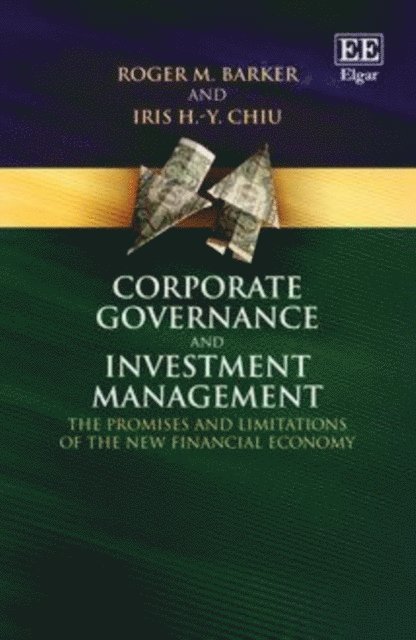
Corporate Governance and Investment Management
The Promises and Limitations of the New Financial Economy
Av Roger M. Barker, Iris H.-Y. Chiu
Inbunden, 2017
2565 kr
Lägg i varukorg
Shareholder engagement with publicly listed companies is often seen as a key means to monitor corporate performance and behavior. In this book, the authors examine the corporate governance roles of key institutional investors in UK corporate equity, including pension funds, insurance companies, …
Corporate Governance and Investment Management
The Promises and Limitations of the New Financial Economy
Av Iris H.-Y. Chiu, Roger M. Barker
E-bok, 2017
422 kr
Lägg i varukorg
Shareholder engagement with publicly listed companies is often seen as a key means to monitor corporate performance and behavior. In this book, the authors examine the corporate governance roles of key institutional investors in UK corporate equity, including pension funds, insurance companies, …