Roger M. Freidinger – författare
Visar alla böcker från författaren Roger M. Freidinger. Handla med fri frakt och snabb leverans.
3 produkter
3 produkter
Inbunden, Engelska, 1998
2 138 kr
Skickas inom 10-15 vardagar
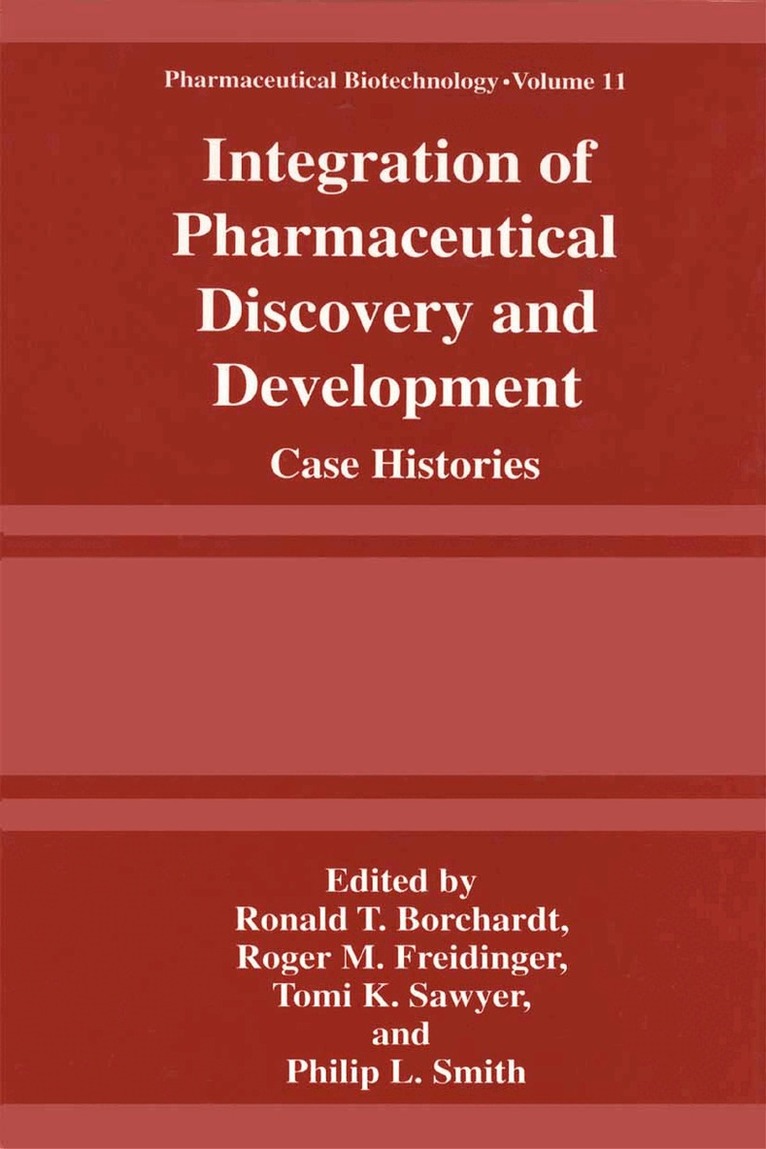
In the late 1980s, it became painfully evident to the pharmaceutical industry that the old paradigm of drug discovery, which involved highly segmented drug - sign and development activities, would not produce an acceptable success rate in the future. Therefore, in the early 1990s a paradigm shift occurred in which drug design and development activities became more highly integrated. This new str- egy required medicinal chemists to design drug candidates with structural f- tures that optimized pharmacological (e. g. , high affinity and specificity for the target receptor), pharmaceutical (e. g. , solubility and chemical stability), bioph- maceutical (e. g. , cell membrane permeability), and metabolic/pharmacokinetic (e. g. , metabolic stability, clearance, and protein binding) properties. Successful implementation of this strategy requires a multidisciplinary team effort, incl- ing scientists from drug design (e. g. , medicinal chemists, cell biologists, en- mologists, pharmacologists) and drug development (e. g. , analytical chemists, pharmaceutical scientists, physiologists, and molecular biologists representing the disciplines of pharmaceutics, biopharmaceutics, and pharmacokinetics/drug metabolism). With this new, highly integrated approach to drug design now widely utilized by the pharmaceutical industry, the editors of this book have provided the sci- tific community with case histories to illustrate the nature of the interdisciplinary interactions necessary to successfully implement this new approach to drug d- covery. In the first chapter, Ralph Hirschmann provides a historical perspective of why this paradigm shift in drug discovery has occurred.
E-bok
PDF, Engelska, 20062 741 kr
Läs direkt efter köp
In the late 1980s, it became painfully evident to the pharmaceutical industry that the old paradigm of drug discovery, which involved highly segmented drug - sign and development activities, would not produce an acceptable success rate in the future. Therefore, in the early 1990s a paradigm shift occurred in which drug design and development activities became more highly integrated. This new str- egy required medicinal chemists to design drug candidates with structural f- tures that optimized pharmacological (e. g. , high affinity and specificity for the target receptor), pharmaceutical (e. g. , solubility and chemical stability), bioph- maceutical (e. g. , cell membrane permeability), and metabolic/pharmacokinetic (e. g. , metabolic stability, clearance, and protein binding) properties. Successful implementation of this strategy requires a multidisciplinary team effort, incl- ing scientists from drug design (e. g. , medicinal chemists, cell biologists, en- mologists, pharmacologists) and drug development (e. g. , analytical chemists, pharmaceutical scientists, physiologists, and molecular biologists representing the disciplines of pharmaceutics, biopharmaceutics, and pharmacokinetics/drug metabolism). With this new, highly integrated approach to drug design now widely utilized by the pharmaceutical industry, the editors of this book have provided the sci- tific community with case histories to illustrate the nature of the interdisciplinary interactions necessary to successfully implement this new approach to drug d- covery. In the first chapter, Ralph Hirschmann provides a historical perspective of why this paradigm shift in drug discovery has occurred.
Häftad, Engelska, 2010
2 156 kr
Skickas inom 10-15 vardagar
This volume provides case histories illustrating the types of interdisciplinary interactions necessary to design drug candidates with optimal pharmacological, pharmaceutical, biopharmaceutical, and metabolic/pharmacokinetic properties. Key features include an incisive discussion of HIV protease inhibitors and 287 illustrations.