Roger T. Fenner - Böcker
Visar alla böcker från författaren Roger T. Fenner. Handla med fri frakt och snabb leverans.
7 produkter
7 produkter
1 835 kr
Skickas inom 3-6 vardagar
2 030 kr
Skickas inom 10-15 vardagar
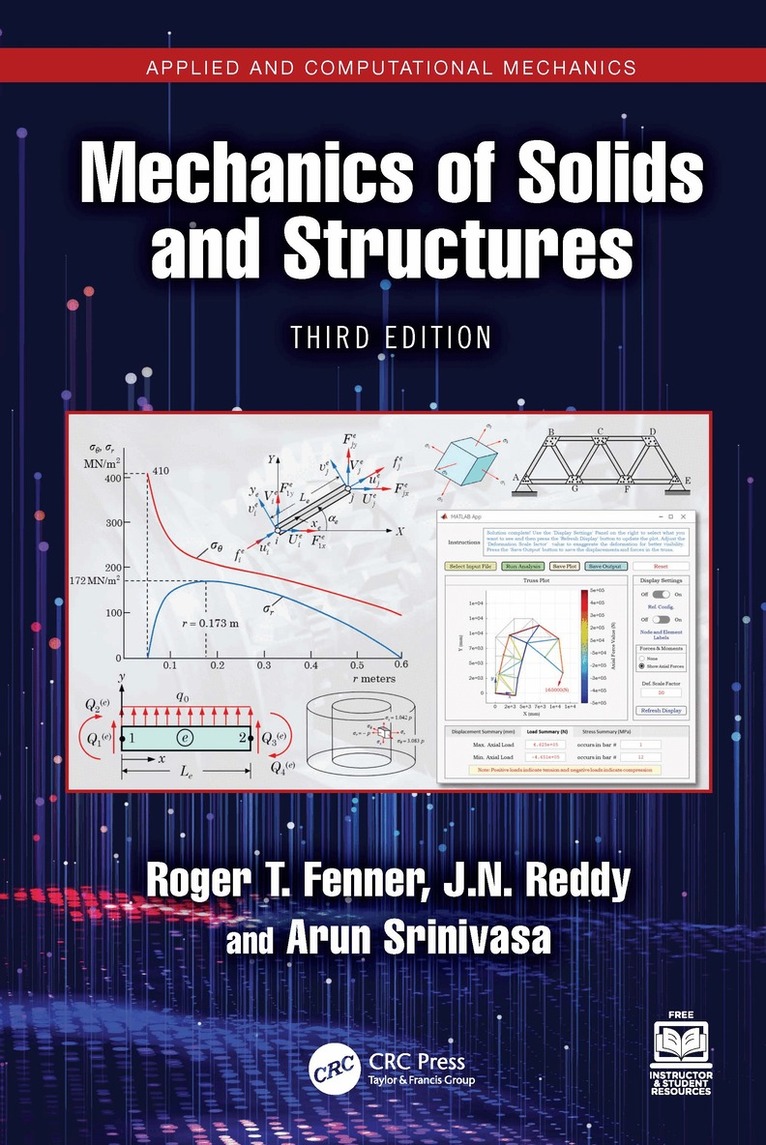
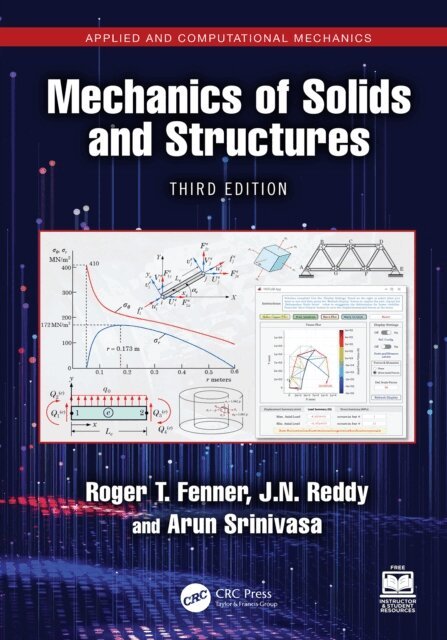
The third edition of Mechanics of Solids and Structures makes use of computational methods such as the finite element method that has revolutionized the field to solve problems while retaining all the basic principles and foundational information needed for mastering advanced engineering mechanics principles and acquiring problem-solving skills. The authors have updated the text to include the integration of numerical approaches and MATLAB® computer programs into the body of the text for carrying out analysis of truss, beam, and frame structures. The third edition also offers an update to Chapters 1 through 4 as follows. All material related to determinate trusses and cables is moved to Chapter 1, as most students most likely were introduced to these topics in a course on statics. Thus, Chapter 1 of the current edition is a review of statics. The concepts of stress and strain and associated examples were moved from Chapter 1 to Chapter 2, with additional discussion of concepts and examples. Chapter 3 in the new edition deals with stress-strain relations with applications to determinate systems, including trusses and thin-walled pressure vessels. Indeterminate trusses and associated computer implementation have been moved from Chapter 4 of the second edition to Chapter 7 of the current edition. Other indeterminate systems from old Chapter 4 have been retained in new Chapter 4. The second major change is the updating of all the computational tools from FORTRAN to MATLAB and providing interactive tools (i.e., APPs) in Chapters 7, 10, and 12 of the new edition. All computational examples from Chapters 4 and 6 on trusses and beams of the second edition are consolidated into a new chapter, Chapter 7 with numerous examples and applications of newly included TRUSS2d, BEAM, and FRAME2d APPs. Chapter 7 also introduces finite element analysis of plane frames (a new topic). The authors have also added new examples and exercise problems throughout the book that allow students to practice and apply the concepts and formulas to solve problems.
810 kr
Skickas inom 10-15 vardagar
The third edition of Mechanics of Solids and Structures makes use of computational methods such as the finite element method that has revolutionized the field to solve problems while retaining all the basic principles and foundational information needed for mastering advanced engineering mechanics principles and acquiring problem-solving skills. The authors have updated the text to include the integration of numerical approaches and MATLAB® computer programs into the body of the text for carrying out analysis of truss, beam, and frame structures. The third edition also offers an update to Chapters 1 through 4 as follows. All material related to determinate trusses and cables is moved to Chapter 1, as most students most likely were introduced to these topics in a course on statics. Thus, Chapter 1 of the current edition is a review of statics. The concepts of stress and strain and associated examples were moved from Chapter 1 to Chapter 2, with additional discussion of concepts and examples. Chapter 3 in the new edition deals with stress-strain relations with applications to determinate systems, including trusses and thin-walled pressure vessels. Indeterminate trusses and associated computer implementation have been moved from Chapter 4 of the second edition to Chapter 7 of the current edition. Other indeterminate systems from old Chapter 4 have been retained in new Chapter 4. The second major change is the updating of all the computational tools from FORTRAN to MATLAB and providing interactive tools (i.e., APPs) in Chapters 7, 10, and 12 of the new edition. All computational examples from Chapters 4 and 6 on trusses and beams of the second edition are consolidated into a new chapter, Chapter 7 with numerous examples and applications of newly included TRUSS2d, BEAM, and FRAME2d APPs. Chapter 7 also introduces finite element analysis of plane frames (a new topic). The authors have also added new examples and exercise problems throughout the book that allow students to practice and apply the concepts and formulas to solve problems.
1 895 kr
Skickas inom 10-15 vardagar
A popular text in its first edition, Mechanics of Solids and Structures serves as a course text for the senior/graduate (fourth or fifth year) courses/modules in the mechanics of solid/advanced strength of materials, offered in aerospace, civil, engineering science, and mechanical engineering departments. Now, Mechanics of Solid and Structure, Second Edition presents the latest developments in computational methods that have revolutionized the field, while retaining all of the basic principles and foundational information needed for mastering advanced engineering mechanics.Key changes to the second edition include full-color illustrations throughout, web-based computational material, and the addition of a new chapter on the energy methods of structural mechanics. Using authoritative, yet accessible language, the authors explain the construction of expressions for both total potential energy and complementary potential energy associated with structures. They explore how the principles of minimal total potential energy and complementary energy provide the means to obtain governing equations of the structure, as well as a means to determine point forces and displacements with ease using Castigliano’s Theorems I and II. The material presented in this chapter also provides a deeper understanding of the finite element method, the most popular method for solving structural mechanics problems.Integrating computer techniques and programs into the body of the text, all chapters offer exercise problems for further understanding. Several appendices provide examples, answers to select problems, and opportunities for investigation into complementary topics. Listings of computer programs discussed are available on the CRC Press website.
712 kr
Skickas inom 5-8 vardagar
This book is intended as a textbook providing a deliberately simple introduction to finite element methods in a way that should be readily understandable to engineers, both students and practising professionals. Only the very simplest elements are considered, mainly two dimensional three-noded “constant strain triangles”, with simple linear variation of the relevant variables. Chapters of the book deal with structural problems (beams), classification of a broad range of engineering into harmonic and biharmonic types, finite element analysis of harmonic problems, and finite element analysis of biharmonic problems (plane stress and plane strain). Full FORTRAN programs are listed and explained in detail, and a range of practical problems solved in the text. Despite being somewhat unfashionable for general programming purposes, the FORTRAN language remains very widely used in engineering. The programs listed, which were originally developed for use on mainframe computers, have been thoroughly updated for use on desktops and laptops. Unlike the first edition, the new edition has problems (with solutions) at the end of each chapter.
480 kr
Skickas inom 5-8 vardagar
Professor Fenner's definitive text is now back in print, with added corrections. It serves as an introduction to finite element methods for engineering undergraduates and other students at an equivalent level. Postgraduate and practising engineers will also find it useful if they are comparatively new to finite element methods.The main emphasis is on the simplest methods suitable for solving two-dimensional continuum mechanics problems, particularly those encountered in the fields of stress analysis, fluid mechanics and heat transfer. Complete FORTRAN programs are presented, described and discussed in detail, and several practical case studies serve to illustrate the methods developed in the book.Finite element methods are compared and contrasted with finite difference methods, and throughout the level of computer programming, continuum mechanics, numerical analysis, matrix algebra and other mathematics employed corresponds to that normally covered in undergraduate engineering courses.
325 kr
Skickas inom 5-8 vardagar
Professor Fenner's definitive text is now back in print, with added corrections. It serves as an introduction to finite element methods for engineering undergraduates and other students at an equivalent level. Postgraduate and practising engineers will also find it useful if they are comparatively new to finite element methods.The main emphasis is on the simplest methods suitable for solving two-dimensional continuum mechanics problems, particularly those encountered in the fields of stress analysis, fluid mechanics and heat transfer. Complete FORTRAN programs are presented, described and discussed in detail, and several practical case studies serve to illustrate the methods developed in the book.Finite element methods are compared and contrasted with finite difference methods, and throughout the level of computer programming, continuum mechanics, numerical analysis, matrix algebra and other mathematics employed corresponds to that normally covered in undergraduate engineering courses.