Roman Frydman – författare
Visar alla böcker från författaren Roman Frydman. Handla med fri frakt och snabb leverans.
15 produkter
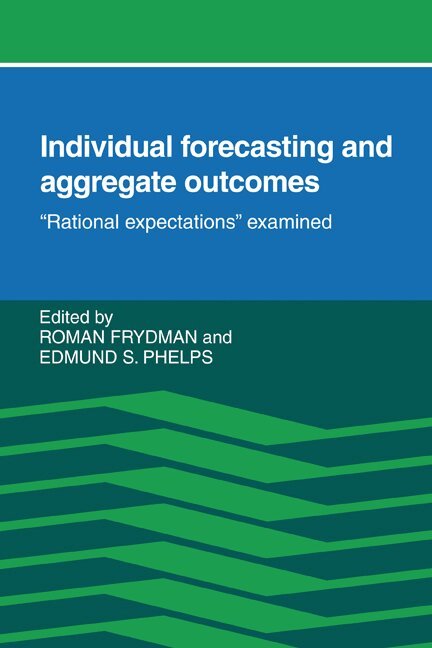
Individual Forecasting and Aggregate Outcomes
'Rational Expectations' Examined
Av Frydman R. Oman, E. Phelps m. fl.
Häftad, 1986
921 kr
Lägg i varukorg
Growing out of a conference on Expectations Formation and Economic Disequilibrium held in New York City in 1981, the papers in this volume provide a complex view of market processes in which individual rationality is no guarantee of convergence to the 'correct' model and the equilibrium …
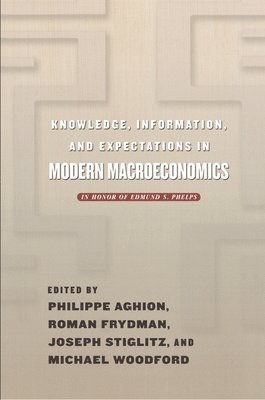
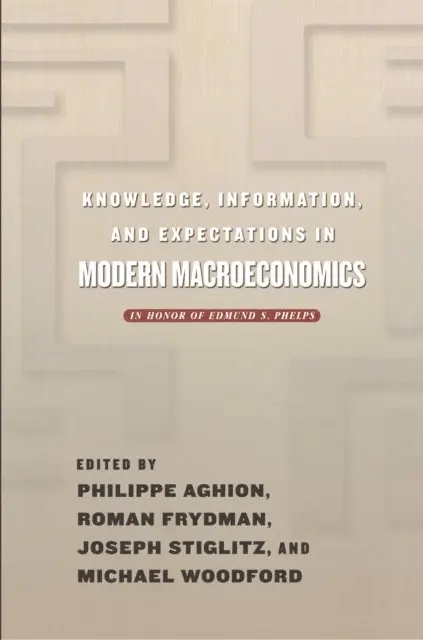
Knowledge, Information, and Expectations in Modern Macroeconomics
In Honor of Edmund S. Phelps
Av Philippe Aghion, Roman Frydman m. fl.
Häftad, 2003
1659 kr
Lägg i varukorg
Macroeconomics would not be what it is today without Edmund Phelps. This book assembles the field's leading figures to highlight the continuing influence of his ideas from the past four decades. Addressing the most important current debates in macroeconomic theory, it focuses on the rates at which …
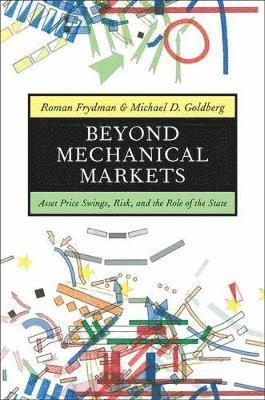
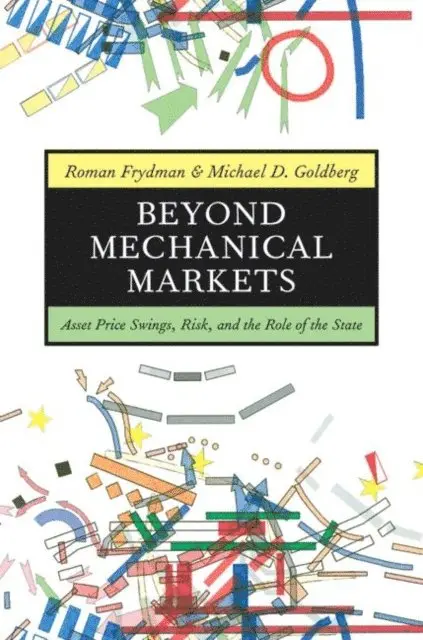
Beyond Mechanical Markets
Asset Price Swings, Risk, and the Role of the State
Av Roman Frydman, Michael D. Goldberg
Inbunden, 2011
305 kr
Lägg i varukorg
In the wake of the global financial crisis that began in 2007, faith in the rationality of markets has lost ground to a new faith in their irrationality. The problem, Roman Frydman and Michael Goldberg argue, is that both the rational and behavioral theories of the market rest on the same fatal …
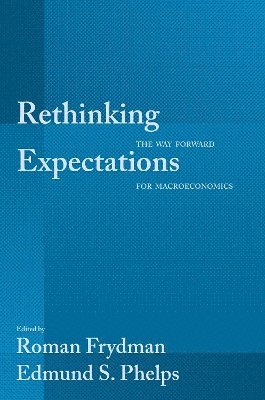
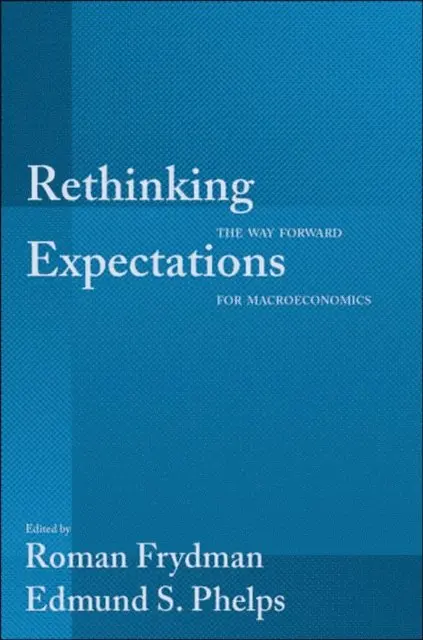
Rethinking Expectations
The Way Forward for Macroeconomics
Av Roman Frydman, Edmund S. Phelps
Inbunden, 2013
682 kr
Lägg i varukorg
This book originated from a 2010 conference marking the fortieth anniversary of the publication of the landmark "Phelps volume," Microeconomic Foundations of Employment and Inflation Theory, a book that is often credited with pioneering the currently dominant approach to macroeconomic analysis. …
Knowledge, Information, and Expectations in Modern Macroeconomics
In Honor of Edmund S. Phelps
Av Michael Woodford, Joseph E. Stiglitz m. fl.
E-bok, 2021
1469 kr
Lägg i varukorg
Macroeconomics would not be what it is today without Edmund Phelps. This book assembles the field''s leading figures to highlight the continuing influence of his ideas from the past four decades. Addressing the most important current debates in macroeconomic theory, it focuses on the rates at which …
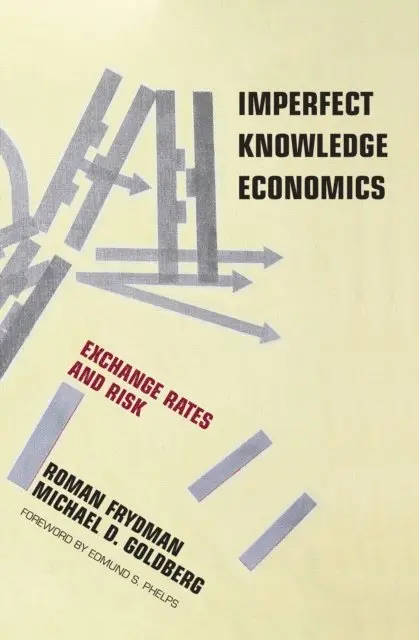
Imperfect Knowledge Economics
Exchange Rates and Risk
Av Michael D. Goldberg, Roman Frydman
E-bok, 2023
1234 kr
Lägg i varukorg
Posing a major challenge to economic orthodoxy, Imperfect Knowledge Economics asserts that exact models of purposeful human behavior are beyond the reach of economic analysis. Roman Frydman and Michael Goldberg argue that the longstanding empirical failures of conventional economic models stem from …
Beyond Mechanical Markets
Asset Price Swings, Risk, and the Role of the State
Av Michael D. Goldberg, Roman Frydman
E-bok, 2011
428 kr
Lägg i varukorg
A powerful challenge to contemporary economics and a new agenda for global finance In the wake of the global financial crisis that began in 2007, faith in the rationality of markets has lost ground to a new faith in their irrationality. The problem, Roman Frydman and Michael Goldberg argue, is that …
Rethinking Expectations
The Way Forward for Macroeconomics
Av Edmund S. Phelps, Roman Frydman
E-bok, 2013
934 kr
Lägg i varukorg
This book originated from a 2010 conference marking the fortieth anniversary of the publication of the landmark "Phelps volume," Microeconomic Foundations of Employment and Inflation Theory , a book that is often credited with pioneering the currently dominant approach to macroeconomic analysis. …
Privatization Process in Central Europe
Av Roman Frydman, Andrzej Rapaczynski
Inbunden, 1993
1728 kr
Lägg i varukorg
In this work, comprehensive comparative information on five Central European countries has been collected by teams of researchers from both within the region and from the West. Following an introduction to the economic environment in each country, it provides an overview of the privatization …
Privatization Process in Russia, the Ukraine, and the Baltic States
Av Roman Frydman, Andrzej Rapaczynski
Inbunden, 1993
1840 kr
Lägg i varukorg
In this work, comprehensive comparative information on five former Soviet republics has been collected by teams of researchers from both within the region and from the West. Following an introduction to the economic environment in each country, it provides an overview of the privatization process, …
Privatization in Eastern Europe
Is the State Withering Away?
Av Roman Frydman, Andrzej Rapaczynski
Inbunden, 1994
1674 kr
Lägg i varukorg
In Eastern Europe privatization is now a mass phenomenon. The authors propose a model of it by means of an illustration from the example of Poland, which envisages the free provision of shares in formerly public undertakings to employees and consumers, and the provision of corporate finance from …
Small Privatization
The Transformation of Retail Trade and Consumer Services in the Czech Republic, Hungary and Poland
Av Roman Frydman, Andrzej Rapaczynski
Inbunden, 1994
1930 kr
Lägg i varukorg
The authors of this treatise attempt to provide a deeper understanding of the economic and political transformations now taking place in Poland, Hungary and the Czech Republic. They build up a detailed picture of the privatization process in the retail trade, catering and more general services. Not …
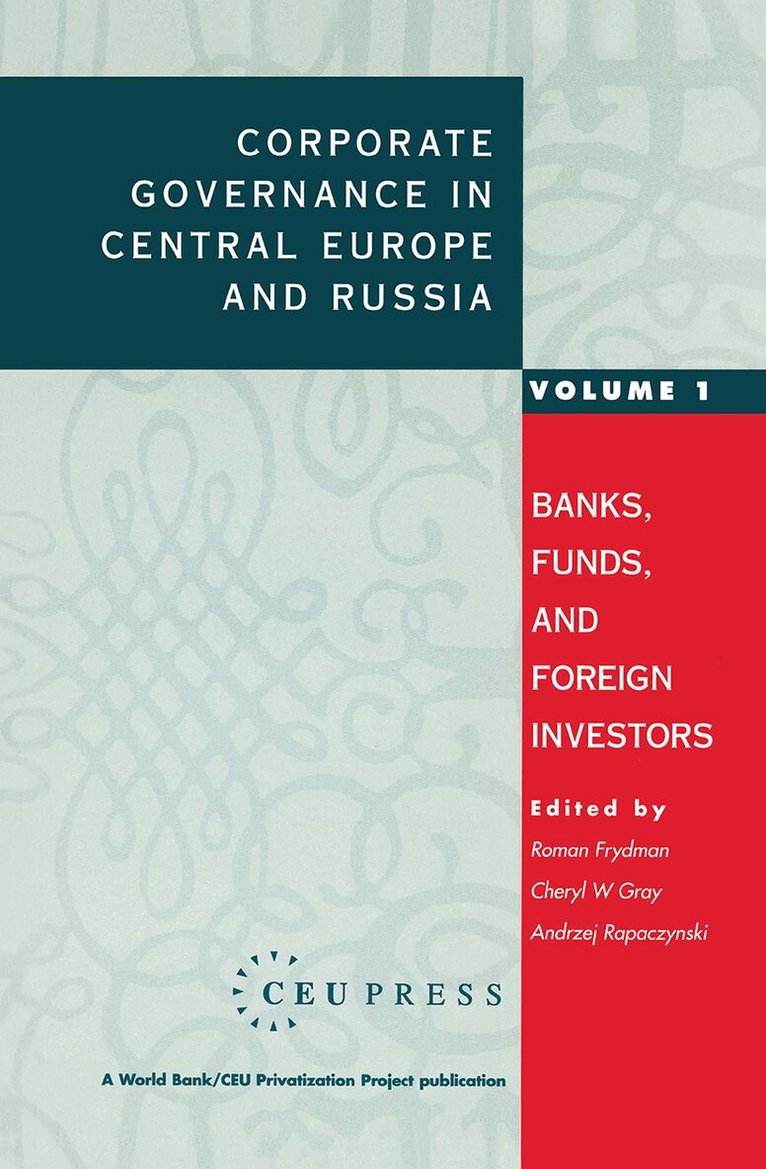
Corporate Governance in Central Europe and Russia
Banks, Funds, and Foreign Investors
Av Roman Frydman, Cheryl W. Gray m. fl.
Inbunden, 1996
1930 kr
Lägg i varukorg
The studies in this two-volume work shed new light on the range and viability of the emerging corporate governance institutions in the transitional economies of Central Europe. Regional specialists and experts on corporate governance in advanced economies examine the emerging forms of ownership and …
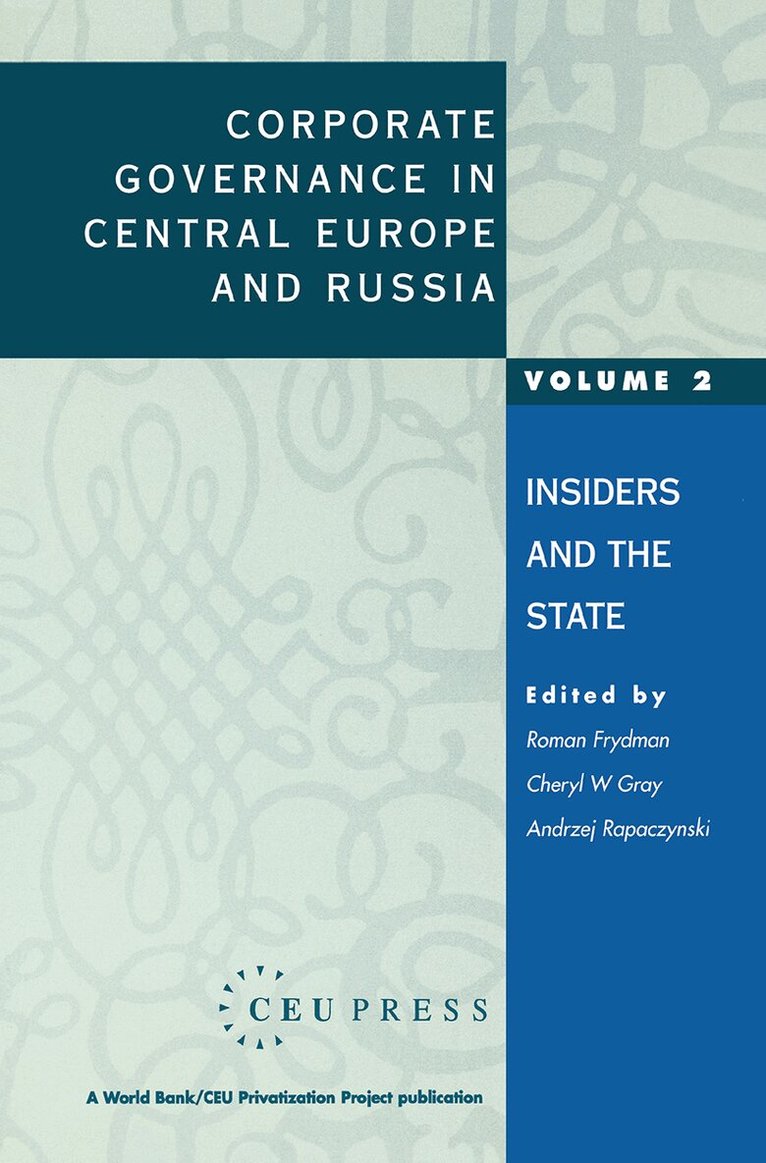
Corporate Governance in Central Europe and Russia
Insiders and the State
Av Andrzej Rapaczynski, Roman Frydman m. fl.
Inbunden, 1996
2005 kr
Lägg i varukorg
The studies in this two-volume work shed new light on the range and viability of the emerging corporate governance institutions in the transitional economies of Central Europe. Regional specialists and experts on corporate governance in advanced economies examine the emerging forms of ownership and …
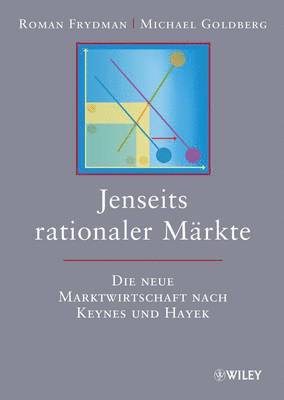
Jenseits rationaler Märkte
Die neue Marktwirtschaft nach Keynes und Hayek
Av Roman Frydman, Michael Goldberg
Inbunden, 2012
428 kr
Tillfälligt slut
Frydman und Goldberg glauben nicht an die Rationalität der Märkte und haben deshalb ein neues Erklärungsmodell für Marktveränderungen entwickelt.Volkswirtschaftliche Modelle gehen davon aus, dass der Markt vollkommenes Wissen besitzt. Dass sich deshalb die Kurse auf den Finanzmärkten wie von einer …