Roman L. Sorochenko - Böcker
Visar alla böcker från författaren Roman L. Sorochenko. Handla med fri frakt och snabb leverans.
3 produkter
3 produkter
Del 282 - Astrophysics and Space Science Library
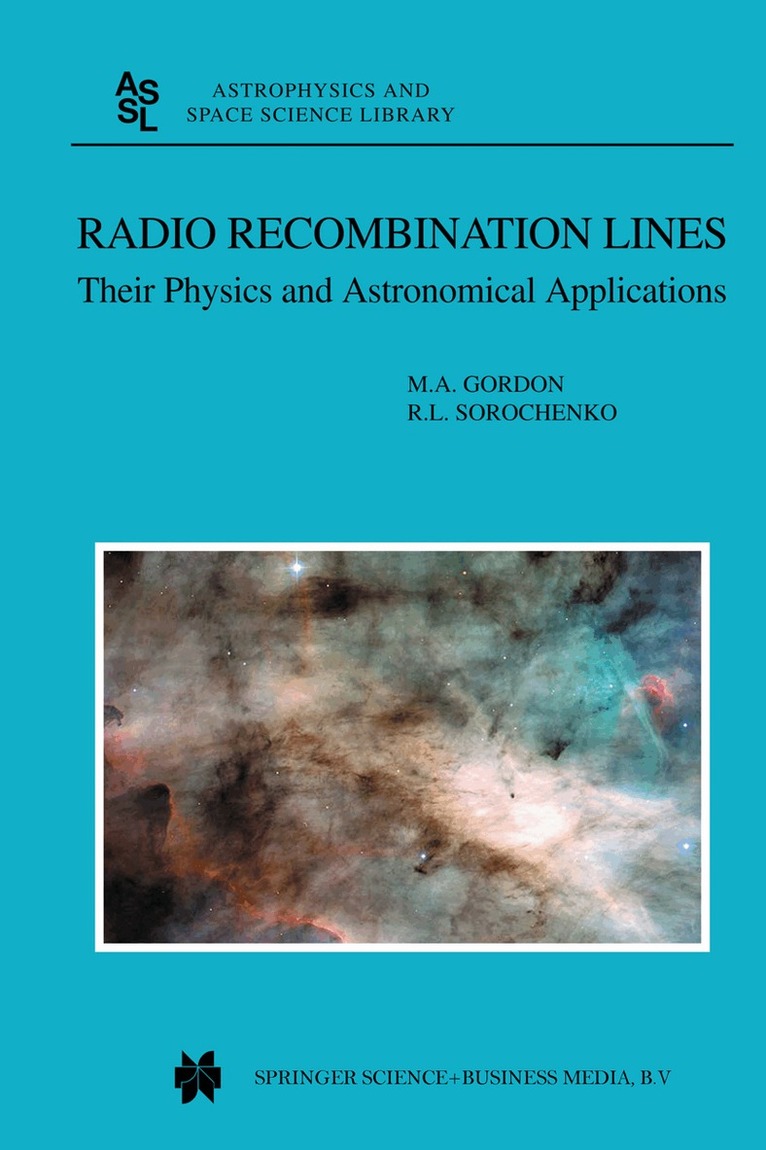
Radio Recombination Lines
Their Physics and Astronomical Applications
Inbunden, Engelska, 2002
1 578 kr
Skickas inom 10-15 vardagar
This book is a comprehensive guide to the physics and observations of Radio Recombination Lines from astronomical sources, written for astronomers, physicists, and graduate students. It is suitable for a graduate-level textbook. It includes the history of RRL detections, the astrophysics underlying their intensities and line shapes including topics like departures from LTE and Stark broadening, the maximum possible size of an atom, as well as detailed descriptions of the astronomical topics for which RRLs have proved to be effective tools. The text includes more than 250 equations and 110 illustrations. It also contains hundreds of specific references to the astronomical literature to enable readers to explore additional details. The appendix includes supplementary information such as the detailed physics underlying the Bohr atomic model, tables of RRL frequencies including fine structure components, techniques for calculating hydrogenic oscillator strengths, FORTRAN code for calculating departure coefficients, and a discussion with formulas for converting observational (telescope) intensity units to astrophysical ones.
Del 282 - Astrophysics and Space Science Library
Radio Recombination Lines
Their Physics and Astronomical Applications
Häftad, Engelska, 2012
1 578 kr
Skickas inom 10-15 vardagar
Recombination lines at radio wavelengths have been - and still are - a pow erful tool for modern astronomy. For more than thirty years they have allowed astronomers to probe the gases from which stars form. They have even been detected in the Sun. In addition, observations of these spectral lines facilitate basic research into the atom, in forms and environments that can only exist in the huge dimensions and extreme conditions of cosmic laboratories. We intend this book to serve as a tourist's guide to the world of Radio Recombination Lines. It contains three divisions: a history of their discovery, the physics of how they form and how their voyage to us influences their spectral profiles, and a description of their many astronomical contributions to date. The appendix includes supplementary calculations that may be useful to some astronomers. This material also includes tables of line frequencies from 12 MHz to 30THz (AlOJLm) as well as FORTRAN computer code to calculate the fine structure components of the lines, to evaluate radial matrix integrals, and to calculate the departure coefficients of hydrogen in a cosmic environment. It also describes how to convert observational to astrophysical units. The text includes extensive references to the literature to assist readers who want more details.
Del 163 - Astrophysics and Space Science Library
Radio Recombination Lines: 25 Years of Investigation
Proceeding of the 125th Colloquium of the International Astronomical Union, Held in Puschino, U.S.S.R., September 11–16, 1989
Häftad, Engelska, 2011
536 kr
Skickas inom 10-15 vardagar
Text no 1 Radio Recombination Lines (RRLs), discovered in the USSR in 1964, have become a powerful research tool for astronomers. Available throughout the radio spectrum, these lines carry information regarding the density, temperature, turbulence and velocity of thermal plasmas. Their very existance shows the presence of thermal gas. They also can carry information regarding magnetic fields if Zeeman splitting were to be detected. Containing the proceedings of an IAU Colloquium celebrating the 25th anniversary of their detection, this volume tells us what has happened since. It contains the story of the detection of RRLs and reviews of many areas of physics of the interstellargas from which stars form, HII regions excited by newly formed stars, planetary nebulae involving dying stars, and the structure of our Milky Way and other galaxies reflecting the large-scale morphology of the star formation process. In addition there is an article describing modern laboratory studies of Rydberg atoms to probe the basic physics of atomic structure, and articles describing the theory of collisions and radiation upon Rydberg atoms leading to observate effects to be used as diagnostic tools in astromony. This book focuses on the 25 years of astronomical research with radio recombination lines (RRLs) since their discovery in 1965. It covers a wide range of topics: papers dealing with research into Rydberg atoms both in the laboratory and in the interstellar medium of our galaxy and others; papers on the interaction of radiation and atomic systems, as well as with the effects of inadiabatic collisions between these atoms and both ions and electrons. It deals with astronomical observations of atoms with `diameters' ranging from 0.08 to 50 mum a size factor of 625. It deals with RRLs in absorption, in emission and as true masers. And it deals with plasmas with temperatures ranging from 10 to greater than 104 kelvins, andwith an even greater range of volume densities. Much new work is reported, including low frequency RRLs discovered in 1980 and the maser RRLs from the star MWC349, discovered in 1989. The advent of aperture synthesis telescopes and large single-element telescopes have made possible RRL studies with high angular resolution. The sum total of the work reported here will make the volume a platform from which to search new horizons in RRL research.