Ronald Davidson – författare
Visar alla böcker från författaren . Handla med fri frakt och snabb leverans.
6 produkter
6 produkter
Inbunden, Engelska, 2002
2 773 kr
Skickas inom 3-6 vardagar
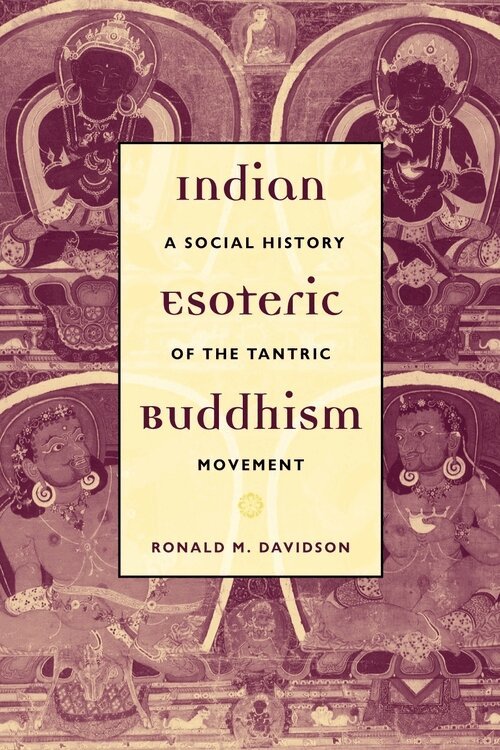
Despite the rapid spread of Buddhism-especially the esoteric system of Tantra, one of its most popular yet most misunderstood forms-the historical origins of Buddhist thought and practice remain obscure. This groundbreaking work describes the genesis of the Tantric movement in early medieval India, where it developed as a response to, and in some ways an example of, the feudalization of Indian society. Drawing on primary documents-many translated for the first time-from Sanskrit, Prakrit, Tibetan, Bengali, and Chinese, Ronald Davidson shows how changes in medieval Indian society, including economic and patronage crises, a decline in women's participation, and the formation of large monastic orders, led to the rise of the esoteric tradition in India that became the model for Buddhist cultures in China, Tibet, and Japan.
Häftad, Engelska, 2002
754 kr
Skickas inom 3-6 vardagar
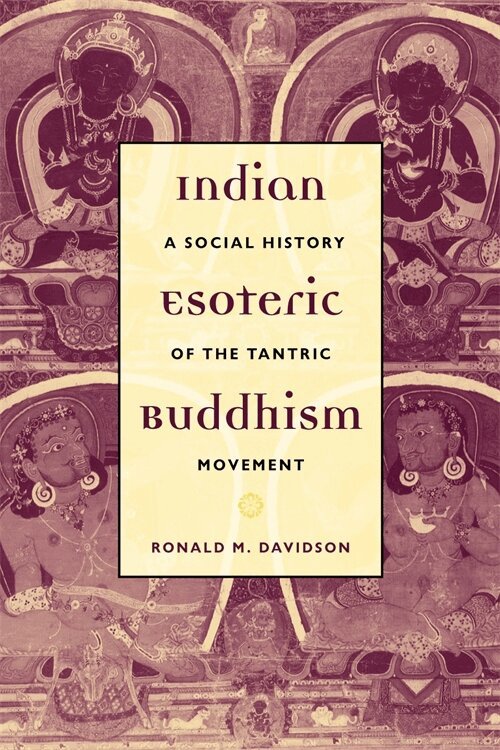
Despite the rapid spread of Buddhism-especially the esoteric system of Tantra, one of its most popular yet most misunderstood forms-the historical origins of Buddhist thought and practice remain obscure. This groundbreaking work describes the genesis of the Tantric movement in early medieval India, where it developed as a response to, and in some ways an example of, the feudalization of Indian society. Drawing on primary documents-many translated for the first time-from Sanskrit, Prakrit, Tibetan, Bengali, and Chinese, Ronald Davidson shows how changes in medieval Indian society, including economic and patronage crises, a decline in women's participation, and the formation of large monastic orders, led to the rise of the esoteric tradition in India that became the model for Buddhist cultures in China, Tibet, and Japan.
Häftad, Engelska, 2005
465 kr
Skickas inom 5-8 vardagar
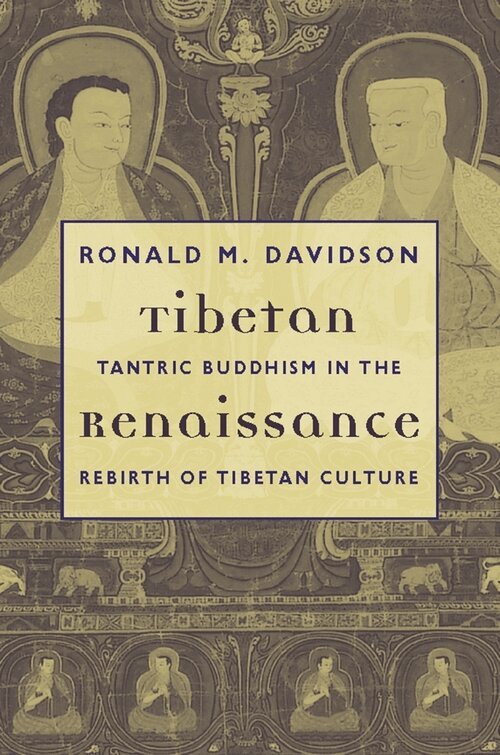
How did a society on the edge of collapse and dominated by wandering bands of armed men give way to a vibrant Buddhist culture, led by yogins and scholars? Ronald M. Davidson explores how the translation and spread of esoteric Buddhist texts dramatically shaped Tibetan society and led to its rise as the center of Buddhist culture throughout Asia, replacing India as the perceived source of religious ideology and tradition. During the Tibetan Renaissance (950-1200 C.E.), monks and yogins translated an enormous number of Indian Buddhist texts. They employed the evolving literature and practices of esoteric Buddhism as the basis to reconstruct Tibetan religious, cultural, and political institutions. Many translators achieved the de facto status of feudal lords and while not always loyal to their Buddhist vows, these figures helped solidify political power in the hands of religious authorities and began a process that led to the Dalai Lama's theocracy.Davidson's vivid portraits of the monks, priests, popular preachers, yogins, and aristocratic clans who changed Tibetan society and culture further enhance his perspectives on the tensions and transformations that characterized medieval Tibet.
E-bok
PDF, Engelska, 2012696 kr
Läs direkt efter köp
Methods in Nonlinear Plasma Theory is from lectures given in graduate classes in both University of Maryland and University of California at Berkeley. To be able to understand fully the contents in this book, the reader is assumed to be a graduate student with background of classical physics and linear plasma waves and instabilities. This text is divided into two major parts. Part I deals with the coherent nonlinear phenomena, while Part II discusses the turbulent nonlinear phenomena. Six chapters comprise Part I, where basic equations and methods are described and discussed. Some of these methods are Vlasov-Maxwell equations and Korteweg-de Vries equation. Part II meanwhile has eight chapters that discuss frameworks and theories for weak plasma turbulence. Specifically, the weak turbulence theory is presented as it is applied to electromagnetic wave-particle interactions, nonlinear wave-wave interactions, and nonlinear wave-particle interactions. This book is a useful reference for students and researchers in the study of classical physics and plasma theory.
Inbunden, Engelska, 2006
1 804 kr
Skickas inom 5-8 vardagar
Collectively, the papers of this volume reveal the cultural dynamism of Tibet in the period between 900 and 1400CE, when the fundamental contours of Tibetan Buddhism were still fluid and highly contested.The papers address a spectrum of issues in Tibetan religion and literature, ranging in time and space from the far eastern oasis of Dunhuang in the tenth century through ‘high classical’ developments in Central Tibet in the early fifteenth century. It is divided into four parts, addressing respectively literary and religious issues in tenth-century Dunhuang, the textual history of the Old Tantric Canon (Rnying ma’i rgyud ’bum), the development of Tibetan religious literature in the new translation period, and the history and transmission of several influential systems of esoteric Buddhism.
Inbunden, Engelska, 2005
1 175 kr
Tillfälligt slut
How did a society on the edge of collapse and dominated by wandering bands of armed men give way to a vibrant Buddhist culture, led by yogins and scholars? Ronald M. Davidson explores how the translation and spread of esoteric Buddhist texts dramatically shaped Tibetan society and led to its rise as the center of Buddhist culture throughout Asia, replacing India as the perceived source of religious ideology and tradition. During the Tibetan Renaissance (950-1200 C.E.), monks and yogins translated an enormous number of Indian Buddhist texts. They employed the evolving literature and practices of esoteric Buddhism as the basis to reconstruct Tibetan religious, cultural, and political institutions. Many translators achieved the de facto status of feudal lords and while not always loyal to their Buddhist vows, these figures helped solidify political power in the hands of religious authorities and began a process that led to the Dalai Lama's theocracy.Davidson's vivid portraits of the monks, priests, popular preachers, yogins, and aristocratic clans who changed Tibetan society and culture further enhance his perspectives on the tensions and transformations that characterized medieval Tibet.