Ronald Driggers - Böcker
Visar alla böcker från författaren Ronald Driggers. Handla med fri frakt och snabb leverans.
3 produkter
3 produkter
35 507 kr
Tillfälligt slut
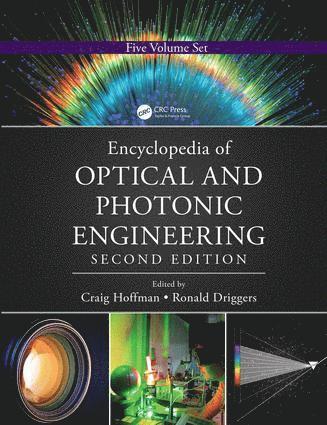
The first edition of the Encyclopedia of Optical and Photonic Engineering provided a valuable reference concerning devices or systems that generate, transmit, measure, or detect light, and to a lesser degree, the basic interaction of light and matter. This Second Edition not only reflects the changes in optical and photonic engineering that have occurred since the first edition was published, but also:Boasts a wealth of new material, expanding the encyclopedia’s length by 25 percentContains extensive updates, with significant revisions made throughout the textFeatures contributions from engineers and scientists leading the fields of optics and photonics todayWith the addition of a second editor, the Encyclopedia of Optical and Photonic Engineering, Second Edition offers a balanced and up-to-date look at the fundamentals of a diverse portfolio of technologies and discoveries in areas ranging from x-ray optics to photon entanglement and beyond. This edition’s release corresponds nicely with the United Nations General Assembly’s declaration of 2015 as the International Year of Light, working in tandem to raise awareness about light’s important role in the modern world.Also Available OnlineThis Taylor & Francis encyclopedia is also available through online subscription, offering a variety of extra benefits for researchers, students, and librarians, including: Citation tracking and alertsActive reference linkingSaved searches and marked listsHTML and PDF format optionsContact Taylor and Francis for more information or to inquire about subscription options and print/online combination packages.US: (Tel) 1.888.318.2367; (E-mail) e-reference@taylorandfrancis.comInternational: (Tel) +44 (0) 20 7017 6062; (E-mail) online.sales@tandf.co.uk
2 663 kr
Skickas inom 5-8 vardagar
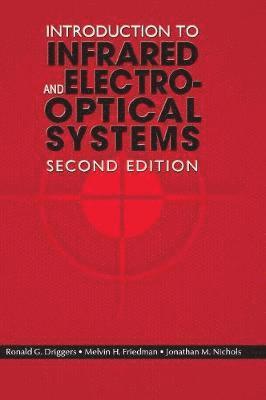
Electro-Optics (EO) is a technology area that involves the generation, modulation, detection, measurement, and display of optical radiation by electrical means. EO includes lasers, photometry, infrared, and other types of imaging systems. This newly revised and updated edition of a classic Artech House book offers a current and complete introduction to the analysis and design of EO imaging systems. The Second Edition provides numerous updates and brand new coverage of today's most important areas, including the integrated spatial frequency approach and a focus on the weapons of terrorists as objects of interest.
1 781 kr
Skickas inom 5-8 vardagar
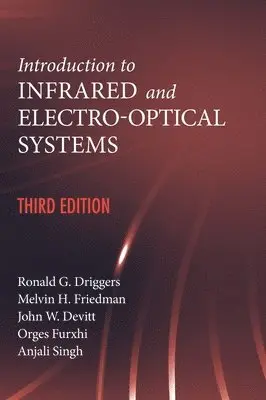
This newly revised and updated edition offers a current and complete introduction to the analysis and design of Electro-Optical (EO) imaging systems. The Third Edition provides numerous updates and several new chapters including those covering Pilotage, Infrared Search and Track, and Simplified Target Acquisition Model. The principles and components of the Linear Shift-Invariant (LSI) infrared and electro-optical systems are detailed in full and help you to combine this approach with calculus and domain transformations to achieve a successful imaging system analysis. Ultimately, the steps described in this book lead to results in quantitative characterizations of performance metrics such as modulation transfer functions, minimum resolvable temperature difference, minimum resolvable contrast, and probability of object discrimination. The book includes an introduction to two-dimensional functions and mathematics which can be used to describe image transfer characteristics and imaging system components. You also learn diffraction concepts of coherent and incoherent imaging systems which show you the fundamental limits of their performance. By using the evaluation procedures contained in this desktop reference, you become capable of predicting both sensor test and field performance and quantifying the effects of component variations. The book contains over 800 time-saving equations and includes numerous analyses and designs throughout. It also includes a reference link to special website prepared by the authors that augments the book in the classroom and serves as an additional resource for practicing engineers. With its comprehensive coverage and practical approach, this is a strong resource for engineers needing a bench reference for sensor and basic scenario performance calculations. Numerous analyses and designs are given throughout the text. It is also an excellent text for upper-level students with an interest in electronic imaging systems.