Ronald F. Inglehart - Böcker
Visar alla böcker från författaren Ronald F. Inglehart. Handla med fri frakt och snabb leverans.
10 produkter
10 produkter
1 670 kr
Skickas inom 5-8 vardagar
In this book, Miguel Basáñez presents a provocative look at the impact of culture on global development. Drawing on data from governments, NGOs, the World Values Survey and more addressing over one hundred countries, he argues that values, as the "building blocks" of culture, are directly related to the speed with which social, cultural and economic development occurs. Basáñez utilizes quantitative survey data to delineate three cultural hyperclusters across the globe: cultures of honor, which prioritize political authority; cultures of achievement, which emphasize economic advancement; and cultures of joy, which focus on social interactions. According to Basáñez, these cultures evolved chronologically, mirroring the development of agrarian, industrial and service societies.He argues that a country's developmental path is profoundly influenced by its people's values and culture, as crystallized through its formal and informal governing institutions. Culture is passed down over generations through families, schools, the media, religious institutions, leadership, and the law. Although culture and values are in a permanent state of evolution, leaders and policymakers can also push cultural change in order to promote desirable goals such as economic growth, democratization, and equality. Over the course of the book, Basáñez introduces two new measures of development: the Objective Development Index (which blends rubrics such as health, education, income, gender equality, political rights and civil liberties, and economic inequality) and the Subjective Development Index (which uses responses to the World Values Survey to classify countries according to their values).
459 kr
Skickas inom 5-8 vardagar
In this book, Miguel Basáñez presents a provocative look at the impact of culture on global development. Drawing on data from governments, NGOs, the World Values Survey and more addressing over one hundred countries, he argues that values, as the "building blocks" of culture, are directly related to the speed with which social, cultural and economic development occurs. Basáñez utilizes quantitative survey data to delineate three cultural hyperclusters across the globe: cultures of honor, which prioritize political authority; cultures of achievement, which emphasize economic advancement; and cultures of joy, which focus on social interactions. According to Basáñez, these cultures evolved chronologically, mirroring the development of agrarian, industrial and service societies.He argues that a country's developmental path is profoundly influenced by its people's values and culture, as crystallized through its formal and informal governing institutions. Culture is passed down over generations through families, schools, the media, religious institutions, leadership, and the law. Although culture and values are in a permanent state of evolution, leaders and policymakers can also push cultural change in order to promote desirable goals such as economic growth, democratization, and equality. Over the course of the book, Basáñez introduces two new measures of development: the Objective Development Index (which blends rubrics such as health, education, income, gender equality, political rights and civil liberties, and economic inequality) and the Subjective Development Index (which uses responses to the World Values Survey to classify countries according to their values).
1 130 kr
Skickas inom 5-8 vardagar
Mass attachment to religion is rapidly declining in most of the world; Why, and What comes next?The world is becoming less religious. Since 2007, there has been a pervasive decline in religious belief and most of the world's people now say that God is less important in their lives than they said He was in the quarter century before 2007. The American public showed the most dramatic shift of all. The United States, which for many years stood as a highly religious outlier among the world's high-income countries, now ranks as the 12th least religious country for which data are available. Many factors contributed to this dramatic worldwide shift, but as Inglehart shows, certain ones stand out. For centuries, virtually all major religions encouraged women to stay home and produce as many children as possible; and they sternly discouraged divorce, abortion, homosexuality, contraception, and any other form of sexual behavior not linked with reproduction. These norms were necessary for societies to survive when facing high infant mortality and low life expectancy: societies that didn't instill them tended to die out. Recent technological advances have greatly increased life expectancy and cut infant mortality to a tiny fraction of its historic levels, making these norms no longer necessary for societal survival. These norms require repressing strong natural urges, but, since they present traditional norms as absolute values, most religions strongly resist change. The resulting tension, together with the fact that rising existential security has made people less dependent on religion, opened the way for an exodus from religion. Utilizing a massive global data base, Inglehart analyzes the conditions under which religiosity collapses, and explores its implications for the future.
309 kr
Skickas inom 5-8 vardagar
Mass attachment to religion is rapidly declining in most of the world; Why, and What comes next?The world is becoming less religious. Since 2007, there has been a pervasive decline in religious belief and most of the world's people now say that God is less important in their lives than they said He was in the quarter century before 2007. The American public showed the most dramatic shift of all. The United States, which for many years stood as a highly religious outlier among the world's high-income countries, now ranks as the 12th least religious country for which data are available. Many factors contributed to this dramatic worldwide shift, but as Inglehart shows, certain ones stand out. For centuries, virtually all major religions encouraged women to stay home and produce as many children as possible; and they sternly discouraged divorce, abortion, homosexuality, contraception, and any other form of sexual behavior not linked with reproduction. These norms were necessary for societies to survive when facing high infant mortality and low life expectancy: societies that didn't instill them tended to die out. Recent technological advances have greatly increased life expectancy and cut infant mortality to a tiny fraction of its historic levels, making these norms no longer necessary for societal survival. These norms require repressing strong natural urges, but, since they present traditional norms as absolute values, most religions strongly resist change. The resulting tension, together with the fact that rising existential security has made people less dependent on religion, opened the way for an exodus from religion. Utilizing a massive global data base, Inglehart analyzes the conditions under which religiosity collapses, and explores its implications for the future.
721 kr
Skickas inom 5-8 vardagar
Democratization is the most comprehensive volume on this critical field of contemporary politics, with insightful coverage of the key theories, actors, dynamics, and developments. This authoritative guide brings together leading experts from diverse international backgrounds, including some of the best known names in the field, making it an invaluable resource to students of democratization. This second edition reflects the dramatic changes in today's political world, with empirical coverage of developments on every continent. It considers the role of new technologies, including a dedicated chapter on social media and democratization, as well as the resilience of authoritarianism and renewed antidemocratic tendencies in many parts of the world. The book is accompanied by a range of online resources designed to support both students and lecturers.For students: - Revise key terms and test your knowledge of terminology from the book with our digital flashcard glossary.- Expand your knowledge of key developments in world affairs with additional case studies.- Take your learning further with links to reliable web content and relevant OUP journals.For registered adopters of the textbook: - Guide class debate with suggested seminar questions and activities.- Adapt PowerPoint(R) slides as a basis for lecture presentations, or use as handouts in class.
359 kr
Skickas inom 7-10 vardagar
One of the most significant global events in the last forty years has been the rise of China— economically, technologically, politically, and militarily. The question on people's minds for decades has been whether China will replace the United States as a superpower in the near future. But for China, this power must be comprehensive — having strong economic and militant forces are only two pieces of the puzzle. China must also possess soft power, such as attractive ideologies, values, and culture.China as Number One? explores China’s soft powers through the eyes of Chinese citizens. Utilizing data from the World Values Survey, the contributors to this collection analyze the potential soft power of a rising China by examining its residents' social values. A comprehensive study of changes and continuities in the political and social values of Chinese citizens, the book examines findings in the context of evolutionary modernization theory and cross-national comparison.
345 kr
Skickas inom 7-10 vardagar
In this pioneering work, Paul R. Abramson and Ronald Inglehart show that the gradual shift from Materialist values (such as the desire for economic and physical security) to Post-materialist values (such as the desire for freedom, self-expression, and the quality of life) is in all likelihood a global phenomenon. Value Change in Global Perspective analyzes over thirty years worth of national surveys in European countries and presents the most comprehensive and nuanced discussion of this shift to date. By paying special attention to the way generational replacement transforms values among mass publics, the authors are able to present a comprehensive analysis of the processes through which values change. In addition, Value Change in Global Perspective analyzes the 1990-91 World Values Survey, conducted in forty societies representing over seventy percent of the world's population. These surveys cover an unprecedentedly broad range of the economic and political spectrum, with data from low-income countries (such as China, India, Mexico, and Nigeria), newly industrialized countries (such as South Korea) and former state-socialist countries in Eastern Europe and the former Soviet Union. This data adds significant new meaning to our understanding of attitude shifts throughout the world. Value Change in Global Perspective has been written to meet the needs of scholars and students alike. The use of percentage, percentage differences, and algebraic standardization procedures will make the results easy to understand and useful in courses in comparative politics and in public opinion. Paul R. Abramson is Professor of Political Science, Michigan State University. Ronald Inglehart is Professor of Political Science and Program Director, Institute for Social Research, University of Michigan.
1 054 kr
Skickas inom 7-10 vardagar
One of the most significant global events in the last forty years has been the rise of China— economically, technologically, politically, and militarily. The question on people's minds for decades has been whether China will replace the United States as a superpower in the near future. But for China, this power must be comprehensive — having strong economic and militant forces are only two pieces of the puzzle. China must also possess soft power, such as attractive ideologies, values, and culture.China as Number One? explores China’s soft powers through the eyes of Chinese citizens. Utilizing data from the World Values Survey, the contributors to this collection analyze the potential soft power of a rising China by examining its residents' social values. A comprehensive study of changes and continuities in the political and social values of Chinese citizens, the book examines findings in the context of evolutionary modernization theory and cross-national comparison.
392 kr
Skickas inom 7-10 vardagar
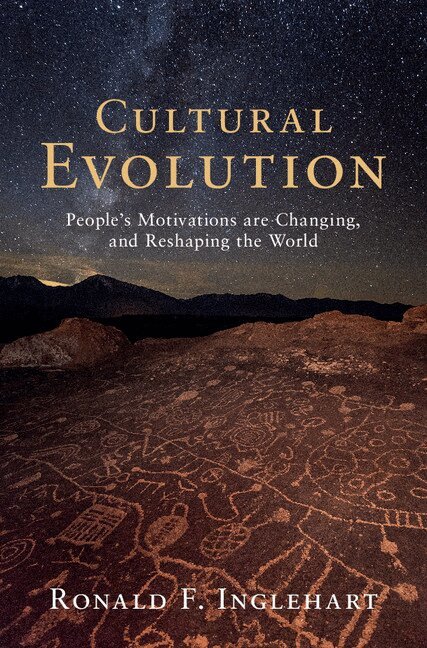
Cultural Evolution argues that people's values and behavior are shaped by the degree to which survival is secure; it was precarious for most of history, which encouraged heavy emphasis on group solidarity, rejection of outsiders, and obedience to strong leaders. For under extreme scarcity, xenophobia is realistic: if there is just enough land to support one tribe and another tribe tries to claim it, survival may literally be a choice between Us and Them. Conversely, high levels of existential security encourage openness to change, diversity, and new ideas. The unprecedented prosperity and security of the postwar era brought cultural change, the environmentalist movement, and the spread of democracy. But in recent decades, diminishing job security and rising inequality have led to an authoritarian reaction. Evidence from more than 100 countries demonstrates that people's motivations and behavior reflect the extent to which they take survival for granted - and that modernization changes them in roughly predictable ways. This book explains the rise of environmentalist parties, gender equality, and same-sex marriage through a new, empirically-tested version of modernization theory.
386 kr
Skickas inom 7-10 vardagar
Cultural Evolution argues that people's values and behavior are shaped by the degree to which survival is secure; it was precarious for most of history, which encouraged heavy emphasis on group solidarity, rejection of outsiders, and obedience to strong leaders. For under extreme scarcity, xenophobia is realistic: if there is just enough land to support one tribe and another tribe tries to claim it, survival may literally be a choice between Us and Them. Conversely, high levels of existential security encourage openness to change, diversity, and new ideas. The unprecedented prosperity and security of the postwar era brought cultural change, the environmentalist movement, and the spread of democracy. But in recent decades, diminishing job security and rising inequality have led to an authoritarian reaction. Evidence from more than 100 countries demonstrates that people's motivations and behavior reflect the extent to which they take survival for granted - and that modernization changes them in roughly predictable ways. This book explains the rise of environmentalist parties, gender equality, and same-sex marriage through a new, empirically-tested version of modernization theory.