Ronald H. Dolkart - Böcker
Visar alla böcker från författaren Ronald H. Dolkart. Handla med fri frakt och snabb leverans.
3 produkter
3 produkter
684 kr
Skickas inom 3-6 vardagar
Since 1943 the personality and legend of General Juan Domingo Peron have towered over the Argentine Republic. Yet until 1930 Argentina was widely regarded as the best example of democracy and prosperity on a politically turbulent and economically underdeveloped continent. The present collection of articles by American and Argentine scholars examines the thirteen critical years that separated the "old" Argentina from the "new," and made possible the rise of one of the most powerful dictators in Latin America. In a little over a decade wracked by depression and war, political democracy in Argentina collapsed and the landed aristocracy was restored to power; the traditional relationship between the British and Argentine economies deteriorated and no satisfactory alternative was found; a generalized disillusionment and pessimism led to a fascination by intellectuals with authoritarian ideologies; a new "nationalistic" consciousness became increasingly evident in films, radio, and popular music; and social and demographic changes produced the constituency for a messianic populism. This volume thus identifies the symptoms that eventually resulted into the eleven year reign and twenty year cult of Peronismo, symptoms which strongly influence the course of events in present-day Argentina. This title is part of UC Press's Voices Revived program, which commemorates University of California Press's mission to seek out and cultivate the brightest minds and give them voice, reach, and impact. Drawing on a backlist dating to 1893, Voices Revived makes high-quality, peer-reviewed scholarship accessible once again using print-on-demand technology. This title was originally published in 1975.
1 513 kr
Skickas inom 3-6 vardagar
Since 1943 the personality and legend of General Juan Domingo Peron have towered over the Argentine Republic. Yet until 1930 Argentina was widely regarded as the best example of democracy and prosperity on a politically turbulent and economically underdeveloped continent. The present collection of articles by American and Argentine scholars examines the thirteen critical years that separated the "old" Argentina from the "new," and made possible the rise of one of the most powerful dictators in Latin America. In a little over a decade wracked by depression and war, political democracy in Argentina collapsed and the landed aristocracy was restored to power; the traditional relationship between the British and Argentine economies deteriorated and no satisfactory alternative was found; a generalized disillusionment and pessimism led to a fascination by intellectuals with authoritarian ideologies; a new "nationalistic" consciousness became increasingly evident in films, radio, and popular music; and social and demographic changes produced the constituency for a messianic populism. This volume thus identifies the symptoms that eventually resulted into the eleven year reign and twenty year cult of Peronismo, symptoms which strongly influence the course of events in present-day Argentina. This title is part of UC Press's Voices Revived program, which commemorates University of California Press's mission to seek out and cultivate the brightest minds and give them voice, reach, and impact. Drawing on a backlist dating to 1893, Voices Revived makes high-quality, peer-reviewed scholarship accessible once again using print-on-demand technology. This title was originally published in 1975.
Argentine Right
Its History and Intellectual Origins, 1910 to the Present (Latin American Silhouettes)
Häftad, Engelska, 1992
528 kr
Skickas inom 10-15 vardagar
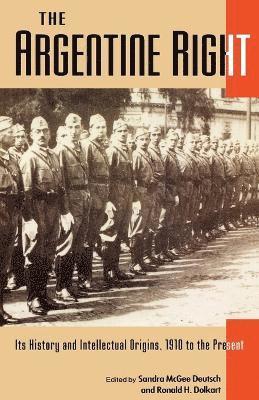
In "The Argentine Right: Its History and Intellectual Origins" scholars of Argentine and Latin American history chart the growth of the Right from its roots in 19th-century European political theory through to the collapse of the conservative government in the 1980s. The contributors describe the Right's development, uneasy alliance with Peronists, years of triumph and subsequent retreat to opposition status. Arguing that the Right was unified, if at all, by no more than a fear of the Left, the essays distinguish the many groups and individuals prominent in the conservative and "nacionalista" movements. The discussions refer frequently to parallel events in Europe, identifying differences and similarities, and allowing the reader to make comparisons. In the process, the authors refute the myth that the right was substantially influenced by the Nazi party and convincingly document instead the more prevalent relationship between the ideology of the Spanish Falangists and that of like-minded activists struggling for a purifying Argentine renewal.