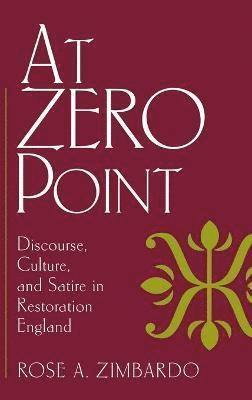
At Zero Point presents an entirely new way of looking at Restoration culture, discourse, and satire. The book locates a rupture in English culture and epistemology not at the end of the eighteenth century (when it occurred in France) but at the end of the seventeenth century. Rose Zimbardo's hypothesis is based on Hans Blumenberg's concept of "zero point" -- the moment when an epistemology collapses under the weight of questions it has itself raised and simultaneously a new epistemology begins to construct itself. Zimbardo demonstrates that the Restoration marked both the collapse of the Renaissance order and the birth of modernism (with its new conceptions of self, nation, gender, language, logic, subjectivity, and reality). Using satire as the site for her investigation, Zimbardo examines works by Rochester, Oldham, Wycherley, and the early Swift for examples of Restoration deconstructive satire that, she argues, measure the collapse of Renaissance epistemology. Constructive satire, as exemplified in works by Dryden, has at its discursive center the "I" from which all order arises to be projected to the external world. No other book treats Restoration culture or satire in this way.
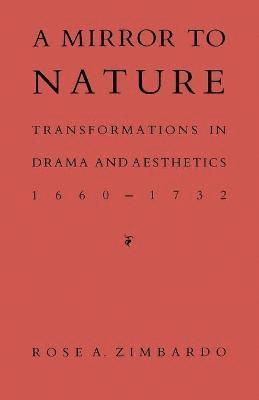
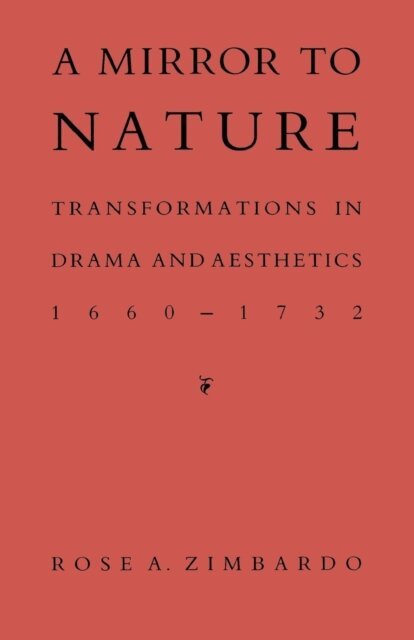
In this provocative study Rose Zimbardo examines a crucial revolution in aesthetics that took place in the late seventeenth century and that to this day dominates our response to literature. Although artists of that time continued to follow the precept "imitate nature," that nature no longer corresponds to the earlier understanding of the term. What had been in essence an allegorical mode came to be a literal one.Focusing on the drama of the period as an exemplary form, Zimbardo shows how it moved from depicting a metaphysical reality of idea to portraying an inner reality of individual experience. But drama is constrained in expressing the inner experience since its medium is limited to human action. The novel arose to replace drama as the popular literary form, Zimbardo argues, because it could better and more freely convey man's inner world and thereby imitate the "new" nature.The study concluded that the changes which took place in drama during this period and which led to the invention of the novel resulted not from any "change of heart" or sensibility but from a fundamental change in the understanding of the nature which art was thought to imitate. Neither the drama of the 1690s nor the early novel, Zimbardo finds, was in the least "sentimental."A Mirror to Nature brings a new critical perspective to bear on literary developments at the end of the seventeenth century -- one that must be considered by critics and historians of the period.
At Zero Point presents an entirely new way of looking at Restoration culture, discourse, and satire. The book locates a rupture in English culture and epistemology not at the end of the eighteenth century (when it occurred in France) but at the end of the seventeenth century. Rose Zimbardo's hypothesis is based on Hans Blumenberg's concept of "zero point"the moment when an epistemology collapses under the weight of questions it has itself raised and simultaneously a new epistemology begins to construct itself. Zimbardo demonstrates that the Restoration marked both the collapse of the Renaissance order and the birth of modernism (with its new conceptions of self, nation, gender, language, logic, subjectivity, and reality). Using satire as the site for her investigation, Zimbardo examines works by Rochester, Oldham, Wycherley, and the early Swift for examples of Restoration deconstructive satire that, she argues, measure the collapse of Renaissance epistemology. Constructive satire, as exemplified in works by Dryden, has at its discursive center the "I" from which all order arises to be projected to the external world. No other book treats Restoration culture or satire in this way.
In this provocative study Rose Zimbardo examines a crucial revolution in aesthetics that took place in the late seventeenth century and that to this day dominates our response to literature. Although artists of that time continued to follow the precept "imitate nature," that nature no longer corresponds to the earlier understanding of the term. What had been in essence an allegorical mode came to be a literal one.Focusing on the drama of the period as an exemplary form, Zimbardo shows how it moved from depicting a metaphysical reality of idea to portraying an inner reality of individual experience. But drama is constrained in expressing the inner experience since its medium is limited to human action. The novel arose to replace drama as the popular literary form, Zimbardo argues, because it could better and more freely convey man's inner world and thereby imitate the "new" nature.The study concluded that the changes which took place in drama during this period and which led to the invention of the novel resulted not from any "change of heart" or sensibility but from a fundamental change in the understanding of the nature which art was thought to imitate. Neither the drama of the 1690s nor the early novel, Zimbardo finds, was in the least "sentimental."A Mirror to Nature brings a new critical perspective to bear on literary developments at the end of the seventeenth centuryone that must be considered by critics and historians of the period.