Rosemary Wright - Böcker
Visar alla böcker från författaren Rosemary Wright. Handla med fri frakt och snabb leverans.
5 produkter
5 produkter
2 104 kr
Skickas inom 10-15 vardagar
The popularity of Stephen Hawking's work has put cosmology back in the public eye. The question of how the universe began, and why it hangs together, still puzzles scientists. Their puzzlement began two and a half thousand years ago when Greek philosophers first 'looked up at the sky and formed a theory of everything.' Though their solutions are little credited today, the questions remain fresh.The early Greek thinkers struggled to come to terms with and explain the totality of their surroundings; to identitify an original substance from which the universe was compounded; and to reconcile the presence of balance and proportion with the apparent disorder of the universe.Rosemary Wright examines the cosmological theories of the `natural philosophers' from Thales, Anaximander and Anaximenes to Plato, the Stoics and the NeoPlatonists. The importance of Babylonian and Egyptian forerunners is emphasised.Cosmology in Antiquity is a comprehensive introduction to the cosmological thought of antiquity, the first such survey since Neugebauer's work of 1962.
592 kr
Skickas inom 10-15 vardagar
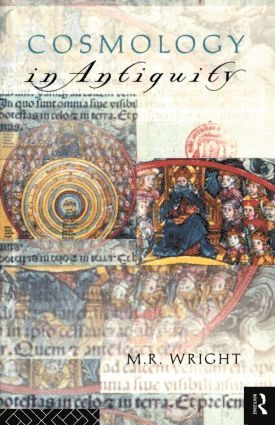
The popularity of Stephen Hawking's work has put cosmology back in the public eye. The question of how the universe began, and why it hangs together, still puzzles scientists. Their puzzlement began two and a half thousand years ago when Greek philosophers first 'looked up at the sky and formed a theory of everything.' Though their solutions are little credited today, the questions remain fresh.The early Greek thinkers struggled to come to terms with and explain the totality of their surroundings; to identitify an original substance from which the universe was compounded; and to reconcile the presence of balance and proportion with the apparent disorder of the universe.Rosemary Wright examines the cosmological theories of the `natural philosophers' from Thales, Anaximander and Anaximenes to Plato, the Stoics and the NeoPlatonists. The importance of Babylonian and Egyptian forerunners is emphasised.Cosmology in Antiquity is a comprehensive introduction to the cosmological thought of antiquity, the first such survey since Neugebauer's work of 1962.

249 kr
Skickas inom 5-8 vardagar
2 240 kr
Skickas inom 10-15 vardagar
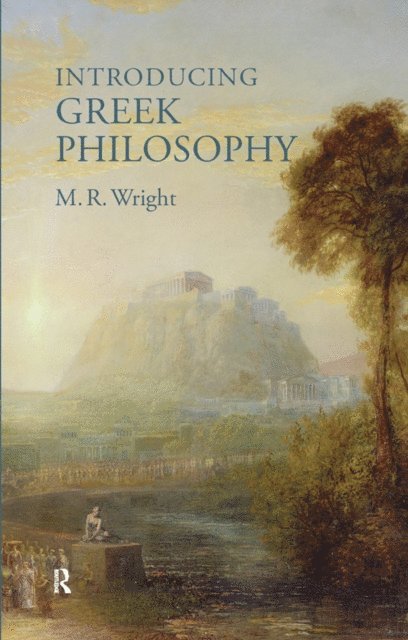
Aimed at students of classics and of philosophy who would like a taste of the subject before being committed to a full course and at those who have already started and need to find their bearings in what may seem at first a complex maze of names and schools, "Introducing Greek Philosophy" is a concise, lively, philosophically aware introduction to ancient Greek philosophy. The book begins with the Milesians in Asia Minor before moving over to the developments in the western Greek world, then focusing on Socrates, Plato and Aristotle in Athens, finishing with the Hellenistic schools and their arrival in Rome, where the main ideas are set out in the Latin poetry of Lucretius and the prose of Cicero.The book eschews the method of most histories of ancient philosophy of addressing one thinker after another through the centuries. Instead, after a basic mapping of the territory, it takes the great themes that the Greeks were engaged in from the earliest times, and looks at them individually, their development in argument and counter-argument, from the beginnings of recorded Greek history, through the various upheavals of tyrannies, democracies, oligarchies and kingships, to their introduction into Rome in the first century BC.
562 kr
Skickas inom 10-15 vardagar
Aimed at students of classics and of philosophy who would like a taste of the subject before being committed to a full course and at those who have already started and need to find their bearings in what may seem at first a complex maze of names and schools, "Introducing Greek Philosophy" is a concise, lively, philosophically aware introduction to ancient Greek philosophy. The book begins with the Milesians in Asia Minor before moving over to the developments in the western Greek world, then focusing on Socrates, Plato and Aristotle in Athens, finishing with the Hellenistic schools and their arrival in Rome, where the main ideas are set out in the Latin poetry of Lucretius and the prose of Cicero.The book eschews the method of most histories of ancient philosophy of addressing one thinker after another through the centuries. Instead, after a basic mapping of the territory, it takes the great themes that the Greeks were engaged in from the earliest times, and looks at them individually, their development in argument and counter-argument, from the beginnings of recorded Greek history, through the various upheavals of tyrannies, democracies, oligarchies and kingships, to their introduction into Rome in the first century BC.