Ross M. Starr – författare
Visar alla böcker från författaren Ross M. Starr. Handla med fri frakt och snabb leverans.
11 produkter
11 produkter
Häftad, Engelska, 2008
462 kr
Skickas inom 7-10 vardagar
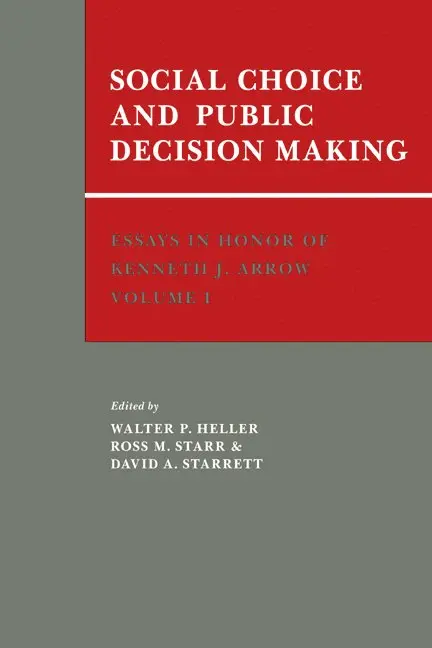
Professor Kenneth J. Arrow is one of the most distinguished economic theorists. He has played a major role in shaping the subject and is honoured by the publication of three volumes of essays on economic theory. Each volume deals with a different area of economic theory. The books include contributions by some of the best economic theorists from the United States, Japan, Israel and Europe.
Häftad, Engelska, 2008
609 kr
Skickas inom 7-10 vardagar
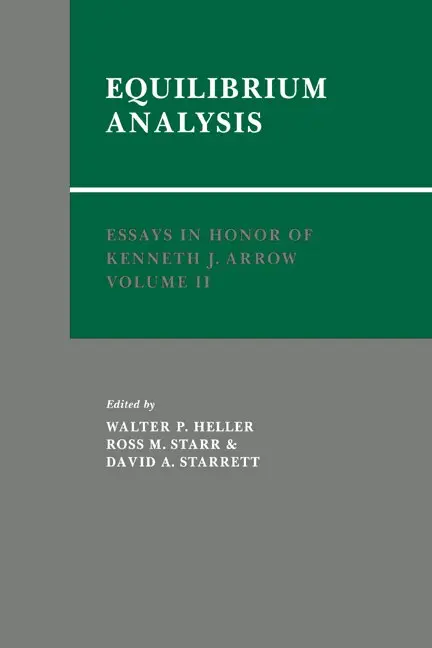
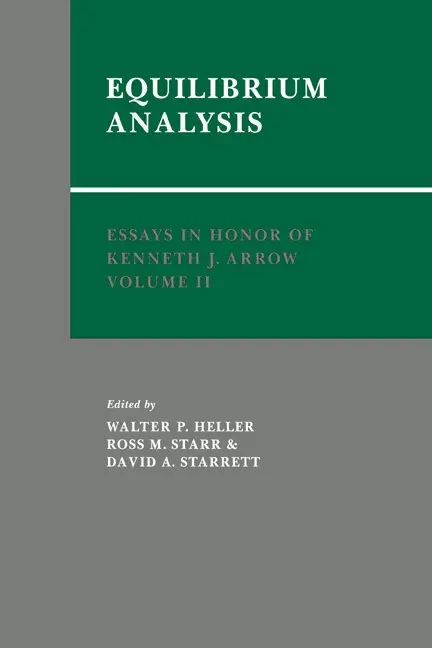
Professor Kenneth J. Arrow is one of the most distinguished economic theorists. He has played a major role in shaping the subject and is honoured by the publication of three volumes of essays on economic theory. Each volume deals with a different area of economic theory. The books include contributions by some of the best economic theorists from the United Stated, Japan, Israel and Europe. This second volume is entitled Equilibrium Analysis and is divided into sections on general equilibrium and on the microfoundations of macroeconomics.
Häftad, Engelska, 2008
582 kr
Skickas inom 7-10 vardagar
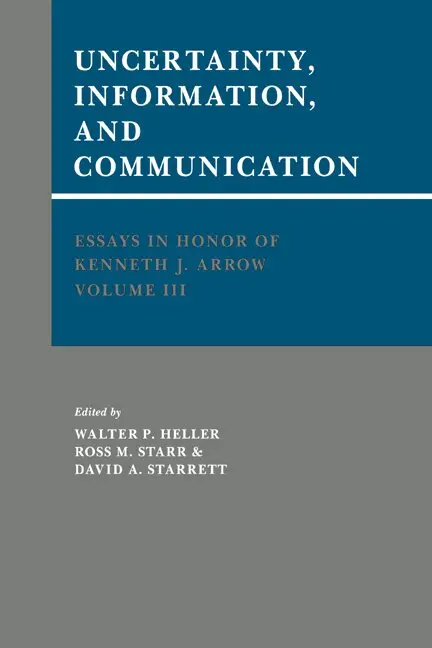
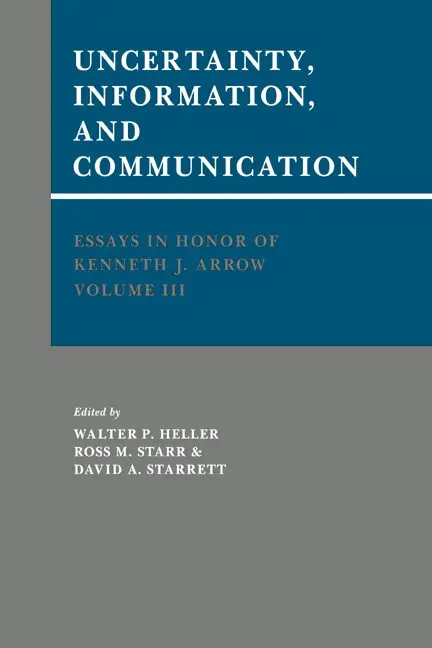
Professor Kenneth J. Arrow is one of the most distinguished economic theorists. He has played a major role in shaping the subject and is honoured by the publication of three volumes of essays on economic theory. Each volume deals with a different area of economic theory. The books include contributions by some of the best economic theorists from the United Stated, Japan, Israel and Europe. This third volume is entitled Uncertainty, Information, and Communication.
Inbunden, Engelska, 1986
1 411 kr
Skickas inom 7-10 vardagar
Professor Kenneth J. Arrow is one of the most distinguished economic theorists. He has played a major role in shaping the subject and is honoured by the publication of three volumes of essays on economic theory. Each volume deals with a different area of economic theory. The books include contributions by some of the best economic theorists from the United States, Japan, Israel and Europe.
Inbunden, Engelska, 1986
1 691 kr
Skickas inom 7-10 vardagar
Professor Kenneth J. Arrow is one of the most distinguished economic theorists. He has played a major role in shaping the subject and is honoured by the publication of three volumes of essays on economic theory. Each volume deals with a different area of economic theory. The books include contributions by some of the best economic theorists from the United Stated, Japan, Israel and Europe. This second volume is entitled Equilibrium Analysis and is divided into sections on general equilibrium and on the microfoundations of macroeconomics.
Inbunden, Engelska, 1986
1 678 kr
Skickas inom 7-10 vardagar
Professor Kenneth J. Arrow is one of the most distinguished economic theorists. He has played a major role in shaping the subject and is honoured by the publication of three volumes of essays on economic theory. Each volume deals with a different area of economic theory. The books include contributions by some of the best economic theorists from the United Stated, Japan, Israel and Europe. This third volume is entitled Uncertainty, Information, and Communication.
Häftad, Engelska, 2011
600 kr
Skickas inom 7-10 vardagar
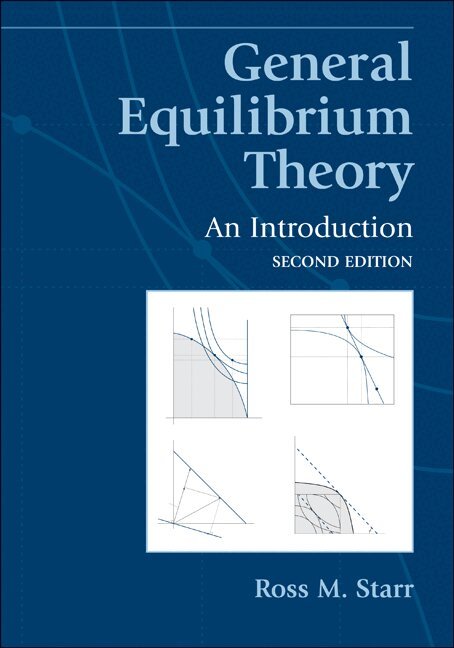
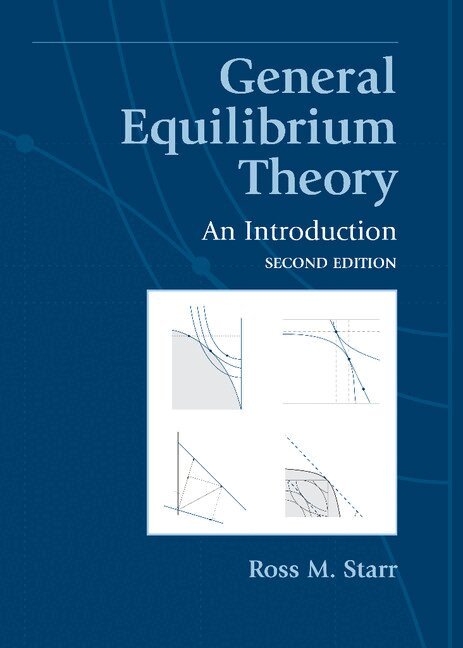
General Equilibrium Theory: An Introduction presents the mathematical economic theory of price determination and resource allocation from elementary to advanced levels, suitable for advanced undergraduates and graduate students of economics. This Arrow-Debreu model (known for two of its most prominent founders, both Nobel Laureates) is the basis of modern price theory and of a wide range of applications. The new edition updates discussion throughout and expands the number and variety of exercises. It offers a revised and extended treatment of core convergence, including the case of non-convex preferences, and introduces the investigation of approximate equilibrium with U-shaped curves and non-convex preferences.
Inbunden, Engelska, 2011
1 311 kr
Skickas inom 7-10 vardagar
General Equilibrium Theory: An Introduction presents the mathematical economic theory of price determination and resource allocation from elementary to advanced levels, suitable for advanced undergraduates and graduate students of economics. This Arrow-Debreu model (known for two of its most prominent founders, both Nobel Laureates) is the basis of modern price theory and of a wide range of applications. The new edition updates discussion throughout and expands the number and variety of exercises. It offers a revised and extended treatment of core convergence, including the case of non-convex preferences, and introduces the investigation of approximate equilibrium with U-shaped curves and non-convex preferences.
General Equilibrium Models of Monetary Economies
Studies in the Static Foundations of Monetary Theory
E-bok
PDF, Engelska, 2014779 kr
Läs direkt efter köp
General Equilibrium Models of Monetary Economies: Studies in the Static Foundations of Monetary Theory is a collection of essays that addresses the integration of the theory of money and the theory of value by using a mathematical general equilibrium theory. The papers discuss monetary theory, microeconomic theory, bilateral trade, transactions costs, intertemporal allocation, and the value of money. The Arrow-Debreu model of Walrasian general equilibrium theory provides a framework to represent money as a device for facilitating trade among economic agents without the use of money as a medium of exchange and as a store of value. The essays analyze the rationale for using a medium of exchange, for using a store of value, and for holding of idle balances in equilibrium. The essays show that by explicit modeling of the structure and difficulties of trade, a powerful class of models which deny money and finance a role in the economy, has by itself shown to have provided the foundation for the structures of trade. The collection will prove helpful for economists, statistician, mathematicians, students or professors of economics and business.
Häftad, Engelska, 2013
534 kr
Skickas inom 5-8 vardagar
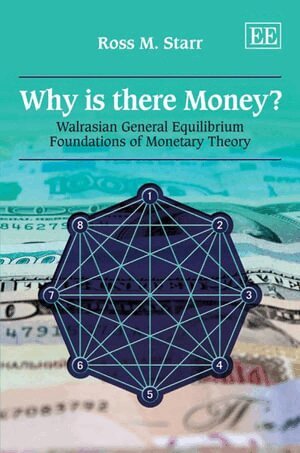
The microeconomic foundation of the theory of money has long represented a puzzle to economic theory. Why is there Money? derives the foundations of monetary theory from advanced price theory in a mathematically precise family of trading post models. It has long been recognized that the fundamental theoretical analysis of a market economy is embodied in the Arrow-Debreu-Walras mathematical general equilibrium model, with one great deficiency: the analysis cannot accommodate money and financial institutions. In this groundbreaking book, Ross M. Starr addresses this problem directly, by expanding the Arrow-Debreu model to include a multiplicity of trading opportunities, with the resultant endogenous derivation of money as the carrier of value among them. This fundamental breakthrough is achieved while maintaining the Walrasian general equilibrium price-theoretic structure, augmented primarily by the introduction of separate bid and ask prices reflecting transaction costs. The result is foundations of monetary theory consistent with and derived from modern price theory. This fascinating book will provide a stimulating and thought-provoking read for academics and postgraduate students focusing on economics, macroeconomics, macroeconomic policy and finance, money and banking. Central bankers will also find much to interest them within this book. Contents: Introduction: Why is There No Money? 1. Why is There Money? 2. An Economy Without Money 3. The Trading Post Model 4. An Elementary Linear Example: Liquidity Creates Money 5. Absence of Double Coincidence of Wants is Essential to Monetization in a Linear Economy 6. Uniqueness of Money: Scale Economy and Network Externality 7. Monetization of General Equilibrium 8. Government-Issued Fiat Money 9. Efficient Structure of Exchange 10. Microfoundations of Jevons's Double Coincidence Condition 11. Commodity Money Equilibrium in a Convex Trading Post Economy 12. Efficiency of Commodity Money Equilibrium 13. Alternative Models 14. Conclusion and a Research Agenda Bibliography Index
Inbunden, Engelska, 2012
1 609 kr
Skickas inom 5-8 vardagar
The microeconomic foundation of the theory of money has long represented a puzzle to economic theory. Why is there Money? derives the foundations of monetary theory from advanced price theory in a mathematically precise family of trading post models. It has long been recognized that the fundamental theoretical analysis of a market economy is embodied in the Arrow-Debreu-Walras mathematical general equilibrium model, with one great deficiency: the analysis cannot accommodate money and financial institutions. In this groundbreaking book, Ross M. Starr addresses this problem directly, by expanding the Arrow-Debreu model to include a multiplicity of trading opportunities, with the resultant endogenous derivation of money as the carrier of value among them. This fundamental breakthrough is achieved while maintaining the Walrasian general equilibrium price-theoretic structure, augmented primarily by the introduction of separate bid and ask prices reflecting transaction costs. The result is foundations of monetary theory consistent with and derived from modern price theory. This fascinating book will provide a stimulating and thought-provoking read for academics and postgraduate students focusing on economics, macroeconomics, macroeconomic policy and finance, money and banking. Central bankers will also find much to interest them within this book. Contents: Introduction: Why is There No Money? 1. Why is There Money? 2. An Economy Without Money 3. The Trading Post Model 4. An Elementary Linear Example: Liquidity Creates Money 5. Absence of Double Coincidence of Wants is Essential to Monetization in a Linear Economy 6. Uniqueness of Money: Scale Economy and Network Externality 7. Monetization of General Equilibrium 8. Government-Issued Fiat Money 9. Efficient Structure of Exchange 10. Microfoundations of Jevons's Double Coincidence Condition 11. Commodity Money Equilibrium in a Convex Trading Post Economy 12. Efficiency of Commodity Money Equilibrium 13. Alternative Models 14. Conclusion and a Research Agenda Bibliography Index