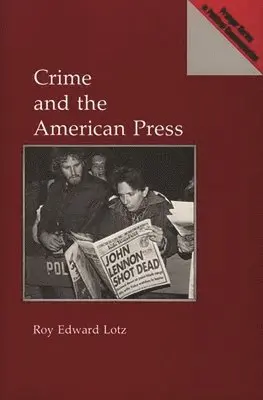
In this study of many mainstream newspapers, Roy Edward Lotz investigates the ample space American papers devote to crime. He also examines the justifications and criticisms this phenomenon has generated. Lotz finds that 30 percent of the front-page stories contain tales of police, courts, and criminals. He concludes that crime reporting neither serves the functions nor has the negative effects that are often attributed to it.Lotz discusses the functions and dysfunctions of crime reporting, the ideological biases of crime news, and the balance between coverage of explosive events and the less dramatic news of courts and prisons. In the beginning, he analyzes the front pages of four mainstream newspapers: the Chicago Tribune, the Los Angeles Times, the Philadelphia Inquirer and the New Orleans Times-Picayune. Lotz finds that coverage of courts and prisons has been more thorough and unbiased than expected. This highly readable book is of interest to journalists and specialists in crime, politics, public opinion, and mass communication.
Long ago, a man from La Mancha went insane by consuming too many tales of knight-errantry. Today, this madness has spread to half our population; victims of podcasts, forums, blogs, and social media. Enter Don Bigote-a man born to be a hero yet confused about the villain. Accompanied by his reluctant assistant, Dan Chopin, the moustachioed crusader sets out to rescue Western Civilization from the great conspiracy that may or may not threaten it. Will he save us all, or merely tilt at windmills?
In this study of many mainstream newspapers, Roy Edward Lotz investigates the ample space American papers devote to crime. He also examines the justifications and criticisms this phenomenon has generated. Lotz finds that 30 percent of the front-page stories contain tales of police, courts, and criminals. He concludes that crime reporting neither serves the functions nor has the negative effects that are often attributed to it.Lotz discusses the functions and dysfunctions of crime reporting, the ideological biases of crime news, and the balance between coverage of explosive events and the less dramatic news of courts and prisons. In the beginning, he analyzes the front pages of four mainstream newspapers: the Chicago Tribune, the Los Angeles Times, the Philadelphia Inquirer and the New Orleans Times-Picayune. Lotz finds that coverage of courts and prisons has been more thorough and unbiased than expected. This highly readable book is of interest to journalists and specialists in crime, politics, public opinion, and mass communication.
Long ago, a man from La Mancha went insane by consuming too many tales of knight-errantry. Today, this madness has spread to half our population; victims of podcasts, forums, blogs, and social media. Enter Don Bigote-a man born to be a hero yet confused about the villain. Accompanied by his reluctant assistant, Dan Chopin, the moustachioed crusader sets out to rescue Western Civilization from the great conspiracy that may or may not threaten it. Will he save us all, or merely tilt at windmills?