Royden Loewen - Böcker
Visar alla böcker från författaren Royden Loewen. Handla med fri frakt och snabb leverans.
10 produkter
10 produkter
Family, Church, and Market
A Mennonite Community in the Old and the New Worlds, 1850-1930
Häftad, Engelska, 1993
398 kr
Skickas inom 5-8 vardagar
In 1874, a group of nine hundred Mennonites migrated from Russia to the western plains of Canada and the United States, settling in and around Steinbach, Manitoba, and Jansen, Nebraska. This social hsitory shows how these conservative, German-speaking farm families adapted to an increasingly urbanized and industrialized world. Royden Loewen examines how the men and women of this immigrant group decised strategies to maintain familiar social structures and cultural patters within a changing society. Because these Mennonites were highly literate, leaving a rich array of diaries, letters, and memoirs, their everyday lives and ethnic self-perceptions can be reconstituted in detail. Loewen's account tells of three generations of Mennonites for whom the farm family was the primary social unit. The sectarian, lay-oriented church congregation interpreted life's meaning and enforced strict social boundaries on the community level. These traditionalist were coupled with a sensitive adaptation to the market economy of the outside world.
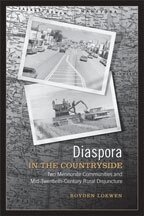
Diaspora in the Countryside
Two Mennonite Communities and Mid-Twentieth Century Rural Disjuncture
Inbunden, Engelska, 2006
970 kr
Skickas inom 11-20 vardagar
From the 1930s to the 1980s, the North American countryside faced a profound cultural transformation in which a once-unified rural society became fragmented and dispersed. Families wishing to remain on the farm were required to accept new levels of automation, while others, unwilling or unable to make the change, migrated to nearby towns or regional cities. The cultural reformulation that resulted saw the emergence of a genuine rural diaspora. The growing cultural and physical separation was especially true for close-knit, ethno-religious communities, Mennonites, in particular. Forced into regional cities, the kaleidoscopic urban culture further fragmented the Mennonites into disparate social entities.In Diaspora in the Countryside, the phenomena of rural fragmentation is examined by comparing and contrasting two closely-related but distinctive Dutch-Russian Mennonite communities located in different parts of the continent: Kansas and Manitoba, respectively. By systematically comparing these communities, two distinctive responses to the mid-twentieth century 'Great Disjuncture' are made apparent. Royden Loewen also contrasts the cultural changes of these farm families to the cultures their kin adopted in nearby towns and cities. Loewen charts not only the dispersion of two rural communities, but follows their former residents as they reformulate their lives in new settings.
371 kr
Skickas inom 7-10 vardagar
Over the course of the twentieth century, sequential waves of immigrants from Europe, Asia, Latin America, and Africa settled in the cities of the Canadian Prairies. In Immigrants in Prairie Cities, Royden Loewen and Gerald Friesen analyze the processes of cultural interaction and adaptation that unfolded in these urban centres and describe how this model of diversity has changed over time. The authors argue that intimate Prairie cities fostered a form of social diversity characterized by vibrant ethnic networks, continuously evolving ethnic identities, and boundary zones that facilitated intercultural contact and hybridity.Impressive in scope, Immigrants in Prairie Cities spans the entire twentieth century, and encompasses personal testimonies, government perspectives, and even fictional narratives. This engaging work will appeal to both historians of the Canadian Prairies and those with a general interest in migration, cross-cultural exchange, and urban history.
695 kr
Skickas inom 7-10 vardagar
Over the course of the twentieth century, sequential waves of immigrants from Europe, Asia, Latin America, and Africa settled in the cities of the Canadian Prairies. In Immigrants in Prairie Cities, Royden Loewen and Gerald Friesen analyze the processes of cultural interaction and adaptation that unfolded in these urban centres and describe how this model of diversity has changed over time. The authors argue that intimate Prairie cities fostered a form of social diversity characterized by vibrant ethnic networks, continuously evolving ethnic identities, and boundary zones that facilitated intercultural contact and hybridity.Impressive in scope, Immigrants in Prairie Cities spans the entire twentieth century, and encompasses personal testimonies, government perspectives, and even fictional narratives. This engaging work will appeal to both historians of the Canadian Prairies and those with a general interest in migration, cross-cultural exchange, and urban history.
751 kr
Skickas inom 10-15 vardagar
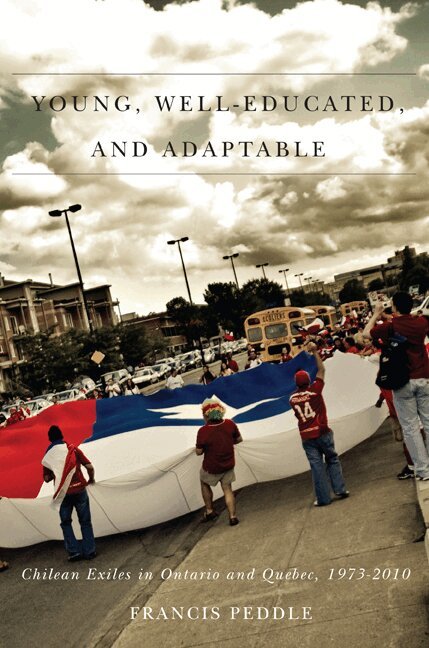
Young, Well-Educated, and Adaptable
Chilean Exiles in Ontario and Quebec, 1973-2010
Häftad, Engelska, 2014
349 kr
Skickas inom 10-15 vardagar
326 kr
Skickas inom 10-15 vardagar
562 kr
Skickas inom 7-10 vardagar
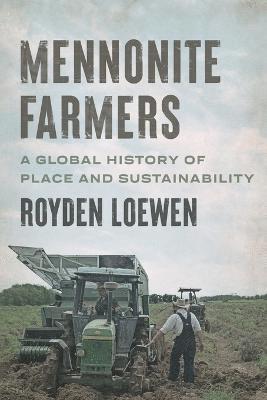
A comparative global history of Mennonites from the ground up.Winner of the Dale W. Brown Book Award for Outstanding Scholarship in Anabaptist and Pietist Studies, Shortlisted for the Wallace K. Ferguson Prize by the Canadian Historical Association, Nominee of the Margaret McWilliams Award by the Manitoba Historical SocietyMennonite farmers can be found in dozens of countries spanning five continents. In this comparative world-scale environmental history, Royden Loewen draws on a multi-year study of seven geographically distinctive Anabaptist communities around the world, focusing on Mennonite farmers in Bolivia, Canada, Indonesia, the Netherlands, Russia, the United States, and Zimbabwe. These farmers, who include Amish, Brethren in Christ, and Siberian Baptists, till the land in starkly distinctive climates. They absorb very disparate societal lessons while being shaped by particular faith outlooks, historical memory, and the natural environment. The book reveals the ways in which modern-day Mennonite farmers have adjusted to diverse temperatures, precipitation, soil types, and relative degrees of climate change. These farmers have faced broad global forces of modernization during the twentieth and early twenty-first centuries, from commodity markets and intrusive governments to technologies marked increasingly by the mechanical, chemical, and genetic. Based on more than 150 interviews and close textual analysis of memoirs, newspapers, and sermons, the narrative follows, among others, Zandile Nyandeni of Matopo as she hoes the spring-fed soils of Matabeleland's semi-arid savannah; Vladimir Friesen of Apollonovka, Siberia, who no longer heeds the dictates of industrial time of the Soviet-era state farm; and Abram Enns of Riva Palacio, Bolivia, who tells how he, a horse-and-buggy traditionalist, hired bulldozers to clear-cut a farm in the eastern lowland forests to grow soybeans, initially leading to dust bowl conditions. As Mennonites, Loewen writes, these farmers were raised with knowledge of the historic Anabaptist teachings on community, simplicity, and peace that stood alongside ideas on place and sustainability. Nonetheless, conditioned by gender, class, ethnicity, race, and local values, they put their agricultural ideas into practice in remarkably diverse ways. Mennonite Farmers is a pioneering work that brings faith into conversation with the land in distinctive ways.
Village Among Nations
"Canadian" Mennonites in a Transnational World, 1916-2006
Häftad, Engelska, 2013
412 kr
Skickas inom 7-10 vardagar
Between the 1920s and the 1940s, 10,000 traditionalist Mennonites emigrated from western Canada to isolated rural sections of Northern Mexico and the Paraguayan Chaco; over the course of the twentieth century, they became increasingly scattered through secondary migrations to East Paraguay, British Honduras, Bolivia, and elsewhere in Latin America. Despite this dispersion, these Canadian-descendant Mennonites, who now number around 250,000, developed a rich transnational culture over the years, resisting allegiance to any one nation and cultivating a strong sense of common peoplehood based on a history of migration, nonviolence, and distinct language and dress.Village among Nations recuperates a missing chapter of Canadian history: the story of these Mennonites who emigrated from Canada for cultural reasons, but then in later generations “returned” in large numbers for economic and social security. Royden Loewen analyzes a wide variety of texts, by men and women – letters, memoirs, reflections on family debates on land settlement, exchanges with curious outsiders, and deliberations on issues of citizenship. They relate the untold experience of this uniquely transnational, ethno-religious community.
Village Among Nations
"Canadian" Mennonites in a Transnational World, 1916-2006
Inbunden, Engelska, 2013
790 kr
Skickas inom 7-10 vardagar
Between the 1920s and the 1940s, 10,000 traditionalist Mennonites emigrated from western Canada to isolated rural sections of Northern Mexico and the Paraguayan Chaco; over the course of the twentieth century, they became increasingly scattered through secondary migrations to East Paraguay, British Honduras, Bolivia, and elsewhere in Latin America. Despite this dispersion, these Canadian-descendant Mennonites, who now number around 250,000, developed a rich transnational culture over the years, resisting allegiance to any one nation and cultivating a strong sense of common peoplehood based on a history of migration, nonviolence, and distinct language and dress.Village among Nations recuperates a missing chapter of Canadian history: the story of these Mennonites who emigrated from Canada for cultural reasons, but then in later generations “returned” in large numbers for economic and social security. Royden Loewen analyzes a wide variety of texts, by men and women – letters, memoirs, reflections on family debates on land settlement, exchanges with curious outsiders, and deliberations on issues of citizenship. They relate the untold experience of this uniquely transnational, ethno-religious community.