Ruan Da – författare
Visar alla böcker från författaren Ruan Da. Handla med fri frakt och snabb leverans.
9 produkter
LINGUISTIC VALUES BASED INTELLIGENT INFORMATION PROCESSING: THEORY, METHODS AND APPLICATIONS
Inbunden, 2010
1878 kr
Lägg i varukorg
This book focuses on systematic and intelligent information processing theories and methods based on linguistic values. The main contents include topics such as the 2-tuple model of linguistic values, 2-tuple linguistic aggregation operator hedge algebras, complete hedge algebras and linguistic …
LINGUISTIC VALUES BASED INTELLIGENT INFORMATION PROCESSING
E-bok, 2010
1284 kr
Lägg i varukorg
Humans employ mostly natural languages in describing and representing problems, c- puting and reasoning, arriving at ?nal conclusions described similarly as words in a natural language or as the form of mental perceptions. To make machines imitate humans’ mental activities, the key point in terms …
COMPUTATIONAL INTELLIGENCE IN COMPLEX DECISION MAKING SYSTEMS
Av Ruan Da
E-bok, 2010
1243 kr
Lägg i varukorg
In recent years, there has been a growing interest in the need for designing intelligent systems to address complex decision systems. One of the most challenging issues for the intelligent system is to effectively handle real-world uncertainties that cannot be eliminated. These uncertainties …
COMPUTATIONAL INTELLIGENCE: FOUNDATIONS AND APPLICATIONS - PROCEEDINGS OF THE 9TH INTERNATIONAL FLINS CONFERENCE
Inbunden, 2010
5482 kr
Lägg i varukorg
FLINS, originally an acronym for Fuzzy Logic and Intelligent Technologies in Nuclear Science, is now extended to Computational Intelligence for applied research. The contributions to the ninth in the series of FLINS conferences cover state-of-the-art research, development, and technology for …
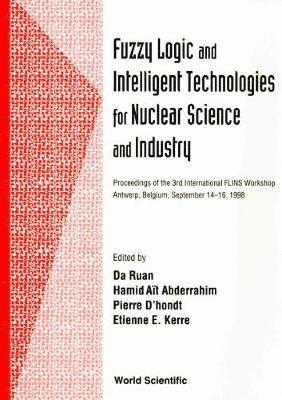
FUZZY LOGIC AND INTELLIGENT TECHNOLOGIES FOR NUCLEAR SCIENCE AND INDUSTRY - PROCEEDINGS OF THE 3RD INTERNATIONAL FLINS WORKSHOP
Inbunden, 1998
2915 kr
Tillfälligt slut
Following FLINS '94 and FLINS '96, the first and second International Workshops on Fuzzy Logic and Intelligent Technologies in Nuclear Science, FLINS '98 covers recent developments, both of a foundational and applicational character, in the fields of intelligent techniques such as fuzzy logic, …
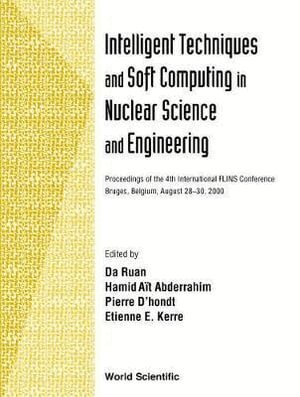
INTELLIGENT TECHNIQUES AND SOFT COMPUTING IN NUCLEAR SCIENCE AND ENGINEERING - PROCEEDINGS OF THE 4TH INTERNATIONAL FLINS CONFERENCE
Inbunden, 2000
3024 kr
Tillfälligt slut
This book is divided into three parts. The first part, “Mathematical Tools and New Developments”, provides basic tools to treat fuzzy set theory, rough set theory, fuzzy control, fuzzy modelling, decision support systems, and related applications. The second part, “Intelligent Engineering …
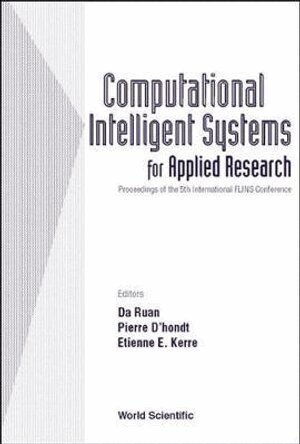
COMPUTATIONAL INTELLIGENT SYSTEMS FOR APPLIED RESEARCH, PROCEEDINGS OF THE 5TH INTERNATIONAL FLINS CONFERENCE (FLINS 2002)
Inbunden, 2002
3459 kr
Tillfälligt slut
FLINS is an acronym for Fuzzy Logic and Intelligent Technologies in Nuclear Science. FLINS 2002 is the fifth in a series of FLINS conferences and covers state-of-the-art research and development in computational intelligence for applied research in general and for nuclear science and engineering in …
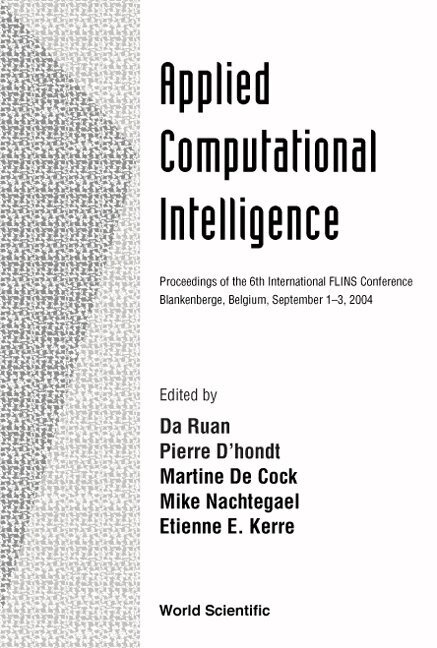
APPLIED COMPUTATIONAL INTELLIGENCE, PROCEEDINGS OF THE 6TH INTERNATIONAL FLINS CONFERENCE
Inbunden, 2004
4552 kr
Tillfälligt slut
FLINS, originally an acronym for “Fuzzy Logic and Intelligent technologies in Nuclear Science”, has now been extended to include computational intelligent systems for applied research. FLINS 2004, is the sixth in a series of international conferences, covers state-of-the-art research and …
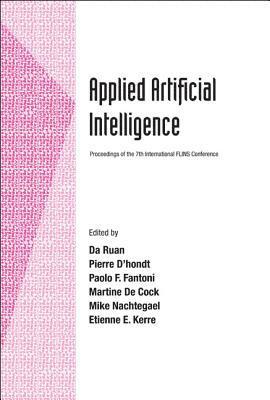
APPLIED ARTIFICIAL INTELLIGENCE - PROCEEDINGS OF THE 7TH INTERNATIONAL FLINS CONFERENCE
Inbunden, 2006
6083 kr
Tillfälligt slut
FLINS, originally an acronym for Fuzzy Logic and Intelligent Technologies in Nuclear Science, is now extended to Applied Artificial Intelligence for Applied Research. The contributions to the seventh in the series of FLINS conferences contained in this volume cover state-of-the-art research and …