Ruchira Ganguly-Scrase - Böcker
Visar alla böcker från författaren Ruchira Ganguly-Scrase. Handla med fri frakt och snabb leverans.
4 produkter
4 produkter
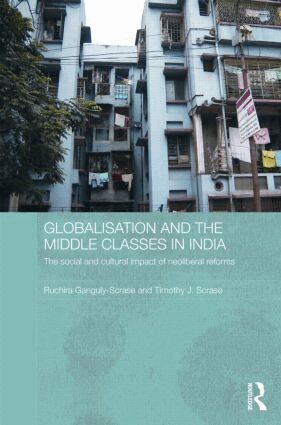
Globalisation and the Middle Classes in India
The Social and Cultural Impact of Neoliberal Reforms
Inbunden, Engelska, 2008
1 355 kr
Skickas inom 10-15 vardagar
This book fills an important gap in the existing literature on economic liberalization and globalisation in India by providing much needed ethnographic data from those affected by neoliberal globalisation. Based on ethnographic fieldwork and interviews, it reveals the complexity of the globalisation process and describes and accounts for the contradictory attitudes of the lower middle classes. The authors challenge the notion of a homogeneous Indian middle class as being the undoubted beneficiaries of recent neoliberal economic reforms, showing that while the lower middle classes are generally supportive of the recent economic reforms, they remain doubtful about the long term benefits of the country's New Economic Policy and liberalisation. Significantly, this book discusses and analyzes both the economic and cultural sides to globalisation in India, providing much-needed data in relation to several dimensions including the changing costs of living; household expenditure, debt and consumerism; employment and workplace restructuring; gender relations and girls’ education; global media and satellite television; and the significance of English in a globalising India.Globalisation and the Middle Classes in India will be of interest to scholars and students working in the fields of Sociology, Social Anthropology and Development Studies, as well as Asian Studies - in particular studies of South Asia and India - and Globalisation Studies.
Globalisation and the Middle Classes in India
The Social and Cultural Impact of Neoliberal Reforms
Häftad, Engelska, 2010
519 kr
Skickas inom 10-15 vardagar
This book fills an important gap in the existing literature on economic liberalization and globalisation in India by providing much needed ethnographic data from those affected by neoliberal globalisation. Based on ethnographic fieldwork and interviews, it reveals the complexity of the globalisation process and describes and accounts for the contradictory attitudes of the lower middle classes. The authors challenge the notion of a homogeneous Indian middle class as being the undoubted beneficiaries of recent neoliberal economic reforms, showing that while the lower middle classes are generally supportive of the recent economic reforms, they remain doubtful about the long term benefits of the country's New Economic Policy and liberalisation. Significantly, this book discusses and analyzes both the economic and cultural sides to globalisation in India, providing much-needed data in relation to several dimensions including the changing costs of living; household expenditure, debt and consumerism; employment and workplace restructuring; gender relations and girls’ education; global media and satellite television; and the significance of English in a globalising India.Globalisation and the Middle Classes in India will be of interest to scholars and students working in the fields of Sociology, Social Anthropology and Development Studies, as well as Asian Studies - in particular studies of South Asia and India - and Globalisation Studies.
748 kr
Skickas inom 10-15 vardagar
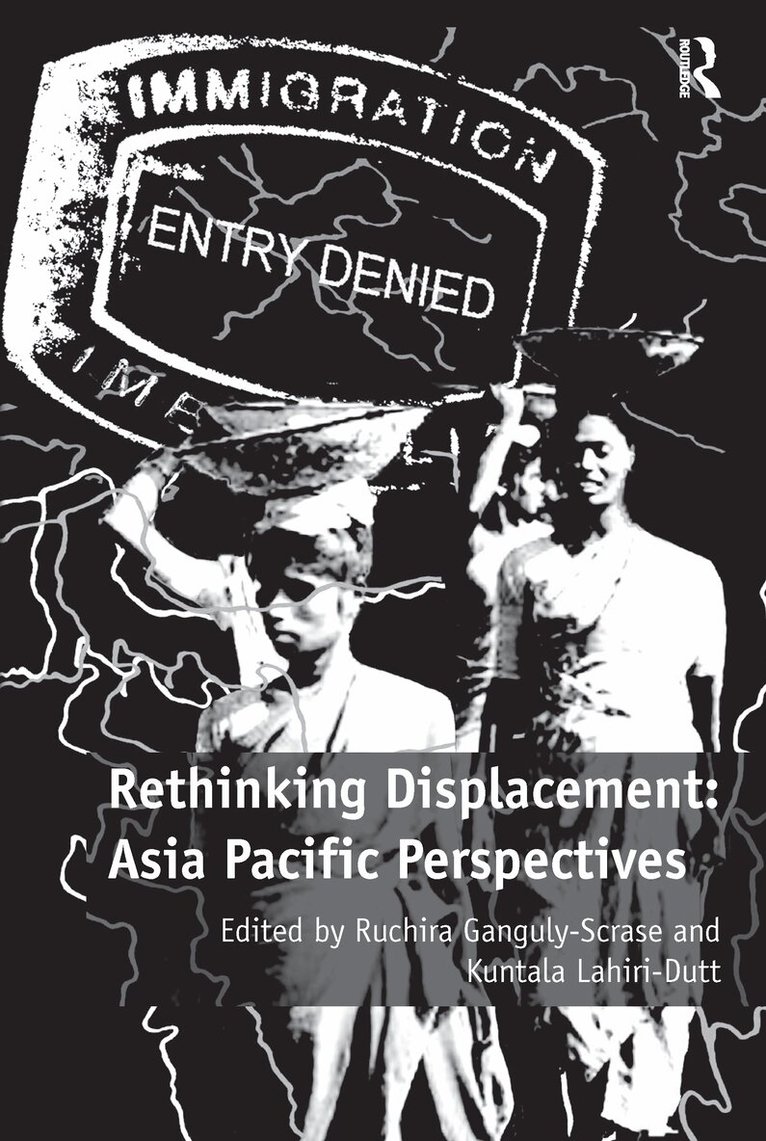
This book responds to the need to explore the multitude of interconnected factors causing displacements that compel people to move within their homelands or traverse various borders in the contemporary world that is characterised by extensive and rapid movements of people. It addresses this need by bringing together historical and contemporary accounts and critical examinations of the displaced, by articulating the commonalities in their lived experiences. It accomplishes the task of charting a new path in displacement studies by offering a number of studies from interdisciplinary and diverse methodological approaches comprising ethnographic and qualitative research and literary interpretations to emphasise that although the forms and conditions of mobility are highly divergent, individual experiences of displacement and placelessness offer a critical challenge to the artificial categorisations of people's movements. Each chapter adds insights into the different configurations of displacement and placement, and offers fresh interpretations of migration and dislocation in today's rapidly changing world. The contributors critically examine a variety of displacement processes and experiences in the context of war, tourism, neoliberal policies of development, and the impact of various agro-forestry policies. They focus on a range of countries, enabling a thorough comparative analysis in terms of scope and range of examples and methods of analysis. This book makes an original contribution to the growing body of literature on displacement, and will appeal to a wide readership including advanced undergraduates, and graduate students and professors in disciplines such as human geography, development studies, sociology and anthropology, regional studies and comparative impact assessment.
2 298 kr
Skickas inom 10-15 vardagar
This book responds to the need to explore the multitude of interconnected factors causing displacements that compel people to move within their homelands or traverse various borders in the contemporary world that is characterised by extensive and rapid movements of people. It addresses this need by bringing together historical and contemporary accounts and critical examinations of the displaced, by articulating the commonalities in their lived experiences. It accomplishes the task of charting a new path in displacement studies by offering a number of studies from interdisciplinary and diverse methodological approaches comprising ethnographic and qualitative research and literary interpretations to emphasise that although the forms and conditions of mobility are highly divergent, individual experiences of displacement and placelessness offer a critical challenge to the artificial categorisations of people's movements. Each chapter adds insights into the different configurations of displacement and placement, and offers fresh interpretations of migration and dislocation in today's rapidly changing world. The contributors critically examine a variety of displacement processes and experiences in the context of war, tourism, neoliberal policies of development, and the impact of various agro-forestry policies. They focus on a range of countries, enabling a thorough comparative analysis in terms of scope and range of examples and methods of analysis. This book makes an original contribution to the growing body of literature on displacement, and will appeal to a wide readership including advanced undergraduates, and graduate students and professors in disciplines such as human geography, development studies, sociology and anthropology, regional studies and comparative impact assessment.