Rui P. Chaves – författare
Visar alla böcker från författaren Rui P. Chaves. Handla med fri frakt och snabb leverans.
7 produkter
Unbounded Dependency Constructions
Theoretical and Experimental Perspectives
Av Michael T. Putnam, Rui P. Chaves
E-bok, 2020
488 kr
Lägg i varukorg
This book is about one of the most intriguing features of human communication systems: the fact that words that go together in meaning can occur arbitrarily far away from each other. In the sentence This is technology that most people think about, but rarely consider the implications of , the word …
Unbounded Dependency Constructions
Theoretical and Experimental Perspectives
Av Rui P. Chaves, Michael T. Putnam
Inbunden, 2020
2060 kr
Lägg i varukorg
This book is about one of the most intriguing features of human communication systems: the fact that words that go together in meaning can occur arbitrarily far away from each other. In the sentence This is technology that most people think about, but rarely consider the implications of, the word …
Unbounded Dependency Constructions
Theoretical and Experimental Perspectives
Av Rui P. Chaves, Michael T. Putnam
Häftad, 2020
589 kr
Lägg i varukorg
This book is about one of the most intriguing features of human communication systems: the fact that words that go together in meaning can occur arbitrarily far away from each other. In the sentence This is technology that most people think about, but rarely consider the implications of, the word …
Unrealized Arguments and the Grammar of Context
Av Laura A. Michaelis, Paul Kay m. fl.
E-bok, 2025
270 kr
Lägg i varukorg
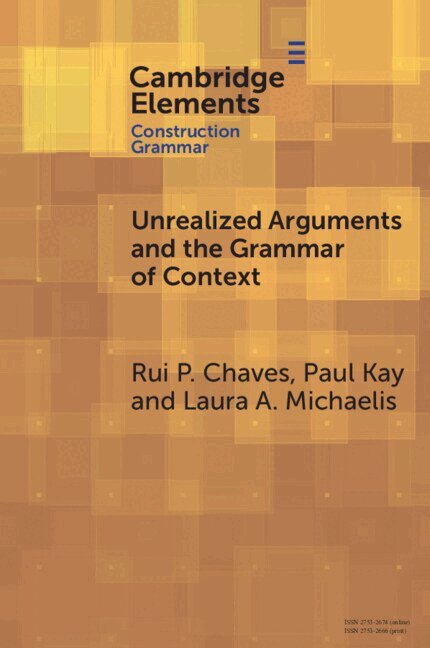
Unrealized Arguments and the Grammar of Context
Av Laura A. Michaelis, Paul Kay m. fl.
E-bok, 2025
270 kr
Lägg i varukorg
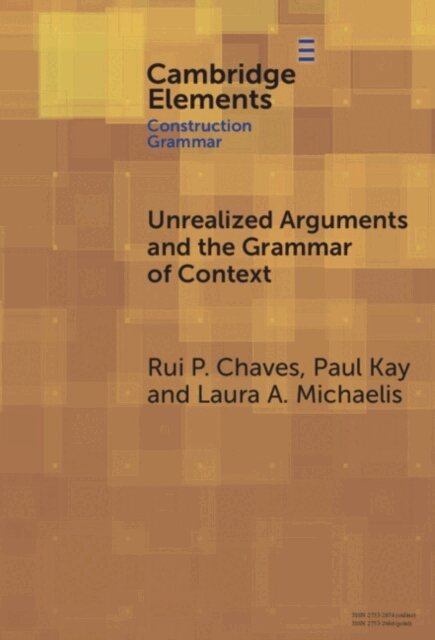
Unrealized Arguments and the Grammar of Context
Av Rui P. Chaves, Paul Kay m. fl.
Inbunden, 2025
806 kr
Lägg i varukorg
In null instantiation (NI) an optionally unexpressed argument receives either anaphoric or existential interpretation. One cannot accurately predict a predicator's NI potential based either on semantic factors (e.g., Aktionsart class of the verb) or pragmatic factors (e.g., relative discourse …
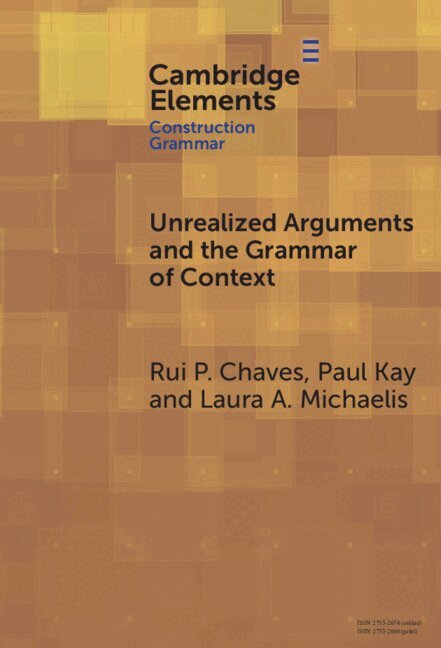
Unrealized Arguments and the Grammar of Context
Av Rui P. Chaves, Paul Kay m. fl.
Häftad, 2025
259 kr
Lägg i varukorg
In null instantiation (NI) an optionally unexpressed argument receives either anaphoric or existential interpretation. One cannot accurately predict a predicator's NI potential based either on semantic factors (e.g., Aktionsart class of the verb) or pragmatic factors (e.g., relative discourse …