Ruth Kempson – författare
Visar alla böcker från författaren Ruth Kempson. Handla med fri frakt och snabb leverans.
8 produkter
The Dynamics of Language
Av Ronnie Cann, Ruth Kempson m. fl.
Inbunden, 2006
1798 kr
Lägg i varukorg
Argues that knowledge in language consists of being able to use it in speaking and understanding. This work analyses a variety of languages, from English to Japanese and Swahili. It is intended for those in the disciplines of language, linguistics, anthropology, education, psychology, cognitive …
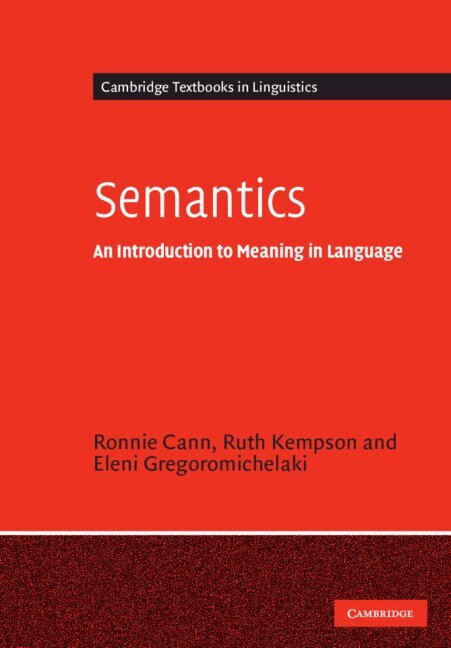
Semantics
An Introduction to Meaning in Language
Av Ronnie Cann, Ruth Kempson m. fl.
Häftad, 2009
4,0 utav 5 stjärnor. Totalt antal röster: (1)
838 kr
Lägg i varukorg
The study of meaning in language has developed dramatically over the last fifty years. Semantics is distinctive as it not only presents a general introduction to the topic, including the most recent developments, but it also provides a unique perspective for addressing current issues. It opens by …
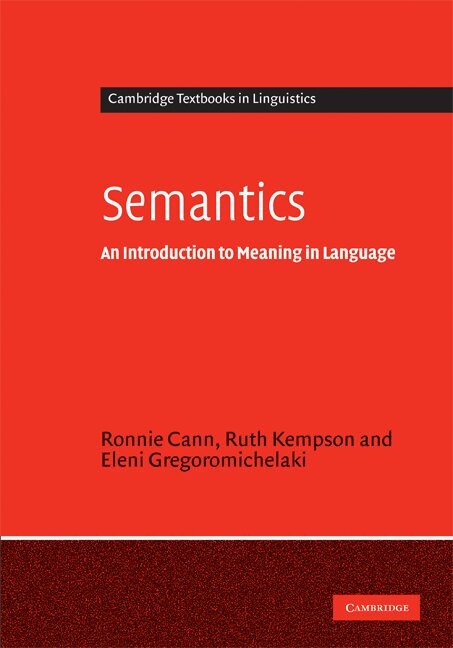
Semantics
An Introduction to Meaning in Language
Av Ronnie Cann, Ruth Kempson m. fl.
Inbunden, 2009
1871 kr
Lägg i varukorg
The study of meaning in language has developed dramatically over the last fifty years. Semantics is distinctive as it not only presents a general introduction to the topic, including the most recent developments, but it also provides a unique perspective for addressing current issues. It opens by …
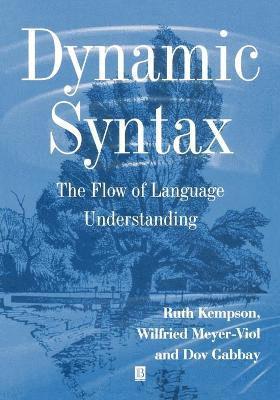
Dynamic Syntax
The Flow of Language Understanding
Av Ruth Kempson, Wilfried Meyer-Viol m. fl.
Häftad, 2000
871 kr
Lägg i varukorg
This ground-breaking volume sets out an original model of the dynamics of language processing, which can be used to explain the structural properties of language in a simple and elegant way. The model is introduced both informally and formally, and is applied to a range of languages.
Cognitive Science in Europe
A report from the FAST Programme of the Commission of the European Communities
Av Michel Imbert, Paul Bertelson m. fl.
Häftad, 1987
1067 kr
Lägg i varukorg
AIMS AND ORGANISATION OF THE PRESENT REPORT This document is a report on the state of Cognitive Science research in the European Economic Community. Since Cognitive Science is a young discipline, we have taken part of our task to be an exposition of its goals, methods and progress, and of its …
Dynamics of Lexical Interfaces
Av Ruth Kempson, Eleni Gregoromichelaki m. fl.
Häftad, 2011
315 kr
Tillfälligt slut
Dynamic Syntax is a formal model of utterance description that attempts to articulate and substantiate the claim that human linguistic knowledge is essentially the ability to process language in context. The model provides an explicit demonstration of how interpretation is built up incrementally …
Dynamics of Lexical Interfaces
Av Ruth Kempson, Eleni Gregoromichelaki m. fl.
Inbunden, 2011
624 kr
Tillfälligt slut
Dynamic Syntax is a formal model of utterance description that attempts to articulate and substantiate the claim that human linguistic knowledge is essentially the ability to process language in context. The model provides an explicit demonstration of how interpretation is built up incrementally …