Ryan C Hendrickson - Böcker
Visar alla böcker från författaren Ryan C Hendrickson. Handla med fri frakt och snabb leverans.
4 produkter
4 produkter
512 kr
Skickas inom 3-6 vardagar
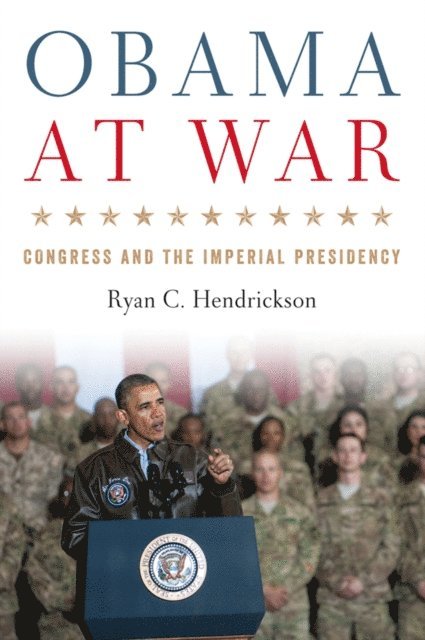
During President Barack Obama's first term in office, the United States expanded its military presence in Afghanistan and increased drone missile strikes across Pakistan, Yemen, and Somalia. The administration also deployed the military to combat piracy in the Indian Ocean, engaged in a sustained bombing operation in Libya, and deployed U.S. Special Forces in Central Africa to capture or kill Joseph Kony. In these cases, President Obama decided to use force without congressional approval. Yet, this increased executive power has not been achieved simply by the presidential assertion of such powers. It has also been supported by a group of senators and representatives who, for political reasons that stem from constant campaigning, seek to avoid responsibility for military action abroad.In this revealing book, Ryan C. Hendrickson examines President Obama's use of force in his first term with four major case studies. He demonstrates that, much like his predecessors, Obama has protected the executive branch's right not only to command, but also to determine when and where American forces are deployed. He also considers the voting records of Democrat John Kerry and Republican John McCain in the Senate, detailing how both men have played leading roles in empowering the commander-in-chief while limiting Congress's influence on military decision-making. Obama at War establishes that the imperial presidency poses significant foreign policy risks, and concludes with possible solutions to restore a more meaningful balance of power. The first book on the constitutional and political relationship between President Obama and the U.S. Congress and the use of military force, this timely reassessment of war powers provides a lucid examination of executive privilege and legislative deference in the modern American republic.
Diplomacy and War at NATO
The Secretary General and Military Action After the Cold War
Häftad, Engelska, 2006
211 kr
Skickas inom 7-10 vardagar
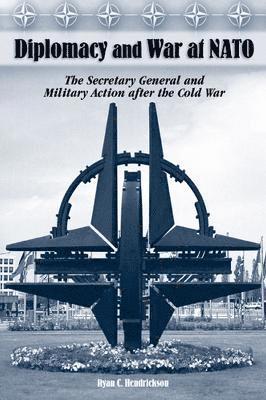
NATO is an alliance transformed. Originally created to confront Soviet aggression, the North Atlantic Treaty Organization evolved in the 1990s as a military alliance with a broader agenda. Whether conducting combat operations in the Balkans or defending Turkey from an Iraqi threat in 2003, NATO continues to face new security challenges on several fronts. Although a number of studies have addressed NATO's historic evolution, conceptual changes, and military activities, none has considered the role in this transformation of the secretary general, who is most often seen as a minor player operating under severe political constraints. In ""Diplomacy and War at NATO"", Ryan C. Hendrickson examines the first four post-Cold War secretaries general and establishes their roles in moving the alliance toward military action. Drawing on interviews with former NATO ambassadors, alliance military leaders, and senior NATO officials, Hendrickson shows that these leaders played critical roles when military force was used and were often instrumental in promoting transatlantic consensus. Hendrickson offers a focus on actual diplomacy within NATO unmatched by any other study, providing previously unreported accounts of closed sessions of the North Atlantic Council to show how these four leaders differed in their impacts on the alliance but were all critical players in explaining how and when NATO used force. He examines Manfred Worner's role in moving the alliance toward military action in the Balkans; Willy Claes's influence in shaping alliance policies regarding NATO's 1995 bombing campaign on the Bosnian Serbs; Javier Solana's part in shaping political and military agendas in the Yugoslavian war; and George Robertson's efforts to promote consensus on the Iraqi issue, which culminated in NATO's decision to provide Turkey with military defensive measures. Through each case, Hendrickson demonstrates that the secretary general is often the central diplomat in generating cooperation within NATO. As the alliance has expanded its membership and undertaken new peacekeeping missions, it now confronts new threats in international security. ""Diplomacy and War at NATO"" offers readers a more complete understanding of the alliance's post-Cold War transformation as well as policy recommendations for the improvement of transatlantic tensions.
1 164 kr
Skickas inom 5-8 vardagar
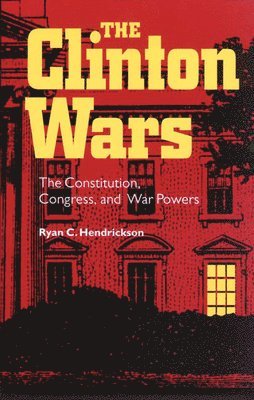
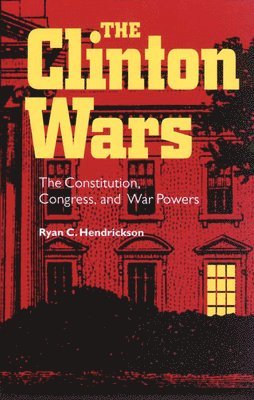
Today the United States is fighting a ""war"" against terrorism, a military action whose definition will be a matter of controversy, particularly, if history is any guide, between Congress and the president. Throughout its history, the United States has grappled with the constitutional tension built into the conduct of its foreign affairs and the interpretation of the power to make war and use force abroad. Since the Cold War's end, the United States has had to navigate through a period of strategic ambiguity, where American national security interests are much less certain. This volume examines the behaviour of the Clinton administration and Congress in dealing with the range of American military operations that occurred during the Clinton presidency. The author uses a case-study approach, laying out the foreign background and domestic political controversies in separate chapters on Somalia, Haiti, Bosnia, Kosovo and Iraq. Of special interest after the World Trade Center attacks is the chapter ""Terrorism: Usama Bin Laden"".
590 kr
Skickas inom 5-8 vardagar
Today the United States is fighting a ""war"" against terrorism, a military action whose definition will be a matter of controversy, particularly, if history is any guide, between Congress and the president. Throughout its history, the United States has grappled with the constitutional tension built into the conduct of its foreign affairs and the interpretation of the power to make war and use force abroad. Since the Cold War's end, the United States has had to navigate through a period of strategic ambiguity, where American national security interests are much less certain. This volume examines the behaviour of the Clinton administration and Congress in dealing with the range of American military operations that occurred during the Clinton presidency. The author uses a case-study approach, laying out the foreign background and domestic political controversies in separate chapters on Somalia, Haiti, Bosnia, Kosovo and Iraq. Of special interest after the World Trade Center attacks is the chapter ""Terrorism: Usama Bin Laden"".