Ryan Tafilowski – författare
Visar alla böcker från författaren . Handla med fri frakt och snabb leverans.
4 produkter
4 produkter
Häftad, Engelska, 2024
220 kr
Skickas inom 5-8 vardagar
Häftad, Engelska, 2025
292 kr
Skickas inom 5-8 vardagar
E-bok
Engelska, 2025240 kr
Läs direkt efter köp
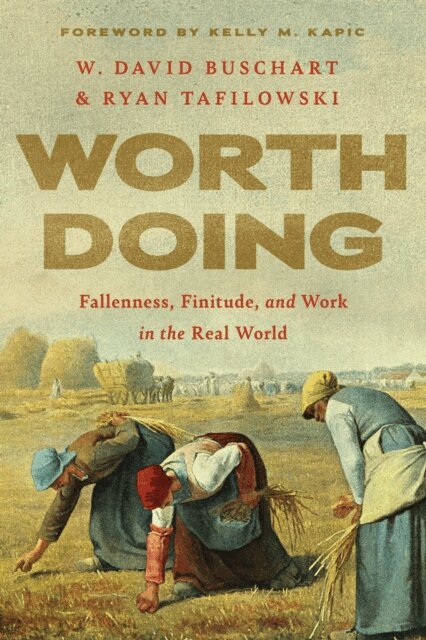
Reimagine Your Theology of Faith and WorkConversations about faith and work often miss an important truth: limitations are not a problem; they're a key part of what it means to be human. Work has always been part of humanity's purpose, but we're no longer in the perfect Garden of Eden, nor are we in the future new heavens and new earth. To truly address the challenges of work, we need a new theological perspective. In Worth Doing, David Buschart and Ryan Tafilowski embrace the realities of limitations, challenging the myths of "e;You are what you do"e; and "e;Do what you love."e; Instead, they propose a theology of work that affirms the goodness of human limits while addressing the realities of fallenness, offering hope for those who may not find deep fulfillment in their daily jobs. Buschart and Tafilowski outline a new vision of work that resonates with all workers, recognizing that every job has value, even when it doesn't align with idealized notions of purpose or calling. By embracing this perspective, people can find new ways to approach daily labor, even when it doesn't feel deeply fulfilling. In Worth Doing, readers will:- Gain a theology of work that moves beyond only ideas of productivity or calling. - Learn how to embrace human limitations as part of God's good design. - Reflect on the ways work connects to broader questions of purpose and human flourishing. Worth Doing invites readers to consider their limitations as valuable aspects of their vocational journey, offering a thoughtful framework for addressing the complexities of work. This book is particularly relevant for theologians examining the intersections of work, faith, and rest; Christian educators; and leaders in the faith and work space. By moving beyond conventional theological approaches to faith and work, Worth Doing presents a hopeful and theologically rich perspective on vocation that acknowledges and embraces human limitations.
E-bok
PDF, Engelska, 20191 026 kr
Läs direkt efter köp
At the twilight of the Weimar Republic, politicians, scientists, and theologians were engaged in debates surrounding the so-called "Jewish Question." When the Nazi Party came to power in 1933, these discussions took on a new sense of urgency and poignancy. As state measures against Jews unfolded, theological conceptions of the meaning of "Israel" and "Judaism" began to impact living, breathing Jewish persons.In this study, Ryan Tafilowski traces the thought of the Lutheran theologian Paul Althaus (1888–1966), who once greeted the rise of Hitler as a "gift and miracle of God," as he negotiated the "Jewish Question" and its meaning for his understanding of Germanness across the Weimar Republic, the Nazi years, and the post-war period. In particular, the study uncovers the paradoxical categories Althaus used to interpret the ongoing theological significance of the Jewish people, whom he considered both an imminent threat to German ethnic identity and yet a mysterious cipher by which Germans might decode their own spiritual destiny in world history.Sketching the peculiar contours of Althaus'' theology of Israel, this study offers a fresh interpretation of the Erlangen Opinion on the Aryan Paragraph, which is an important artifact not only of the Kirchenkampf, but also of the complex and ambivalent history of Christian antisemitism. By bringing Althaus into conversation with some of the most influential theologians of the twentieth century—from Karl Barth and Emil Brunner to Rudolf Bultmann and Dietrich Bonhoeffer—Tafilowski broadens the scope of his inquiry to vital questions of political theology, ethnic identity, social ethics, and ecclesiology. As Christian theologians must once again reckon with questions of national self-understanding under the pressures of mass migration and resurgent nationalisms, this investigation into the logic of ethno-nationalist theologies is a timely contribution.