S. Nilsson – författare
Visar alla böcker från författaren S. Nilsson. Handla med fri frakt och snabb leverans.
3 produkter
3 produkter
E-bok
PDF, Engelska, 20121 100 kr
Läs direkt efter köp
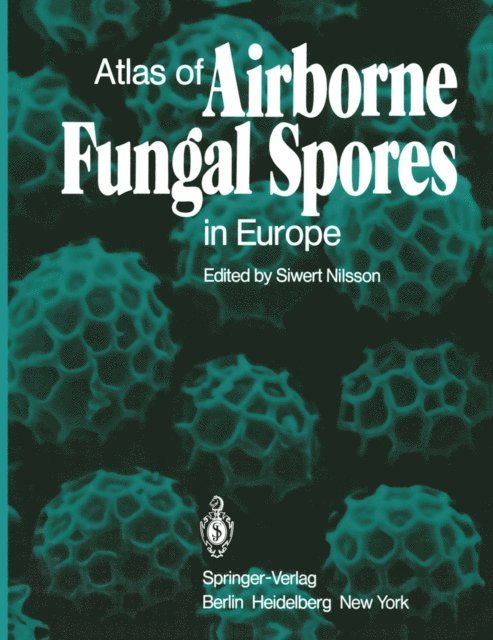
The present atlas is addressed mainly to those who, departing from different spheres of interest, are studying the dispersal of fungus spores in the air, like aero biologists, plant pathologists, medical mycologists, allergologists, or those interested in spore morphology as a taxonomic tool. The steadily increasing interest in air pollution problems has also stimulat ed investigations in the microbiological fraction of air pollutants. During the last decades the study of microbial life in the atmosphere has developed to a special branch of biological sciences - aerobiology of which the first studies are from the end of the last century. Besides pollen grains and spores of higher plants and bacteria, fungal diaspores contribute a constant and sub stantial part of the airborne microorganisms. Methods for studying airborne spores are described and critically discussed by e. g. Dimmick and Akers (1969), Ingold (1971) and Gregory (1973). The actual content of fungus spores in the air is a result of complicated processes, all of which are influ enced by external factors in different ways. The influence of the different meteorological factors on spore formation, liberation, transport and deposi tion is essentially discussed by Ingold and Gregory. There are considerable difficulties in identifying detached fungus spores visually. The taxonomy of the fungi is often based on the ontogeny of the spores which cannot be followed by examination of single spores in the air. The conidial development in Deuteromycotina and structure of conidiopho res are excellently described and illustrated by Cole and Samson (1979).
E-bok
PDF, Engelska, 20121 367 kr
Läs direkt efter köp
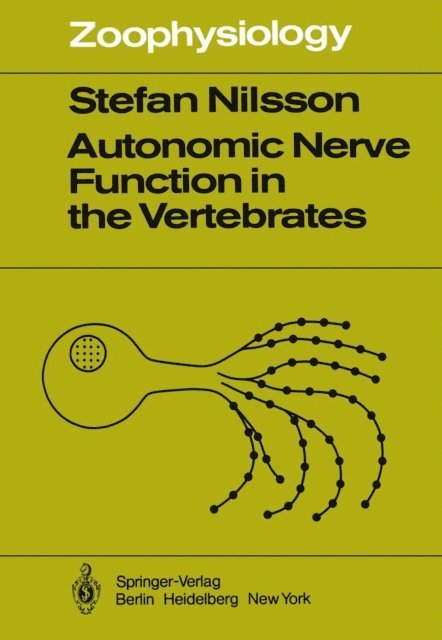
The intention of this book is to offer a comprehensive description and discussion of autonomic nerve function in the vertebrates from several points of view. Sections on anatomy, biochemistry of the transmitter substances and the structure, physiology and pharmacology of the different types of autonomic neurons have been included, together with chapters dealing with the autonomic nervous control of some organs and organ systems in the different vertebrate groups. Although knowledge in several of these areas is based primarily on studies of mammals, a certain emphasis has been placed on the autonomic nerve functions in the non-mammalian vertebrates to describe, from a comparative physiological point of view, the adaptations and possible "phylogenetic trends" in the development of the autonomic nerve functions in the vertebrates. It is very obvious that the literature created by the vigorous research activities within the fields of autonomic nervous anatomy, histochemistry, biochemistry, pharmacology and physiology is vast indeed, and not all aspects of the subject may have received fair treatment in the present volume. With an analogy from astronomy, it is hoped that the mass compressed into this book has reached the level of an energy-emitting neutron star, rather than the black hole which would be the result of compressing too large a mass.
Del 13 - Zoophysiology
Autonomic Nerve Function in the Vertebrates
Häftad, Engelska, 2011
1 091 kr
Skickas inom 10-15 vardagar
The intention of this book is to offer a comprehensive description and discussion of autonomic nerve function in the vertebrates from several points of view. Sections on anatomy, biochemistry of the transmitter substances and the structure, physiology and pharmacology of the different types of autonomic neurons have been included, together with chapters dealing with the autonomic nervous control of some organs and organ systems in the different vertebrate groups. Although knowledge in several of these areas is based primarily on studies of mammals, a certain emphasis has been placed on the autonomic nerve functions in the non-mammalian vertebrates to describe, from a comparative physiological point of view, the adaptations and possible "phylogenetic trends" in the development of the autonomic nerve functions in the vertebrates. It is very obvious that the literature created by the vigorous research activities within the fields of autonomic nervous anatomy, histochemistry, biochemistry, pharmacology and physiology is vast indeed, and not all aspects of the subject may have received fair treatment in the present volume. With an analogy from astronomy, it is hoped that the mass compressed into this book has reached the level of an energy-emitting neutron star, rather than the black hole which would be the result of compressing too large a mass.