S Rajasekaran – författare
Visar alla böcker från författaren S Rajasekaran. Handla med fri frakt och snabb leverans.
4 produkter
4 produkter
E-bok
Engelska, 20093 435 kr
Läs direkt efter köp
Given the risk of earthquakes in many countries, knowing how structural dynamics can be applied to earthquake engineering of structures, both in theory and practice, is a vital aspect of improving the safety of buildings and structures. It can also reduce the number of deaths and injuries and the amount of property damage.The book begins by discussing free vibration of single-degree-of-freedom (SDOF) systems, both damped and undamped, and forced vibration (harmonic force) of SDOF systems. Response to periodic dynamic loadings and impulse loads are also discussed, as are two degrees of freedom linear system response methods and free vibration of multiple degrees of freedom. Further chapters cover time history response by natural mode superposition, numerical solution methods for natural frequencies and mode shapes and differential quadrature, transformation and Finite Element methods for vibration problems. Other topics such as earthquake ground motion, response spectra and earthquake analysis of linear systems are discussed.Structural dynamics of earthquake engineering: theory and application using Mathematica and Matlab provides civil and structural engineers and students with an understanding of the dynamic response of structures to earthquakes and the common analysis techniques employed to evaluate these responses. Worked examples in Mathematica and Matlab are given.- Explains the dynamic response of structures to earthquakes including periodic dynamic loadings and impulse loads- Examines common analysis techniques such as natural mode superposition, the finite element method and numerical solutions- Investigates this important topic in terms of both theory and practise with the inclusion of practical exercise and diagrams
E-bok
PDF, Engelska, 20081 580 kr
Läs direkt efter köp
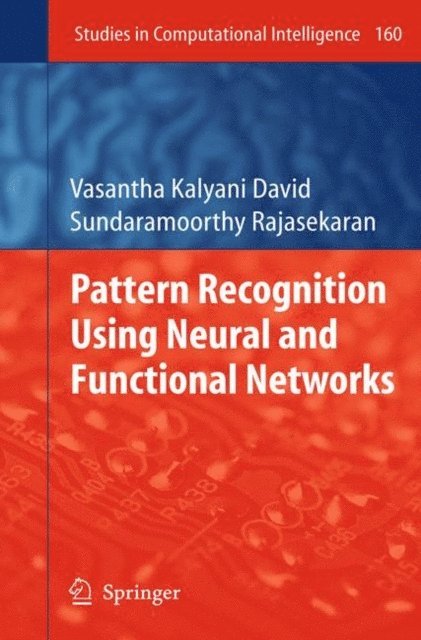
Biologically inspiredcomputing isdi?erentfromconventionalcomputing.Ithas adi?erentfeel; often the terminology does notsound like it’stalkingabout machines.The activities ofthiscomputingsoundmorehumanthanmechanistic as peoplespeak ofmachines that behave, react, self-organize,learn, generalize, remember andeven to forget.Much ofthistechnology tries to mimic nature’s approach in orderto mimicsome of nature’s capabilities.They havearigorous, mathematical basisand neuralnetworks forexamplehaveastatistically valid set on which the network istrained. Twooutlinesaresuggestedasthepossibletracksforpatternrecognition.They are neuralnetworks andfunctionalnetworks.NeuralNetworks (many interc- nected elements operating in parallel) carryout tasks that are not only beyond the scope ofconventionalprocessing but also cannotbeunderstood in the same terms.Imagingapplicationsfor neuralnetworksseemtobea natural?t.Neural networks loveto do pattern recognition. A new approachto pattern recognition usingmicroARTMAP together with wavelet transforms in the context ofhand written characters,gestures andsignatures havebeen dealt.The KohonenN- work,Back Propagation Networks andCompetitive Hop?eld NeuralNetwork havebeen considered for various applications. Functionalnetworks,beingageneralizedformofNeuralNetworkswherefu- tionsarelearnedratherthanweightsiscomparedwithMultipleRegressionAn- ysisforsome applicationsandtheresults are seen to be coincident. New kinds of intelligence can be added to machines, and we will havethe possibilityof learningmore about learning.Thus our imaginationsand options are beingstretched.These new machines will be fault-tolerant,intelligentand self-programmingthustryingtomakethemachinessmarter.Soastomakethose who use the techniques even smarter. Chapter1isabrief introduction toNeural and Functionalnetworks in the context of Patternrecognitionusing these disciplinesChapter2 givesa review ofthearchitectures relevantto the investigation andthedevelopment ofthese technologies in the past few decades. Retracted VIII Preface Chapter3begins with the lookattherecognition ofhandwritten alphabets usingthealgorithm for ordered list ofboundary pixelsas well as the Ko- nenSelf-Organizing Map (SOM).Chapter 4 describes the architecture ofthe MicroARTMAP and its capability.
Inbunden, Engelska, 2019
6 184 kr
Skickas inom 5-8 vardagar
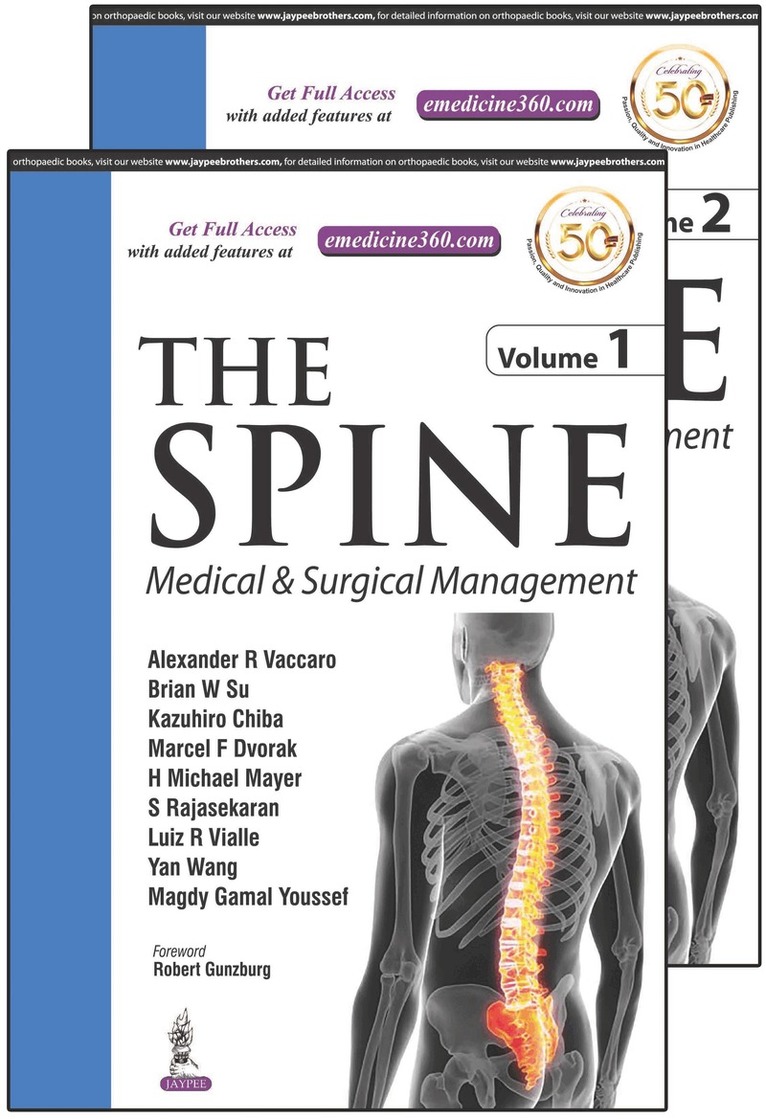
The Spine: Medical and Surgical Conditions is a complete, two volume, evidence based study edited by an internationally recognised team of spine surgeons based in the USA, China, Canada, Germany, Japan, Brazil, Egypt and India.The two volumes are divided into 137 chapters, across fourteen sections. The first section covers general topics in spinal medicine, including anatomy, biomechanics, physical and neurological examination, interventional diagnostics and therapeutics, and anaesthesia. This is followed by sections on the development of the spine, metabolic disorders, and bone grafting. Subsequent sections focus on surgery for particular parts of the spine, including cervical, lumbar and thoracic, as well as sections on spinal cord injuries and motor preservation.Later sections in the book provide information on the spine in paediatrics, adult deformity, tumours, vascular malformations and infections, complications of spinal surgery, and a final section on minimally invasive techniques.Enhanced by 1500 full colour images, The Spine: Medical and Surgical Conditions is also made available online, complete with text, images and video, with each physical copy.Key PointsComprehensive, two volume guide to spinal medicineCovers anatomy, biomechanics, examination, diagnostics, therapeutics, anaesthesia, surgery and complicationsEnhanced by 1500 full colour imagesIncludes access to online version with complete text, images and video
Inbunden, Engelska, 2011
2 144 kr
Tillfälligt slut
This reference book examines the diagnosis and treatment of spinal infections and trauma. Beginning with the fundamental concepts of spinal infections, it continues with detailed chapters dedicated to the different types of infection and spinal cord injury. Emphasis is placed not only on surgical techniques, but also the pathology, clinical features, value of modern diagnostic features, and appropriate drug therapy.