
S. Shelah – författare
Visar alla böcker från författaren S. Shelah. Handla med fri frakt och snabb leverans.
2 produkter
2 produkter
E-bok
PDF, Engelska, 19903 934 kr
Läs direkt efter köp
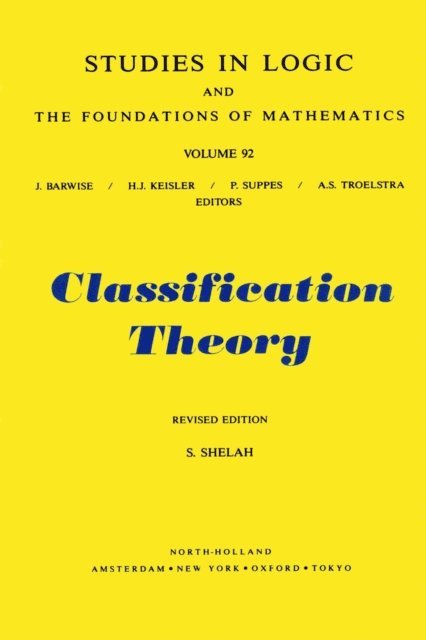
In this research monograph, the author''s work on classification and related topics are presented. This revised edition brings the book up to date with the addition of four new chapters as well as various corrections to the 1978 text.The additional chapters X - XIII present the solution to countable first order T of what the author sees as the main test of the theory. In Chapter X the Dimensional Order Property is introduced and it is shown to be a meaningful dividing line for superstable theories. In Chapter XI there is a proof of the decomposition theorems. Chapter XII is the crux of the matter: there is proof that the negation of the assumption used in Chapter XI implies that in models of T a relation can be defined which orders a large subset of m
E-bok
PDF, Engelska, 20131 116 kr
Läs direkt efter köp
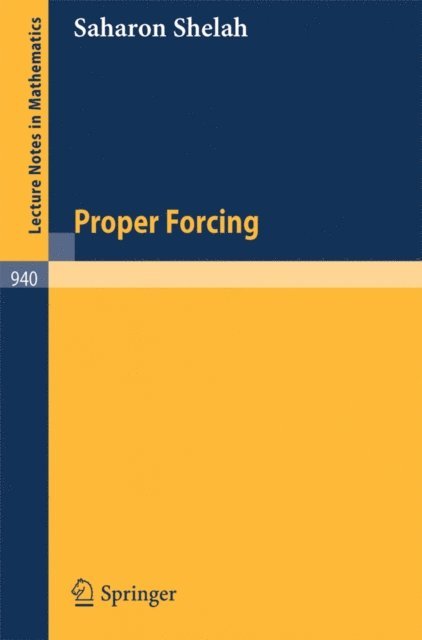
These notes can be viewed and used in several different ways, each has some justification, a collection of papers, a research monograph or a text book. The author has lectured variants of several of the chapters several times: in University of California, Berkeley, 1978, Ch. III , N, V in Ohio State Univer sity in Columbus, Ohio 1979, Ch. I,ll and in the Hebrew University 1979/80 Ch. I, II, III, V, and parts of VI. Moreover Azriel Levi, who has a much better name than the author in such matters, made notes from the lectures in the Hebrew University, rewrote them, and they ·are Chapters I, II and part of III , and were somewhat corrected and expanded by D. Drai, R. Grossberg and the author. Also most of XI §1-5 were lectured on and written up by Shai Ben David. Also our presentation is quite self-contained. We adopted an approach I heard from Baumgartner and may have been used by others: not proving that forcing work, rather take axiomatically that it does and go ahead to applying it. As a result we assume only knowledge of naive set theory (except some iso lated points later on in the book).