Sagi Schaefer – författare
Visar alla böcker från författaren Sagi Schaefer. Handla med fri frakt och snabb leverans.
6 produkter
6 produkter
E-bok
PDF, Engelska, 20141 327 kr
Läs direkt efter köp
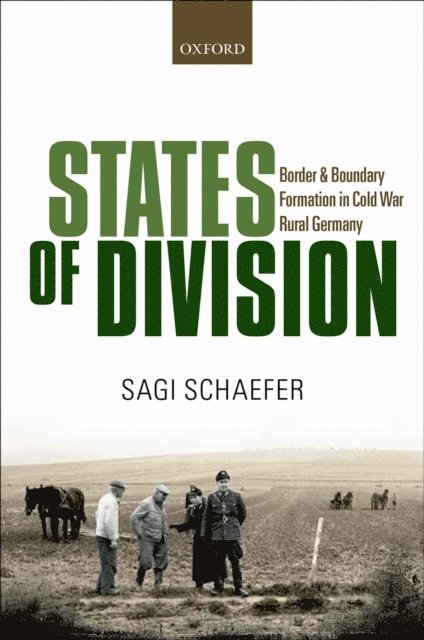
States of Division analyses the division of Germany and the development of the Iron Curtain during the four and a half decades of the Cold War. The centerpiece of this global fault-line was the thousand-mile-long border dividing Germany into West and East. This long border traversed primarily rural peripheries and the development of division along it entailed protracted processes of social and cultural demarcation. Unlike the Berlin Wall, which sprang upovernight in the urban enclave under watchful eyes of Soviet and Western armies, the inter-German border evolved slowly through interactions between frontier residents and various state agencies. The division of Germany and of the world emerged through conflicts between everyday practices, economic necessities,policies of German and foreign governments, and their ability to push these policies through.The division of Germany was a multi-faceted process, which progressed slowly and unevenly. States of Division demonstrates that along with the crucial context of the Cold War, multiple historical and social frameworks are required to decipher division and explain how and where it took place. Dividing a modern integrated society along a thousand-mile border was not planned or intended by the allies and at no stage was agreed upon by East and West German authorities. It gave rise tocontradictions and conflicts with practice and tradition, undermining economy and culture in the borderlands, and required protracted negotiations and considerable resources. It was not a fait accompli of Yalta or Potsdam, nor was it completed with the construction of the Berlin Wall in 1961. German division onlystabilized as a sociopolitical fact through the inter-German compromise of the 1970s, which also planted the seeds of its undoing. Integrating local, regional and national perspectives, this volume tells a complex story, showing how diplomacy and policy affected daily practices and were affected by them.
Inbunden, Engelska, 2014
2 093 kr
Skickas inom 5-8 vardagar
States of Division analyses the division of Germany and the development of the Iron Curtain during the four and a half decades of the Cold War. The centerpiece of this global fault-line was the thousand-mile-long border dividing Germany into West and East. This long border traversed primarily rural peripheries and the development of division along it entailed protracted processes of social and cultural demarcation. Unlike the Berlin Wall, which sprang up overnight in the urban enclave under watchful eyes of Soviet and Western armies, the inter-German border evolved slowly through interactions between frontier residents and various state agencies. The division of Germany and of the world emerged through conflicts between everyday practices, economic necessities, policies of German and foreign governments, and their ability to push these policies through.The division of Germany was a multi-faceted process, which progressed slowly and unevenly. States of Division demonstrates that along with the crucial context of the Cold War, multiple historical and social frameworks are required to decipher division and explain how and where it took place. Dividing a modern integrated society along a thousand-mile border was not planned or intended by the allies and at no stage was agreed upon by East and West German authorities. It gave rise to contradictions and conflicts with practice and tradition, undermining economy and culture in the borderlands, and required protracted negotiations and considerable resources. It was not a fait accompli of Yalta or Potsdam, nor was it completed with the construction of the Berlin Wall in 1961. German division only stabilized as a sociopolitical fact through the inter-German compromise of the 1970s, which also planted the seeds of its undoing. Integrating local, regional and national perspectives, this volume tells a complex story, showing how diplomacy and policy affected daily practices and were affected by them.
E-bok
PDF, Tyska, 2020329 kr
Läs direkt efter köp
Technologien und ihr Einfluss auf Mensch, Gesellschaft und Kultur in der Moderne.Was wir heute als Moderne bezeichnen, ist nicht zuletzt eine Epoche der Technologie. Individuen und Gesellschaften erfuhren durch technologische Erfindungen und Produktionen eine tiefgreifende Umgestaltung, neue Maschinen veränderten Arbeit und Kriegführung, Wohnen und Mobilität, Sprache und Kommunikation sowie soziale und wirtschaftliche Beziehungen. Die Autorinnen und Autoren des Tel Aviver Jahrbuchs 2020 fragen nach den historischen Bedingungen und Konsequenzen der modernen Technologien: Wie haben die neuen Maschinen die Modi des Lebens und des Schreibens in Deutschland und anderswo beeinflusst?
E-bok
PDF, Tyska, 2022329 kr
Läs direkt efter köp
Der »spatial turn« in der deutschen Geschichte.Die deutsche Geschichtsschreibung hat in den letzten Jahrzehnten einen spezifischen »spatial turn« erfahren. Insbesondere haben Historikerinnen und Historiker dabei die Funktion von Rassenideologie und (»Lebens«-)Raum im Zusammenhang mit dem Zweiten Weltkrieg analysiert. Später geriet auch die Nachkriegszeit in den Fokus, in der auch die Ideologien und Logiken des Kalten Kriegs in den Blick rückten. Die Beiträgerinnen und Beiträger des Bandes vereinen die Themen Raum, Ort, Grenzen, Landschaften, Territorialisierung, Umweltgeschichte und Stadtgeschichte. So arbeiten sie heraus, wie die verschiedenen Weltanschauungen und Ideen in der Moderne Deutschland geformt und umgeformt haben.
E-bok
PDF, Tyska, 2026393 kr
Läs direkt efter köp
Uber Walder und Forste, vermeintlich alte und sehr moderne, ihre Rodung und Wiederaufforstung. Die Beschaftigung mit dem Thema Wald hat in der deutschen Geschichte zweifelsohne eine lange Tradition. Die Auswirkungen jedoch sind weit umfassender. Umweltschutzer weltweit weisen auf die strategische Bedeutung von Waldern hin, haufig werden diese als Teil der nicht-sozialisierten Natur verstanden, die vor ungezugelter Ausbeutung zu schutzen ist. Andererseits haben Forscher aus verschiedenen Blickwinkeln darauf hingewiesen, dass Entwaldung und Versteppung nicht immer der Realitat entsprechen, so dass man sich mit den ideologischen Dimensionen der Aufforstungspolitik beschaftigen muss. Die Bewirtschaftung von Waldern kann zugleich Teil der Erhaltung wie auch der Ausbeutung naturlicher Ressourcen sein, flankiert Staats- und Nationenbildung ebenso wie Kolonialpolitik.
Del 50 - Tel Aviver Jahrbuch für deutsche Geschichte
Verflochtene Waldgeschichten / Entangled Woods
Häftad, Engelska, 2026
413 kr
Skickas inom 3-6 vardagar