Sahla Aroussi – författare
Visar alla böcker från författaren . Handla med fri frakt och snabb leverans.
2 produkter
2 produkter
At the time of its adoption in October 2000, United Nations Security Council resolution 1325 on Women, Peace and Security (WPS) was hailed as a turning point for women involved in conflicts, peacemaking, peacekeeping and post-conflict reconstruction. Resolution 1325 required all efforts aimed at resolving conflicts and building peace to be inclusive, gender-sensitive and transformative for women. In recent years, National Action Plans (NAPs) on WPS have become one of the most commonly used tools by states to channel, assess and monitor the implementation of resolution 1325 and other UN WPS resolutions.This book presents an edited version of the proceedings of the NATO Advanced Research Workshop (ARW) on ‘National Action Plans on Women, Peace and Security’, held in Dublin, Ireland, in May 2016. The workshop brought together representatives from various states, as well as academics, and members of civil society and international organizations, to discuss their experiences with NAPs and to critically reflect on the role of NAPs in supporting the implementation by states of the WPS framework.The aim of this book is to disseminate the key arguments, findings, and recommendations which emerged from the discussions held at the ARW. It includes a summary report which sets out key arguments and recommendations and offers a number of key papers from the ARW, with the intention of contributing to academic and policy debates concerning gender and armed conflict and, more particularly, the WPS framework.
Del 6 - Law & Cosmopolitan Values
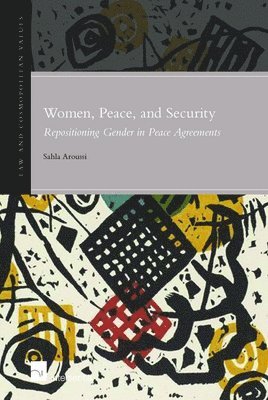
Women, Peace, and Security
Repositioning gender in peace agreements
Inbunden, Engelska, 2015
1 047 kr
Skickas inom 5-8 vardagar
The adoption of Security Council resolution 1325 on women, peace and security in October 2000 marked the beginning of a global agenda on women in armed conflicts and post-conflict transition. Women, Peace and Security: Repositioning gender in peace agreements discusses the context and the content of this UN agenda and provides a systematic review of its implementation, over the last fifteen years, in peace agreements around the world.This book is timely, offering a valuable contribution to the literature on gender in armed conflicts, peace agreements, peace mediation, and transitional justice and is essential reading for practitioners and scholars working in this field. The study adopts an interdisciplinary approach to raise key theoretical and practical questions often overlooked by scholars working within the strict boundaries of the distinct disciplines. The book introduces a new dataset on peace agreements that provides important comprehensive evidence on the extent to which resolution 1325 and other subsequent resolutions on women, peace and security have impacted on peace agreements. Through the reflections of elite peacemakers, the book provides additional insights into the practice of peacemaking and the challenges of implementing the UN resolutions on women, peace and security on the ground.The findings of this book have important policy implications for governments, international organisations and NGOs who must refocus their efforts on bridging the gap between the theory and practice of gender sensitive peacemaking.