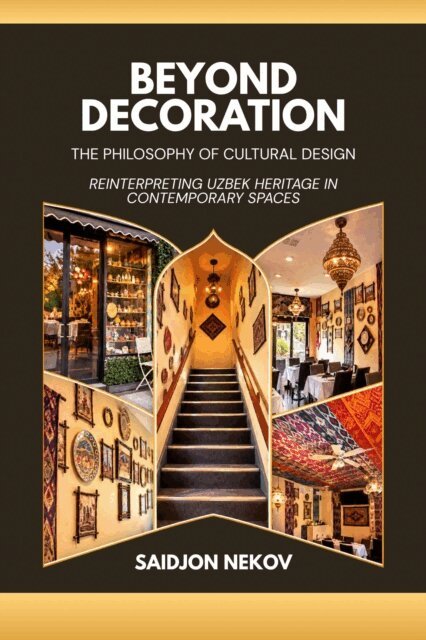
What does it mean to design a space that truly belongs to a culture?Beyond Decoration challenges the idea that cultural identity can be created simply by adding traditional patterns, colors, objects, or architectural motifs to an otherwise generic interior. Instead, it argues that meaningful cultural design begins with understanding how heritage shapes space, behavior, memory, craft, hospitality, and everyday life.Drawing on the architectural and cultural heritage of Uzbekistan, with Bukhara as a central source of inspiration, Saidjon Nekov explores how historical knowledge can become a foundation for contemporary design without turning heritage into imitation or nostalgia. Bukhara is approached not as a template to reproduce, but as a teacher: its courtyards, thresholds, material traditions, urban sequences, craft practices, patterns of gathering, and relationship between monument and everyday life reveal principles that can be reinterpreted for new contexts.At the heart of the book is a practical philosophy: research before motif, meaning before styling, culture in the plan rather than only on the surface, craft as knowledge rather than prop, and authenticity as informed continuity rather than theatrical reproduction.The book also examines the challenges of cultural translation through Old Bukhara, a contemporary Uzbek restaurant project in Morganville, New Jersey. The project demonstrates the complexities of carrying cultural identity across geography, building type, audience, and regulatory environments while maintaining contemporary functionality and hospitality.Beyond a discussion of Uzbek design, Beyond Decoration offers a broader framework for architects, interior designers, cultural practitioners, researchers, and anyone interested in the relationship between heritage and contemporary space. It proposes that cultural identity becomes most powerful when it is not merely displayed, but experienced.This is a book about moving from symbol to system, from image to environment, and from decoration to meaning.When heritage begins to shape how a space is organized, experienced, remembered, and inhabited, culture no longer decorates architecture.It becomes architecture.