Samantha Majic - Böcker
Visar alla böcker från författaren Samantha Majic. Handla med fri frakt och snabb leverans.
6 produkter
6 produkter
758 kr
Skickas inom 7-10 vardagar
Celebrities in the United States have drawn significant attention and resources to the complex issue of human trafficking—a subject of feminist concern—and they are often criticized for promoting sensationalized and simplistic understandings of the issue. In this comprehensive analysis of celebrities’ anti-trafficking activism, however, Samantha Majic finds that this phenomenon is more nuanced: even as some celebrities promote regressive issue narratives and carceral solutions, others use their platforms to elevate more diverse representations of human trafficking and feminist analyses of gender inequality. Lights, Camera, Feminism? thus argues that we should understand celebrities as multilevel political actors whose activism is shaped and mediated by a range of personal and contextual factors, with implications for feminist and democratic politics more broadly.
244 kr
Skickas inom 7-10 vardagar
Celebrities in the United States have drawn significant attention and resources to the complex issue of human trafficking—a subject of feminist concern—and they are often criticized for promoting sensationalized and simplistic understandings of the issue. In this comprehensive analysis of celebrities’ anti-trafficking activism, however, Samantha Majic finds that this phenomenon is more nuanced: even as some celebrities promote regressive issue narratives and carceral solutions, others use their platforms to elevate more diverse representations of human trafficking and feminist analyses of gender inequality. Lights, Camera, Feminism? thus argues that we should understand celebrities as multilevel political actors whose activism is shaped and mediated by a range of personal and contextual factors, with implications for feminist and democratic politics more broadly.
631 kr
Skickas inom 10-15 vardagar
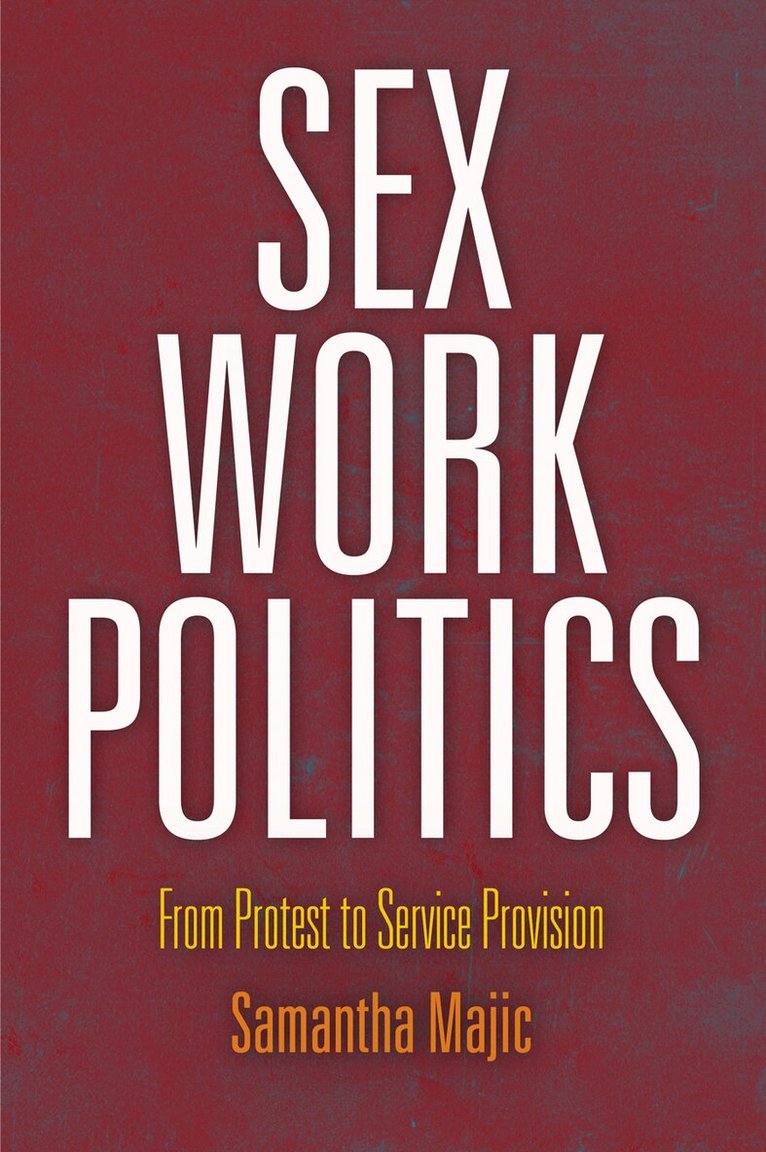
In San Francisco, the St. James Infirmary (SJI) and the California Prostitutes Education Project (CAL-PEP) provide free, nonjudgmental medical care, counseling, and other health and social services by and for sex workers-a radical political commitment at odds with government policies that criminalize prostitution. To maintain and expand these much-needed services and to qualify for funding from state, federal, and local authorities, such organizations must comply with federal and state regulations for nonprofits. In Sex Work Politics, Samantha Majic investigates the way nonprofit organizations negotiate their governmental obligations while maintaining their commitment to outreach and advocacy for sex workers' rights as well as broader sociopolitical change.Drawing on multimethod qualitative research, Majic outlines the strategies that CAL-PEP and SJI employ to balance the conflicting demands of service and advocacy, which include treating sex work as labor with legitimate occupational health and safety concerns, empowering their clients with civic skills to advance their political commitments outside the nonprofit organization, and conducting and publishing research and analysis to inform the public and policymakers of their constituents' needs. Challenging the assumption that activists must "sell out" and abandon radical politics to manage formal organizations, Majic comes to the surprising conclusion that it is indeed possible to maintain effective advocacy and key social movement values, beliefs, and practices, even while partnering with government agencies. Sex Work Politics significantly contributes to studies of transformational politics with its nuanced portrait of nonprofits as centers capable of sustaining political and social change.
284 kr
Skickas inom 7-10 vardagar
Globally, discussions about sex work focus on exploitation. The media regularly provides us with stories about teen girls coerced to perform sexual acts for money, frequently beaten and robbed by their pimps or traffickers. While one would have to be hard-pressed to deny that sex workers are victimized, the popular media and our political leaders emphasize sex work as exclusively exploitative. In Negotiating Sex Work, Carisa R. Showden and Samantha Majic present a series of essays that depict sex work as an issue far more complex than generally perceived.Positions on sex work are primarily divided between those who consider that selling sexual acts is legitimate work and those who consider it a form of exploitation. Organized into three parts, Negotiating Sex Work rejects this either/or framework and offers instead diverse and compelling contributions that aim to reframe these viewpoints. Part I addresses how knowledge about sex work and sex workers is generated. The next section explores how nations and political actors who claim to protect individuals in sex work often further marginalize them. Finally, part III examines sex workers’ own political-organizational efforts to combat laws and policies that deem them deviant, sinful, or total victims.A timely and necessary intervention into sex work debates, this volume challenges how policy makers and the broader public regard sex workers’ capacity to advocate for their own interests.Contributors: Cheryl Auger; Sarah Beer, Dawson College, Montreal; Michele Tracy Berger, U of North Carolina–Chapel Hill; Thaddeus Gregory Blanchette, Federal U of Rio de Janeiro; Raven Bowen; Gregg Bucken-Knapp, U of Gothenburg, Sweden; Ana Paula da Silva, Federal U of ViÇosa; Valerie Feldman; Gregor Gall, U of Bradford; Kathleen Guidroz, Georgetown U; Annie Hill, U of Minnesota; Johan Karlsson Schaffer, U of Oslo; Edith Kinney, Mills College; Yasmin Lalani; Pia Levin; Alexandra Lutnick; Tamara O’Doherty, U of the Fraser Valley, British Columbia; Joyce Outshoorn, U of Leiden; Francine Tremblay, Concordia U, Montreal.
955 kr
Skickas inom 7-10 vardagar
When cases of domestic minor sex trafficking (DMST) by predatory men are reported in the media, it is often presented that a young, innocent girl has been abused by bad men with their demand for sex and profit. This narrative has shaped popular understandings of young people in the commercialized sex trades, sparking new policy responses. However, the authors of Youth Who Trade Sex in the U.S. challenge this dominant narrative as incomplete. Carisa Showden and Samantha Majic investigate young people’s engagement in the sex trades through an intersectional lens. The authors examine the dominant policy narrative’s history and the political circumstances generating its emergence and current form. With this background, Showden and Majic review and analyze research published since 2000 about young people who trade sex since 2000 to develop an intersectional “matrix of agency and vulnerability” designed to improve research, policy, and community interventions that center the needs of these young people. Ultimately, they derive an understanding of the complex reality for most young people who sell or trade sex, and are committed to ending such exploitation.
301 kr
Skickas inom 7-10 vardagar
When cases of domestic minor sex trafficking (DMST) by predatory men are reported in the media, it is often presented that a young, innocent girl has been abused by bad men with their demand for sex and profit. This narrative has shaped popular understandings of young people in the commercialized sex trades, sparking new policy responses. However, the authors of Youth Who Trade Sex in the U.S. challenge this dominant narrative as incomplete. Carisa Showden and Samantha Majic investigate young people’s engagement in the sex trades through an intersectional lens. The authors examine the dominant policy narrative’s history and the political circumstances generating its emergence and current form. With this background, Showden and Majic review and analyze research published since 2000 about young people who trade sex since 2000 to develop an intersectional “matrix of agency and vulnerability” designed to improve research, policy, and community interventions that center the needs of these young people. Ultimately, they derive an understanding of the complex reality for most young people who sell or trade sex, and are committed to ending such exploitation.