Sameer Singh – författare
Visar alla böcker från författaren Sameer Singh. Handla med fri frakt och snabb leverans.
17 produkter
17 produkter
E-bok
PDF, Engelska, 20122 599 kr
Läs direkt efter köp
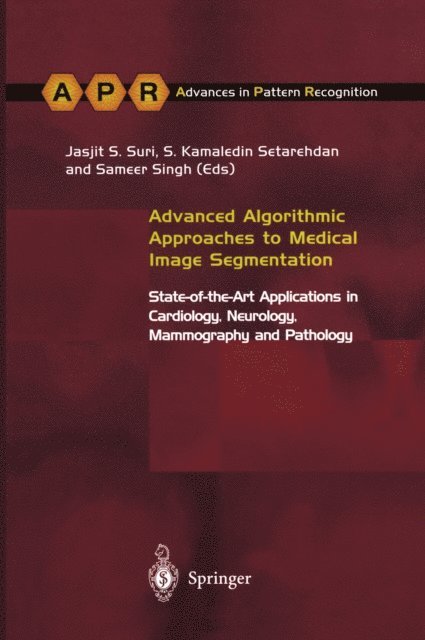
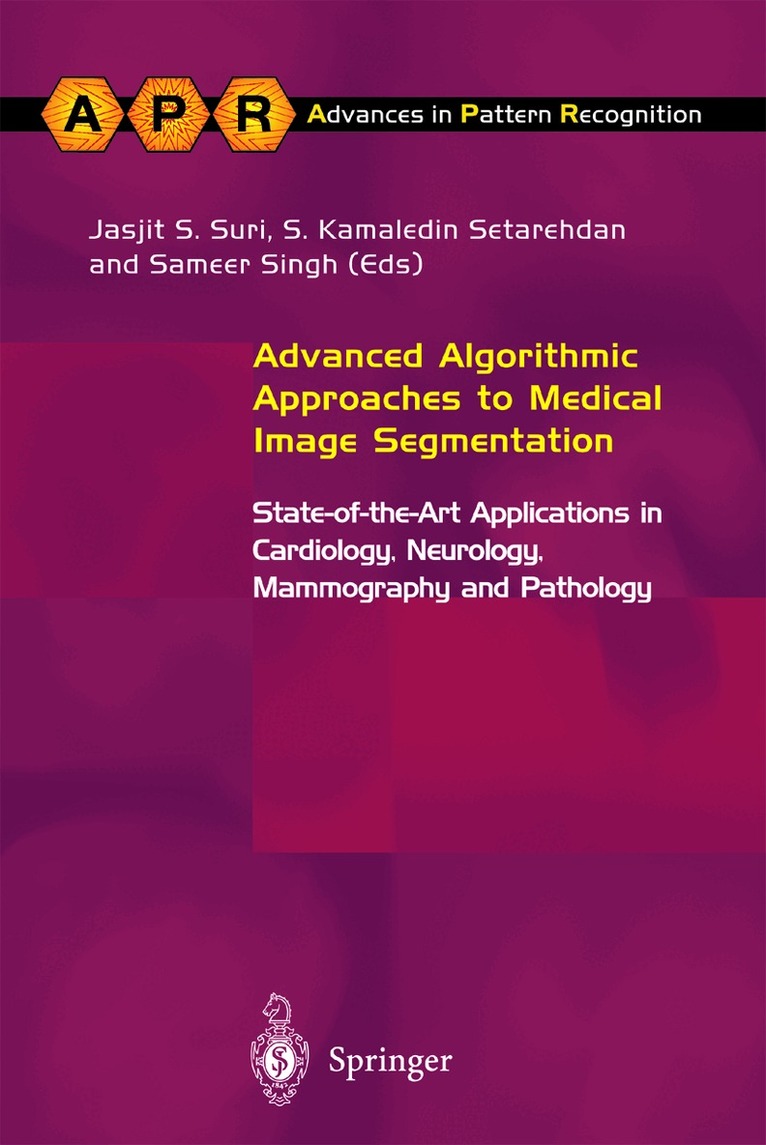
Medical imaging is an important topic which is generally recognised as key to better diagnosis and patient care. It has experienced an explosive growth over the last few years due to imaging modalities such as X-rays, computed tomography (CT), magnetic resonance (MR) imaging, and ultrasound.This book focuses primarily on state-of-the-art model-based segmentation techniques which are applied to cardiac, brain, breast and microscopic cancer cell imaging. It includes contributions from authors based in both industry and academia and presents a host of new material including algorithms for:- brain segmentation applied to MR;- neuro-application using MR; - parametric and geometric deformable models for brain segmentation;- left ventricle segmentation and analysis using least squares and constrained least squares models for cardiac X-rays; - left ventricle analysis in echocardioangiograms;- breast lesion detection in digital mammograms;detection of cells in cell images.As an overview of the latest techniques, this book will be of particular interest to students and researchers in medical engineering, image processing, computer graphics, mathematical modelling and data analysis. It will also be of interest to researchers in the fields of mammography, cardiology, pathology and neurology.
E-bok
PDF, Engelska, 20121 408 kr
Läs direkt efter köp
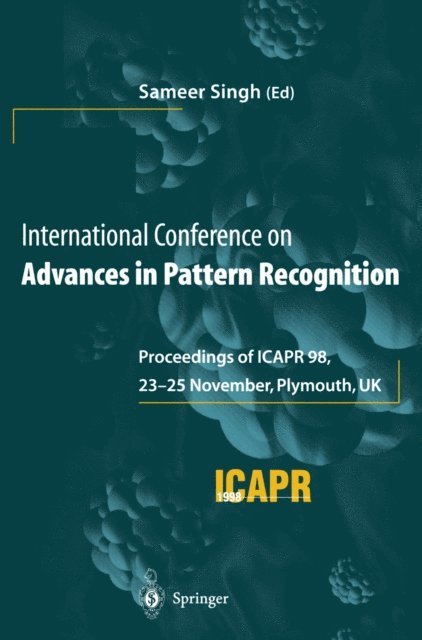
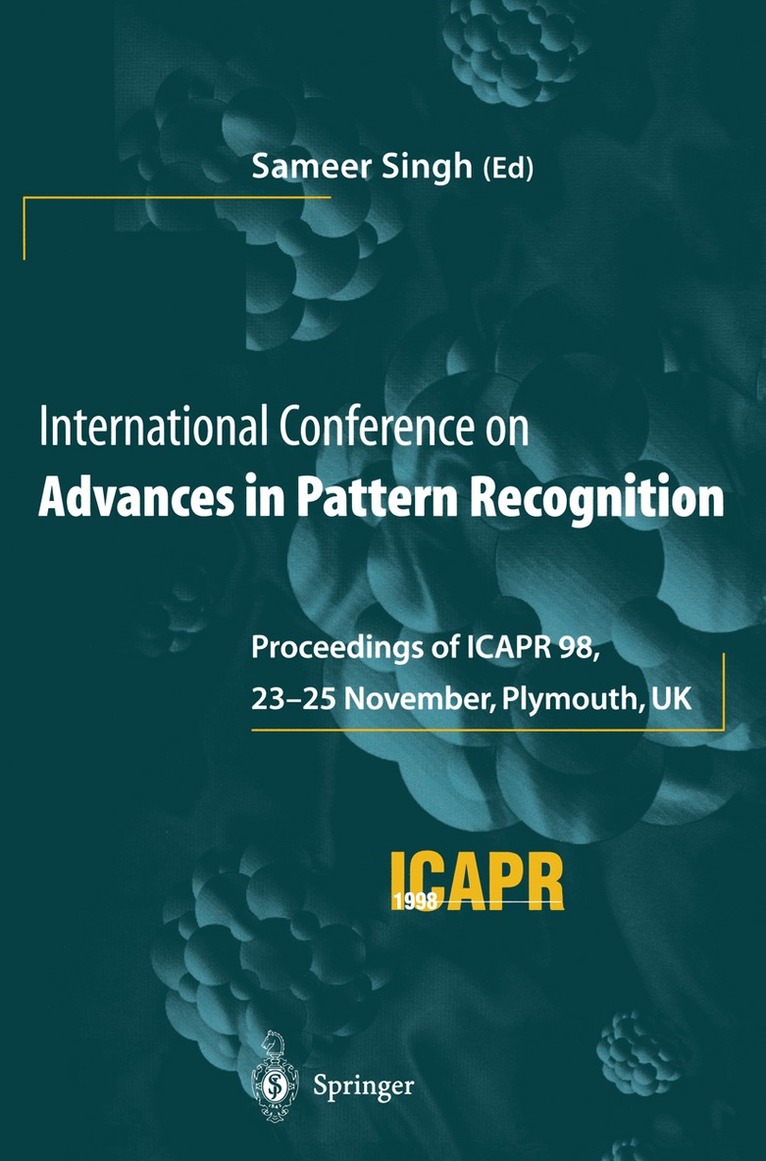
International Conference on Advances in Pattern Recognition (ICAPR 98) at Plymouth represents an important meeting for advanced research in pattern recognition. There is considerable interest in the areas of image processing, medical imaging, speech recognition, document analysis and character recognition, fuzzy data analysis and neural networks. ICAPR 98 is aimed at providing an international platform for invited research in this multi-disciplinary area. It is expected that the conference will grow in future years to include more research contributions that detail state-of the-art research in pattern recognition. ICAPR 98 attracted contributions from different countries of the highest quality. I should like to thank the programme and organising committee for doing an excellent job in organising this conference. The peer reviewed nature of the conference ensured high quality publications in these proceedings. My personal thanks to Mrs. Barbara Davies who served as conference secretary and worked tirelessly in organising the conference. I thank the organising chair for the local arrangements and our should also key-note, plenary and tutorial speakers for their valuable contributions to the conference. I also thank Springer-Verlag for publishing these proceedings that will be a valuable source of research reference for the readers. Finally, I thank all participants who made this conference successful.
Häftad, Engelska, 2012
2 166 kr
Skickas inom 10-15 vardagar
Medical imaging is an important topic which is generally recognised as key to better diagnosis and patient care. It has experienced an explosive growth over the last few years due to imaging modalities such as X-rays, computed tomography (CT), magnetic resonance (MR) imaging, and ultrasound.This book focuses primarily on state-of-the-art model-based segmentation techniques which are applied to cardiac, brain, breast and microscopic cancer cell imaging. It includes contributions from authors based in both industry and academia and presents a host of new material including algorithms for:- brain segmentation applied to MR;- neuro-application using MR; - parametric and geometric deformable models for brain segmentation;- left ventricle segmentation and analysis using least squares and constrained least squares models for cardiac X-rays; - left ventricle analysis in echocardioangiograms;- breast lesion detection in digital mammograms;detection of cells in cell images.As an overview of the latest techniques, this book will be of particular interest to students and researchers in medical engineering, image processing, computer graphics, mathematical modelling and data analysis. It will also be of interest to researchers in the fields of mammography, cardiology, pathology and neurology.
Häftad, Engelska, 2011
1 119 kr
Skickas inom 10-15 vardagar
International Conference on Advances in Pattern Recognition (ICAPR 98) at Plymouth represents an important meeting for advanced research in pattern recognition. There is considerable interest in the areas of image processing, medical imaging, speech recognition, document analysis and character recognition, fuzzy data analysis and neural networks. ICAPR 98 is aimed at providing an international platform for invited research in this multi-disciplinary area. It is expected that the conference will grow in future years to include more research contributions that detail state-of the-art research in pattern recognition. ICAPR 98 attracted contributions from different countries of the highest quality. I should like to thank the programme and organising committee for doing an excellent job in organising this conference. The peer reviewed nature of the conference ensured high quality publications in these proceedings. My personal thanks to Mrs. Barbara Davies who served as conference secretary and worked tirelessly in organising the conference. I thank the organising chair for the local arrangements and our should also key-note, plenary and tutorial speakers for their valuable contributions to the conference. I also thank Springer-Verlag for publishing these proceedings that will be a valuable source of research reference for the readers. Finally, I thank all participants who made this conference successful.
Inbunden, Engelska, 2007
1 681 kr
Skickas inom 10-15 vardagar
Overview andGoals Pattern recognition has evolved as a mature field of data analysis and its practice involves decision making using a wide variety of machine learning tools. Over the last three decades, substantial advances have been made in the areas of classification, prediction, optimisation and planning algorithms. Inparticular, the advances made in the areas of non-linear classification, statistical pattern recognition, multi-objective optimisation, string matching and uncertainty management are notable. These advances have been triggered by the availability of cheap computing power which allows large quantities of data to be processed in a very short period of time, and therefore developed algorithms can be tested easily on real problems. The current focus of pattern recognition research and development is to take laboratory solutions to commercial applications. The main goal of this book is to provide researchers with some of the latest novel techniques in the area of pattern recognition, and to show the potential of such techniques on real problems. The book will provide an excellent background to pattern recognition students and researchers into latest algorithms for pattern matching, and classification and their practical applications for imaging and non-imaging applications. Organization and Features The book is organised in two parts. The first nine chapters of the book describe novel advances in the areas of graph matching, information fusion, data clustering and classification, feature extraction and decision making under uncertainty.
Häftad, Engelska, 2010
1 681 kr
Skickas inom 10-15 vardagar
Overview andGoals Pattern recognition has evolved as a mature field of data analysis and its practice involves decision making using a wide variety of machine learning tools. Over the last three decades, substantial advances have been made in the areas of classification, prediction, optimisation and planning algorithms. Inparticular, the advances made in the areas of non-linear classification, statistical pattern recognition, multi-objective optimisation, string matching and uncertainty management are notable. These advances have been triggered by the availability of cheap computing power which allows large quantities of data to be processed in a very short period of time, and therefore developed algorithms can be tested easily on real problems. The current focus of pattern recognition research and development is to take laboratory solutions to commercial applications. The main goal of this book is to provide researchers with some of the latest novel techniques in the area of pattern recognition, and to show the potential of such techniques on real problems. The book will provide an excellent background to pattern recognition students and researchers into latest algorithms for pattern matching, and classification and their practical applications for imaging and non-imaging applications. Organization and Features The book is organised in two parts. The first nine chapters of the book describe novel advances in the areas of graph matching, information fusion, data clustering and classification, feature extraction and decision making under uncertainty.
Inbunden, Engelska, 2001
2 797 kr
Skickas inom 10-15 vardagar
Medical imaging is an important topic which is generally recognised as key to better diagnosis and patient care. It has experienced an explosive growth over the last few years due to imaging modalities such as X-rays, computed tomography (CT), magnetic resonance (MR) imaging, and ultrasound.This book focuses primarily on state-of-the-art model-based segmentation techniques which are applied to cardiac, brain, breast and microscopic cancer cell imaging. It includes contributions from authors based in both industry and academia and presents a host of new material including algorithms for:- brain segmentation applied to MR;- neuro-application using MR; - parametric and geometric deformable models for brain segmentation;- left ventricle segmentation and analysis using least squares and constrained least squares models for cardiac X-rays; - left ventricle analysis in echocardioangiograms;- breast lesion detection in digital mammograms;detection of cells in cell images.As an overview of the latest techniques, this book will be of particular interest to students and researchers in medical engineering, image processing, computer graphics, mathematical modelling and data analysis. It will also be of interest to researchers in the fields of mammography, cardiology, pathology and neurology.
Häftad, Engelska, 2005
1 125 kr
Skickas inom 10-15 vardagar
This LNCS volume contains the papers presented at the 3rd International C- ferenceonAdvances in PatternRecognition(ICAPR2005)organizedin August, 2005 in the beautiful city of Bath, UK. The conference was ?rst organized in November 1998 in Plymouth, UK and subsequently in March 2001 in Rio de Janeiro, Brazil. The conference encouraged papers that made signi?cant th- reticalandapplication-basedcontributions inpatternrecognition. The emphasis was on an open exchange of ideas and shared learning. The papers submitted to ICAPR 2005 were thoroughly reviewed by up to three referees per paper and less than 40% of the submitted papers were accepted. The papers have been ?nally published as two volumes of LNCS and these are organized under the themes of Pattern Recognition and Data Mining (which included papers from the trackson PatternRecognition Methods, Knowledgeand Learning,and Data Mining), and Pattern Recognition and Image Analysis (which included papers from the Applications track). From the conference technical programme point of view, the ?rst volume contains papers on pattern recognition, data mining, signal processing and OCR/document analysis.The second volume contains - pers from the Workshop on Pattern Recognition for Crime Prevention, Security and Surveillance, Biometrics, Image Processing and Medical Imaging. ICAPR 2005was run in parallel with the InternationalWorkshop on Pattern Recognition for Crime Prevention, Security and Surveillance that was organized onthe22ndofAugust,2005. Thisworkshopbroughttogethera number ofexc- lent papers that focussed on how pattern recognition techniques can be used to developsystemsthathelpwithcrimepreventionanddetection. Onthesameday, a number of tutorials were also organized.
E-bok
PDF, Engelska, 20051 408 kr
Läs direkt efter köp
Häftad, Engelska, 2005
1 125 kr
Skickas inom 10-15 vardagar
This LNCS volume contains the papers presented at the 3rd International C- ferenceonAdvances in PatternRecognition(ICAPR2005)organizedin August, 2005 in the beautiful city of Bath, UK. The conference was ?rst organized in November 1998 in Plymouth, UK and subsequently in March 2001 in Rio de Janeiro, Brazil. The conference encouraged papers that made signi?cant th- reticalandapplication-basedcontributions inpatternrecognition. The emphasis was on an open exchange of ideas and shared learning. The papers submitted to ICAPR 2005 were thoroughly reviewed by up to three referees per paper and less than 40% of the submitted papers were accepted. The papers have been ?nally published as two volumes of LNCS and these are organized under the themes of Pattern Recognition and Data Mining (which included papers from the trackson PatternRecognition Methods, Knowledgeand Learning,and Data Mining), and Pattern Recognition and Image Analysis (which included papers from the Applications track). From the conference technical programme point of view, the ?rst volume contains papers on pattern recognition, data mining, signal processing and OCR/document analysis.The second volume contains - pers from the Workshop on Pattern Recognition for Crime Prevention, Security and Surveillance, Biometrics, Image Processing and Medical Imaging. ICAPR 2005was run in parallel with the InternationalWorkshop on Pattern Recognition for Crime Prevention, Security and Surveillance that was organized onthe22ndofAugust,2005. Thisworkshopbroughttogethera number ofexc- lent papers that focussed on how pattern recognition techniques can be used to developsystemsthathelpwithcrimepreventionanddetection. Onthesameday, a number of tutorials were also organized.
E-bok
PDF, Engelska, 20051 408 kr
Läs direkt efter köp
Häftad, Engelska, 2001
565 kr
Skickas inom 10-15 vardagar
The paper is organized as follows: In section 2, we describe the no- orientation-discontinuity interfering model based on a Gaussian stochastic model in analyzing the properties of the interfering strokes. In section 3, we describe the improved canny edge detector with an ed- orientation constraint to detect the edges and recover the weak ones of the foreground words and characters; In section 4, we illustrate, discuss and evaluate the experimental results of the proposed method, demonstrating that our algorithm significantly improves the segmentation quality; Section 5 concludes this paper. 2. The norm-orientation-discontinuity interfering stroke model Figure 2 shows three typical samples of original image segments from the original documents and their magnitude of the detected edges respectively. The magnitude of the gradient is converted into the gray level value. The darker the edge is, the larger is the gradient magnitude. It is obvious that the topmost strong edges correspond to foreground edges. It should be noted that, while usually, the foreground writing appears darker than the background image, as shown in sample image Figure 2(a), there are cases where the foreground and background have similar intensities as shown in Figure 2(b), or worst still, the background is more prominent than the foreground as in Figure 2(c). So using only the intensity value is not enough to differentiate the foreground from the background. (a) (b) (c) (d) (e) (f)
E-bok
PDF, Engelska, 2003734 kr
Läs direkt efter köp
The paper is organized as follows: In section 2, we describe the no- orientation-discontinuity interfering model based on a Gaussian stochastic model in analyzing the properties of the interfering strokes. In section 3, we describe the improved canny edge detector with an ed- orientation constraint to detect the edges and recover the weak ones of the foreground words and characters; In section 4, we illustrate, discuss and evaluate the experimental results of the proposed method, demonstrating that our algorithm significantly improves the segmentation quality; Section 5 concludes this paper. 2. The norm-orientation-discontinuity interfering stroke model Figure 2 shows three typical samples of original image segments from the original documents and their magnitude of the detected edges respectively. The magnitude of the gradient is converted into the gray level value. The darker the edge is, the larger is the gradient magnitude. It is obvious that the topmost strong edges correspond to foreground edges. It should be noted that, while usually, the foreground writing appears darker than the background image, as shown in sample image Figure 2(a), there are cases where the foreground and background have similar intensities as shown in Figure 2(b), or worst still, the background is more prominent than the foreground as in Figure 2(c). So using only the intensity value is not enough to differentiate the foreground from the background. (a) (b) (c) (d) (e) (f)
Häftad, Tyska, 2026
1 074 kr
Skickas inom 5-8 vardagar
Häftad, Franska, 2026
1 074 kr
Skickas inom 5-8 vardagar
Häftad, Italienska, 2026
1 074 kr
Skickas inom 5-8 vardagar
Häftad, Portugisiska, 2026
1 074 kr
Skickas inom 5-8 vardagar