Sandeep Devgan – författare
Visar alla böcker från författaren Sandeep Devgan. Handla med fri frakt och snabb leverans.
5 produkter
5 produkter
Inbunden, Engelska, 2025
1 793 kr
Skickas inom 10-15 vardagar
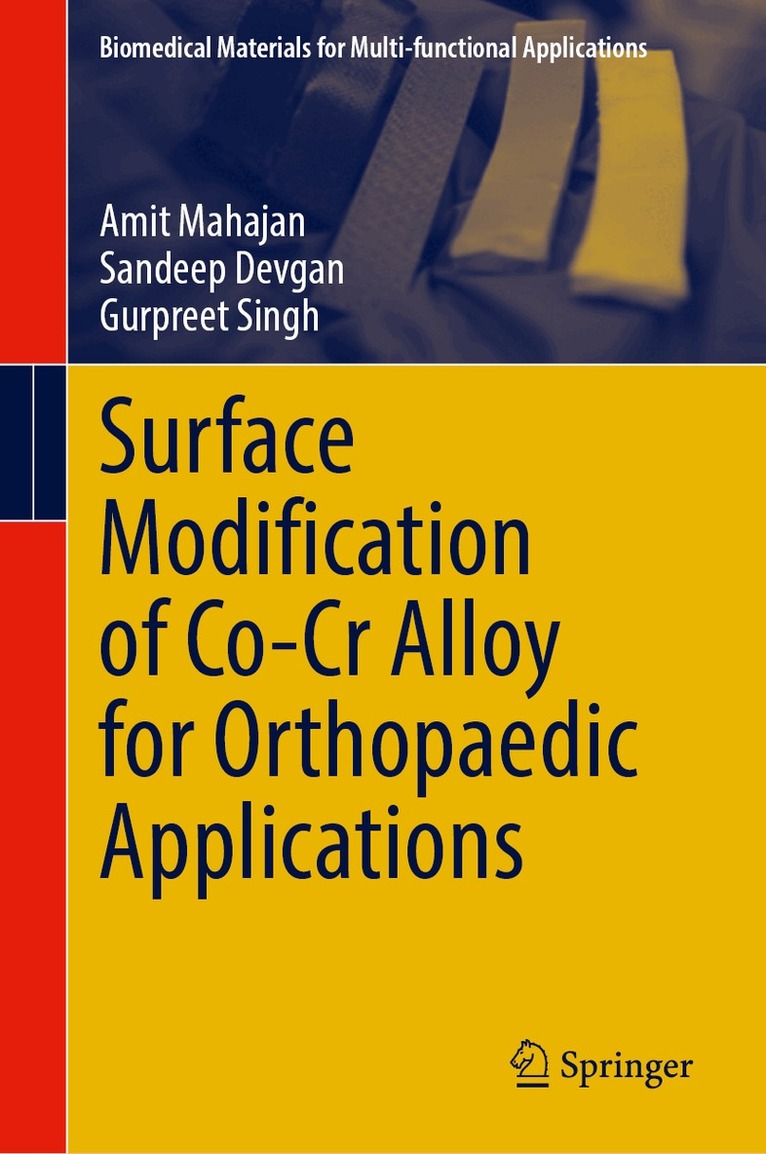
This monograph focuses on the surface modification of medical-grade Co-Cr (ASTM F75) alloy using the Electrical Discharge Machining (EDM) to enhance the biological response, corrosion resistance, and surface properties of metallic implants. The aim is to improve long-term implant functionality by addressing critical challenges such as inflammatory responses, bacterial infections, wear, corrosion, and loosening, which often lead to implant failure and revision surgeries. The work is structured into three stages: in Stage I, a full factorial experimental array was designed by varying current and pulse-on-time to analyze the influence of spark energy on the Co-Cr alloy surface; in Stage II, Taguchi’s L18 orthogonal array was employed to examine the effects of discharge current, pulse-on-time, pause time, dielectric medium, and tool electrode, with corrosion reactivity assessed in biological environments using potentiodynamic techniques; in Stage III, tribological properties and in-vitro cytotoxicity were studied through wear rate and coefficient of friction tests on a pin-on-disc tribometer in ringer solution. Surface characterization using SEM, EDX, and XRD provided detailed insights into the impact of EDM on surface features. This book will serve as a valuable resource for researchers and students in biomaterials, offering guidance on recent trends and applications for enhancing implant bioactivity, adaptability, and durability.
E-bok
Engelska, 20252 273 kr
Läs direkt efter köp
This monograph focuses on the surface modification of medical-grade Co-Cr (ASTM F75) alloy using the Electrical Discharge Machining (EDM) to enhance the biological response, corrosion resistance, and surface properties of metallic implants. The aim is to improve long-term implant functionality by addressing critical challenges such as inflammatory responses, bacterial infections, wear, corrosion, and loosening, which often lead to implant failure and revision surgeries. The work is structured into three stages: in Stage I, a full factorial experimental array was designed by varying current and pulse-on-time to analyze the influence of spark energy on the Co-Cr alloy surface; in Stage II, Taguchi’s L18 orthogonal array was employed to examine the effects of discharge current, pulse-on-time, pause time, dielectric medium, and tool electrode, with corrosion reactivity assessed in biological environments using potentiodynamic techniques; in Stage III, tribological properties and in-vitro cytotoxicity were studied through wear rate and coefficient of friction tests on a pin-on-disc tribometer in ringer solution. Surface characterization using SEM, EDX, and XRD provided detailed insights into the impact of EDM on surface features. This book will serve as a valuable resource for researchers and students in biomaterials, offering guidance on recent trends and applications for enhancing implant bioactivity, adaptability, and durability.
Inbunden, Engelska, 2024
1 605 kr
Skickas inom 5-8 vardagar
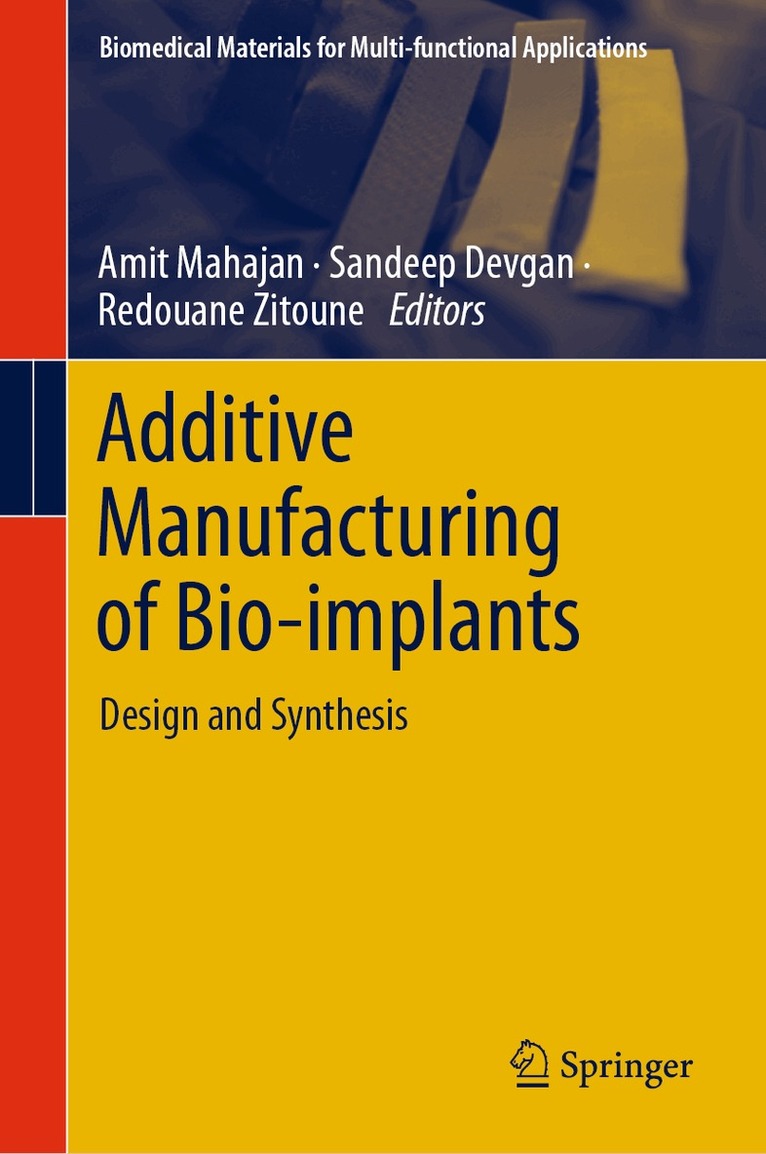
This contributed volume presents the latest research on additive manufacturing (AM) or 3D printing, one of the key techniques of novel medical devices, which can process complicated or customized structures to match the properties of human tissues. AM allows for the fabrication of devices with optimal architectures, complicated morphologies, surface integrity, and regulated porosity and chemical composition. Various AM methods can now consistently fabricate dense products for a variety of materials, comprising steels, titanium alloys, Co-Cr alloys, metal-based composites, and nanocomposites. This book elucidates the chronology of various techniques that are categorized under additive manufacturing. Moreover, the futuristic techniques or advancements in this area are also described. The available literature focuses on the microstructure and various properties of 3D-printed alloys. However, the research on the wear characteristics, corrosion resistance, and biocompatibility of 3D-printedtechnology for biomedical applications is limited. This book comprises the helicopter view of different surface analysis trends of additive manufactured alloys. The book can be a valuable reference for beginners, researchers, and professionals interested in bioimplant manufacturing and allied fields.
Häftad, Engelska, 2025
1 633 kr
Skickas inom 10-15 vardagar
This contributed volume presents the latest research on additive manufacturing (AM) or 3D printing, one of the key techniques of novel medical devices, which can process complicated or customized structures to match the properties of human tissues. AM allows for the fabrication of devices with optimal architectures, complicated morphologies, surface integrity, and regulated porosity and chemical composition. Various AM methods can now consistently fabricate dense products for a variety of materials, comprising steels, titanium alloys, Co-Cr alloys, metal-based composites, and nanocomposites. This book elucidates the chronology of various techniques that are categorized under additive manufacturing. Moreover, the futuristic techniques or advancements in this area are also described. The available literature focuses on the microstructure and various properties of 3D-printed alloys. However, the research on the wear characteristics, corrosion resistance, and biocompatibility of 3D-printedtechnology for biomedical applications is limited. This book comprises the helicopter view of different surface analysis trends of additive manufactured alloys. The book can be a valuable reference for beginners, researchers, and professionals interested in bioimplant manufacturing and allied fields.
E-bok
Engelska, 20241 977 kr
Läs direkt efter köp
This contributed volume presents the latest research on additive manufacturing (AM) or 3D printing, one of the key techniques of novel medical devices, which can process complicated or customized structures to match the properties of human tissues. AM allows for the fabrication of devices with optimal architectures, complicated morphologies, surface integrity, and regulated porosity and chemical composition. Various AM methods can now consistently fabricate dense products for a variety of materials, comprising steels, titanium alloys, Co-Cr alloys, metal-based composites, and nanocomposites. This book elucidates the chronology of various techniques that are categorized under additive manufacturing. Moreover, the futuristic techniques or advancements in this area are also described. The available literature focuses on the microstructure and various properties of 3D-printed alloys. However, the research on the wear characteristics, corrosion resistance, and biocompatibility of 3D-printedtechnology for biomedical applications is limited. This book comprises the helicopter view of different surface analysis trends of additive manufactured alloys. The book can be a valuable reference for beginners, researchers, and professionals interested in bioimplant manufacturing and allied fields.