Sanjay Kaul – Författare
Visar alla böcker från författaren Sanjay Kaul. Handla med fri frakt och snabb leverans.
5 produkter
5 produkter
820 kr
Skickas inom 11-20 vardagar
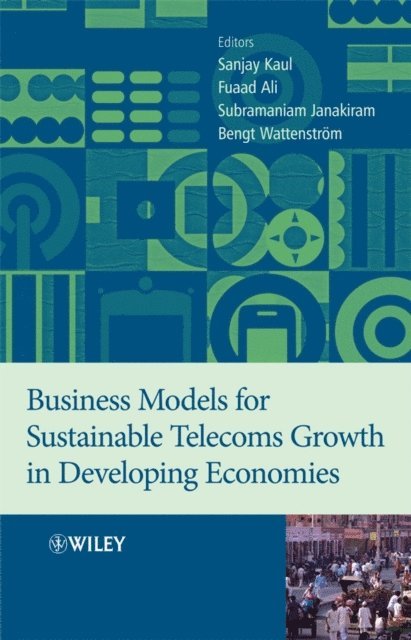
A little more than 3 billion people have access to basic mobile telephony, with 48% living close to or below the poverty line. These people, the so-called ‘mass market’, lack access to basic communications technology. An ongoing issue facing communications providers is how to facilitate and promote communications access to those who live in rural areas of developing economies. The authors utilize their considerable ‘hands on’ experience of working in successful telecommunications companies in order to address the challenges of creating, facilitating and maintaining sustainable telecommunications growth in developing nations. With this focus in mind the authors present a snapshot of these countries through real life case studies.Sustainable Telecoms Growth in Developing Economies: Presents innovative and sustainable business models to address telecommunications adoption in developing countries.Identifies the inherent drivers and barriers in the mass-market adoption of mobile services in developing economies.Discusses the impact and importance of telecoms in developing nations including customer needs and Internet-based services.Highlights the current state of communications in such markets.Includes real-world case studies and interviews with telecoms CEOs from all over the world.The author team provides decision makers, professionals, and application developers in IT, telecommunications and media with a thorough understanding of the current state and future evolution of sustainable telecommunications in developing countries. The book will also be of interest to advanced students in electrical engineering and telecommunications, analysts, and consultants with an interest in growing economies.
1 909 kr
Skickas inom 10-15 vardagar
This book provides a revamped, transformative, and fiscally sustainable developmental agenda for India to radically improve the well-being and livelihoods of its citizens. Grounded in a ‘people first’ approach, this alternative agenda focuses on seven vital development and inter-connected areas, including health, education, food and nutrition, child development, gender, livelihood and jobs, and urbanization. The volume highlights the systemic issues plaguing these sectors and offers pragmatic and implementable solutions to address them. The author takes cognizance of the COVID-19 pandemic and draws attention to the limitations of the current public policies and suggests cost-effective interventions and strategies that focus on the poor. The volume discusses crucial themes of universalizing healthcare, battling malnutrition and food insecurity, ensuring quality schooling, unshackling gendered mindsets, enhancing livelihoods and improving the urban quality of life to spell out a pragmatic and workable development agenda for India.Accessible and reader-friendly, the book will be an essential read for scholars and researchers of development studies, economics, public policy, governance, development policy, public administration, political studies, South Asia studies. It will also be of interest to professionals in the development sector.
578 kr
Skickas inom 10-15 vardagar
This book provides a revamped, transformative, and fiscally sustainable developmental agenda for India to radically improve the well-being and livelihoods of its citizens. Grounded in a ‘people first’ approach, this alternative agenda focuses on seven vital development and inter-connected areas, including health, education, food and nutrition, child development, gender, livelihood and jobs, and urbanization. The volume highlights the systemic issues plaguing these sectors and offers pragmatic and implementable solutions to address them. The author takes cognizance of the COVID-19 pandemic and draws attention to the limitations of the current public policies and suggests cost-effective interventions and strategies that focus on the poor. The volume discusses crucial themes of universalizing healthcare, battling malnutrition and food insecurity, ensuring quality schooling, unshackling gendered mindsets, enhancing livelihoods and improving the urban quality of life to spell out a pragmatic and workable development agenda for India.Accessible and reader-friendly, the book will be an essential read for scholars and researchers of development studies, economics, public policy, governance, development policy, public administration, political studies, South Asia studies. It will also be of interest to professionals in the development sector.
1 009 kr
Skickas inom 10-15 vardagar
The liberalization of U.S. and European electric power markets presents a critical challenge for renewable sources of energy. Edinger and Kaul survey the technological state-of-the-art and economic aspects of renewable electricity generation, and outline the role of other renewable sources, such as solar, wind, and micro-hydroelectric technologies. Offering an empirical and theoretical assessment of these technologies and their assets and liabilities, the book shows how it is possible to restructure our electric power systems and reorient them toward sustainable and environmentally friendly alternatives.International climate conferences such as those in Rio de Janeiro and Kyoto have proclaimed the need for environmentally hospitable technologies. A new electricity system, based on renewable resources and small-scale power technologies, is needed badly; their economics and other efficiencies over conventional central power generation with fossil fuels is clear. Edinger and Kaul assess the rewards and risks associated with renewable technologies and outline a feasible path toward a more environmentally friendly, and reasonable, use of limited natural resources and the global ecosystem. One promising approach for industrialized countries is the decentralization of our current public grid systems. This offers an opportunity for developing countries to leapfrog the stage of fossil fuel, held responsible now for environmental pollution, resource depletion and possibly global climate change. The authors present theoretical analyses and empirical evidence to buttress their contentions, mainly, that electric power systems founded on renewable resources are vital prerequisites if we are to achieve the United Nations' target of globally sustained development.
1 009 kr
Skickas inom 10-15 vardagar
With energy consumption rising and with it our dependence on crude oil from politically uncertain regions, and faced with the threat to the environment from polluting emissions, it is becoming ever more evident that fuels from renewable resources are an increasingly attractive option to fossil fuels. Edinger and Kaul, like a growing number of other experts, hold the mobility of populations—transportation, in other words—responsposible for the rise in the rate of greenhouse gas emissions, a condition that can only get worse as less developed regions of the world emerge with their own needs and demands for mobility. What to do? Edinger and Kaul outline in sharp detail the shortcomings of current vehicular technologies and dominant fossil fuels. They present a careful, authoritative examination of innovative technologies that in their opinion have the best chance of combating dangerous reliance on conventional means of power, not only for transportation but other purposes as well. And they focus on special forms of fuel cell drive systems, with their high efficiencies and reduced consumptions, and on other emerging renewable technologies and their innovative, sustainable power sources—such as fuels from biomass and renewable electricity, a particularly promising source of energy for newly growing economies. Wide ranging in coverage, forthright in style, the book is an important review of how things are today, why they could get worse, but perhaps most importantly, what we can do about it.