Santosh K. Gupta - Böcker
Visar alla böcker från författaren Santosh K. Gupta. Handla med fri frakt och snabb leverans.
2 produkter
2 produkter
536 kr
Skickas inom 10-15 vardagar
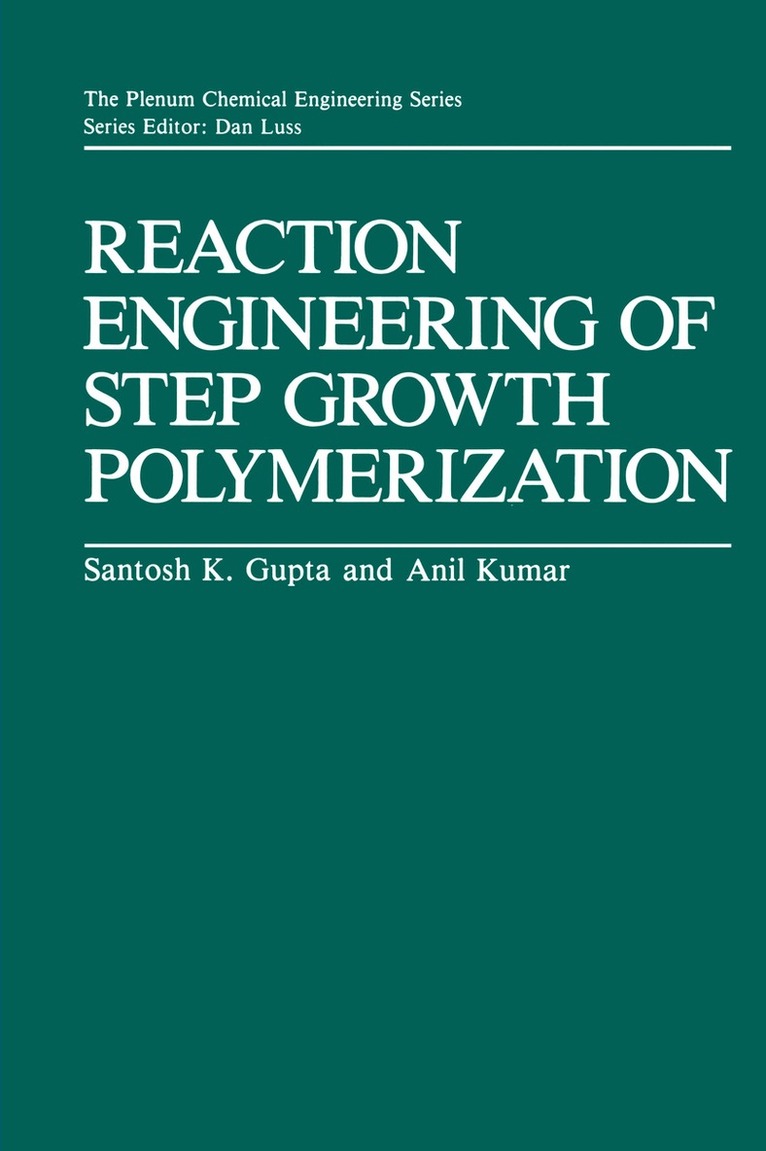
The literature in polymerization reaction engineering has bloomed sufficiently in the last several years to justify our attempt in putting together this book. Rather than offer a comprehensive treatment of the entire field, thereby duplicating earlier texts as well as some ongoing bookwriting efforts, we decided to narrow down our aim to step growth polymerization systems. This not only provides us the lUxury of a more elaborate presentation within the constraints of production costs, but also enables us to remain on somewhat familiar terrain. The style and format we have selected are those of a textbook. The first six chapters present the principles of step growth polymerization. These are quite general, and can easily be applied in such diverse and emerging fields as polymerization applications in photolithography and microelec tronics. A detailed discussion of several important step growth polymeriz ations follows in the next five chapters. One could cover the first six chapters of this book in about six to eight weeks of a three-credit graduate course on polymerization reactors, with the other chapters assigned for reading. This could be followed by a discussion of chain-growth and other polymeriz ations, with which our material blends well. Alternately, the entire contents of this book could be covered in a course on step growth systems alone.
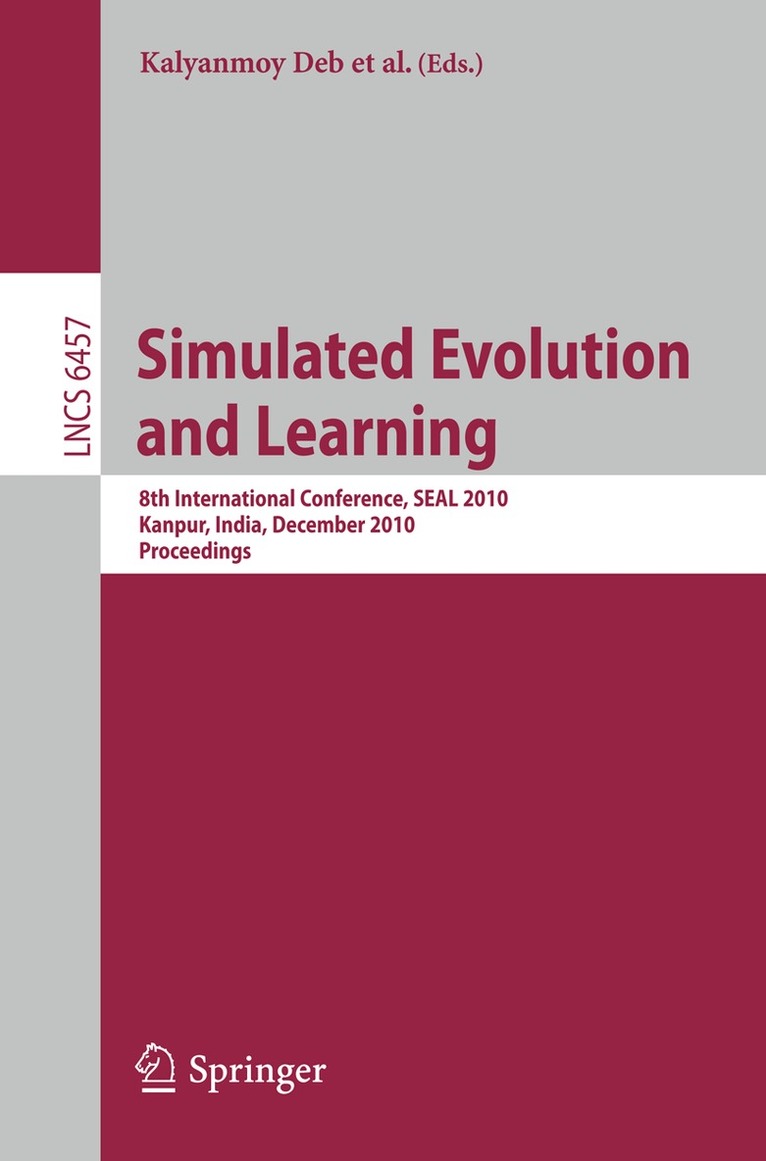
Simulated Evolution and Learning
8th International Conference, SEAL 2010, Kanpur, India, December 1-4, 2010, Proceedings
Häftad, Engelska, 2010
1 096 kr
Skickas inom 10-15 vardagar
ThisLNCSvolumecontainsthepaperspresentedatthe8thSimulatedEvolution and Learning (SEAL 2010) Conference held during December 1-4, 2010 at the Indian Institute of Technology Kanpur in India. SEAL is a prestigious inter- tional conference series in evolutionaryoptimization and machine learning. This biennial event started in Seoul, South Korea in 1996 and was thereafter held in Canberra, Australia in 1998, Nagoya, Japan in 2000, Singapore in 2002, Busan, South Korea in 2004,Hefei, China in 2006and Melbourne, Australia in 2008. SEAL 2010 received 141 paper submissions in total from 30 countries. After a rigorous peer-review process involving 431 reviews in total (averaging a little morethan3reviewsperpaper),60full-lengthand19shortpaperswereaccepted for presentation (both oral and poster) at the conference. The full-length papers alonecorrespondtoa42. 6%acceptancerateandshortpapersaddanother13. 5%. ThepapersincludedinthisLNCSvolumecoverawiderangeoftopicsinsi- latedevolutionandlearning. Theacceptedpapershavebeenclassi?edintothef- lowingmaincategories:(a)theoreticaldevelopments,(b)evolutionaryalgorithms andapplications,(c)learningmethodologies,(d)multi-objectiveevolutionary- gorithms and applications,(e) hybrid algorithms and (f) industrial applications.The conference featured three distinguished keynote speakers. Narendra Karmarkar's talk on "Beyond Convexity: New Perspectives in Computational Optimization" focused on providing new theoretical concepts for non-convex optimization and indicated a rich connection between optimization and ma- ematical physics and also showed a deep signi?cance of advanced geometry to optimization. The advancement of optimization theory for non-convex problems is bene?cial for meta-heuristic optimization algorithms such as evolutionary - gorithms. Manindra Agrawal's talk on "PRIMES is in P" provided a mu- improved version of his celebrated and ground-breaking 2002 work on poly- mial time algorithm for testing prime numbers. The theoretical computation work presented in this keynote lecture should be motivating for the evolutionary optimization and machine learning community at large.