Sara B. Pritchard - Böcker
Visar alla böcker från författaren Sara B. Pritchard. Handla med fri frakt och snabb leverans.
4 produkter
4 produkter
471 kr
Kommande
Who owns the night—and what is lost as we flood it with light, worldwide? Darkness has become legible—and contested. Blending archival narrative with on-the-ground ethnography, Sara B. Pritchard traces how four fields—astronomy, remote sensing, conservation science, and ecology—have investigated artificial light at night, turning a ubiquitous convenience into a category of harm. From observatories chasing ever-receding darkness to the satellite images that first rendered a nocturnal planet from space and recent “Black Marble” maps, Pritchard shows how methods, instruments, and field sites shape what scientists can know about night and light—and what remains unseen. Across these encounters, night emerges not as a backdrop but as an environment in its own right—one transformed by rapidly expanding, brightening illumination in the Anthropocene. The book chronicles the ascent of “light pollution,” as well as the new challenge of space-based brightness from satellite constellations, even as dark-sky advocates fight to preserve the starry firmament. Attentive to politics as much as photons, Pritchard brings environmental justice to the fore—highlighting tensions among light poverty, forced illumination, and surveillance and calls for “beneficial darkness.” She takes seriously Indigenous astronomers’ critiques of dispossession and “astro-colonialism,” asking what it means to site world-class telescopes on sacred land. Sweeping from local parks to planetary vistas, Transforming Night reframes a familiar story of modern light as a history of changing nights—past, present, and possible. It will engage readers in environmental history and humanities, science and technology studies, and the sciences themselves, along with dark-sky activists and anyone drawn to the beauty and politics of the world after nightfall.
1 689 kr
Kommande
Who owns the night—and what is lost as we flood it with light, worldwide? Darkness has become legible—and contested. Blending archival narrative with on-the-ground ethnography, Sara B. Pritchard traces how four fields—astronomy, remote sensing, conservation science, and ecology—have investigated artificial light at night, turning a ubiquitous convenience into a category of harm. From observatories chasing ever-receding darkness to the satellite images that first rendered a nocturnal planet from space and recent “Black Marble” maps, Pritchard shows how methods, instruments, and field sites shape what scientists can know about night and light—and what remains unseen. Across these encounters, night emerges not as a backdrop but as an environment in its own right—one transformed by rapidly expanding, brightening illumination in the Anthropocene. The book chronicles the ascent of “light pollution,” as well as the new challenge of space-based brightness from satellite constellations, even as dark-sky advocates fight to preserve the starry firmament. Attentive to politics as much as photons, Pritchard brings environmental justice to the fore—highlighting tensions among light poverty, forced illumination, and surveillance and calls for “beneficial darkness.” She takes seriously Indigenous astronomers’ critiques of dispossession and “astro-colonialism,” asking what it means to site world-class telescopes on sacred land. Sweeping from local parks to planetary vistas, Transforming Night reframes a familiar story of modern light as a history of changing nights—past, present, and possible. It will engage readers in environmental history and humanities, science and technology studies, and the sciences themselves, along with dark-sky activists and anyone drawn to the beauty and politics of the world after nightfall.
Del 172 - Harvard Historical Studies
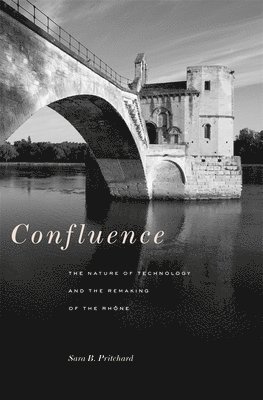
Confluence
The Nature of Technology and the Remaking of the Rhône
Inbunden, Engelska, 2011
541 kr
Skickas inom 7-10 vardagar
Because of its location, volume, speed, and propensity for severe flooding, the Rhône, France’s most powerful river, has long influenced the economy, politics, and transportation networks of Europe. Humans have tried to control the Rhône for over two thousand years, but large-scale development did not occur until the twentieth century. The Rhône valley has undergone especially dramatic changes since World War II. Hydroelectric plants, nuclear reactors, and industrialized agriculture radically altered the river, as they simultaneously fueled both the physical and symbolic reconstruction of France.In Confluence, Sara B. Pritchard traces the Rhône’s remaking since 1945. She interweaves this story with an analysis of how state officials, technical elites, and citizens connected the environment and technology to political identities and state-building. In the process, Pritchard illuminates the relationship between nature and nation in France.Pritchard’s innovative integration of science and technology studies, environmental history, and the political history of modern France makes a powerful case for envirotechnical analysis: an approach that highlights the material and rhetorical links between ecological and technological systems. Her groundbreaking book demonstrates the importance of environmental management and technological development to culture and politics in the twentieth century. As Pritchard shows, reconstructing the Rhône remade France itself.
321 kr
Skickas inom 7-10 vardagar
New perspectives on how envirotech can help us engage with the surrounding world in ways that are more sustainable for humanity—and the planet.Today's scientists, policymakers, and citizens are all confronted by numerous dilemmas at the nexus of technology and the environment. Every day seems to bring new worries about the dangers posed by carcinogens, "superbugs," energy crises, invasive species, genetically modified organisms, groundwater contamination, failing infrastructure, and other troubling issues. In Technology and the Environment in History, Sara B. Pritchard and Carl A. Zimring adopt an analytical approach to explore current research at the intersection of environmental history and the history of technology—an emerging field known as envirotech. Technology and the Environment in History They discuss the important topics, historical processes, and scholarly concerns that have emerged from recent work in thinking about envirotech. Each chapter focuses on a different urgent topic: • Food and Food Systems: How humans have manipulated organisms and ecosystems to produce nutrients for societies throughout history.• Industrialization: How environmental processes have constrained industrialization and required shifts in the relationships between human and nonhuman nature.• Discards: What we can learn from the multifaceted forms, complex histories, and unexpected possibilities of waste.• Disasters: How disaster, which the authors argue is common in the industrialized world, exposes the fallacy of tidy divisions among nature, technology, and society.• Body: How bodies reveal the porous boundaries among technology, the environment, and the human.• Sensescapes: How environmental and technological change have reshaped humans' (and potentially nonhumans') sensory experiences over time.Using five concepts to understand the historical relationships between technology and the environment—porosity, systems, hybridity, biopolitics, and environmental justice—Pritchard and Zimring propose a chronology of key processes, moments, and periodization in the history of technology and the environment. Ultimately, they assert, envirotechnical perspectives help us engage with the surrounding world in ways that are, we hope, more sustainable and just for both humanity and the planet. Aimed at students and scholars new to environmental history, the history of technology, and their nexus, this impressive synthesis looks outward and forward—identifying promising areas in more formative stages of intellectual development and current synergies with related areas that have emerged in the past few years, including environmental anthropology, discard studies, and posthumanism.