Sarah B. Snyder - Böcker
Visar alla böcker från författaren Sarah B. Snyder. Handla med fri frakt och snabb leverans.
6 produkter
6 produkter
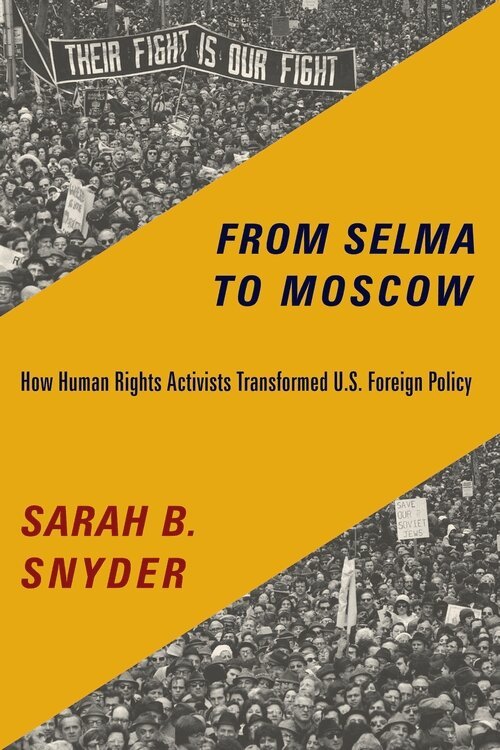
From Selma to Moscow
How Human Rights Activists Transformed U.S. Foreign Policy
Inbunden, Engelska, 2018
1 031 kr
Skickas inom 7-10 vardagar
The 1960s marked a transformation of human rights activism in the United States. At a time of increased concern for the rights of their fellow citizens—civil and political rights, as well as the social and economic rights that Great Society programs sought to secure—many Americans saw inconsistencies between domestic and foreign policy and advocated for a new approach. The activism that arose from the upheavals of the 1960s fundamentally altered U.S. foreign policy—yet previous accounts have often overlooked its crucial role.In From Selma to Moscow, Sarah B. Snyder traces the influence of human rights activists and advances a new interpretation of U.S. foreign policy in the “long 1960s.” She shows how transnational connections and social movements spurred American activism that achieved legislation that curbed military and economic assistance to repressive governments, created institutions to monitor human rights around the world, and enshrined human rights in U.S. foreign policy making for years to come. Snyder analyzes how Americans responded to repression in the Soviet Union, racial discrimination in Southern Rhodesia, authoritarianism in South Korea, and coups in Greece and Chile. By highlighting the importance of nonstate and lower-level actors, Snyder shows how this activism established the networks and tactics critical to the institutionalization of human rights. A major work of international and transnational history, From Selma to Moscow reshapes our understanding of the role of human rights activism in transforming U.S. foreign policy in the 1960s and 1970s and highlights timely lessons for those seeking to promote a policy agenda resisted by the White House.
From Selma to Moscow
How Human Rights Activists Transformed U.S. Foreign Policy
Häftad, Engelska, 2018
259 kr
Skickas inom 7-10 vardagar
The 1960s marked a transformation of human rights activism in the United States. At a time of increased concern for the rights of their fellow citizens—civil and political rights, as well as the social and economic rights that Great Society programs sought to secure—many Americans saw inconsistencies between domestic and foreign policy and advocated for a new approach. The activism that arose from the upheavals of the 1960s fundamentally altered U.S. foreign policy—yet previous accounts have often overlooked its crucial role.In From Selma to Moscow, Sarah B. Snyder traces the influence of human rights activists and advances a new interpretation of U.S. foreign policy in the “long 1960s.” She shows how transnational connections and social movements spurred American activism that achieved legislation that curbed military and economic assistance to repressive governments, created institutions to monitor human rights around the world, and enshrined human rights in U.S. foreign policy making for years to come. Snyder analyzes how Americans responded to repression in the Soviet Union, racial discrimination in Southern Rhodesia, authoritarianism in South Korea, and coups in Greece and Chile. By highlighting the importance of nonstate and lower-level actors, Snyder shows how this activism established the networks and tactics critical to the institutionalization of human rights. A major work of international and transnational history, From Selma to Moscow reshapes our understanding of the role of human rights activism in transforming U.S. foreign policy in the 1960s and 1970s and highlights timely lessons for those seeking to promote a policy agenda resisted by the White House.
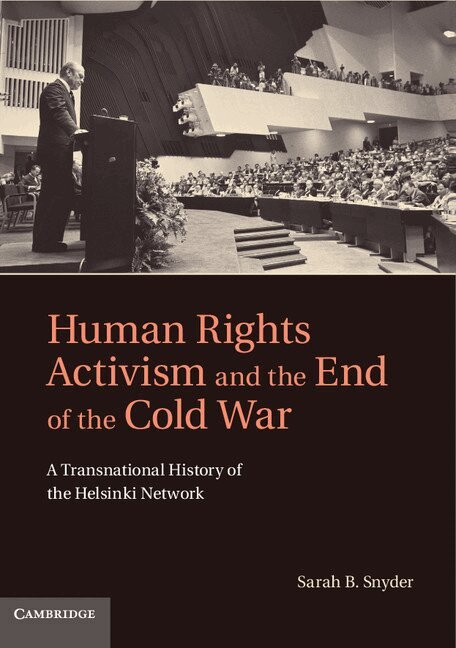
Human Rights Activism and the End of the Cold War
A Transnational History of the Helsinki Network
Inbunden, Engelska, 2011
1 282 kr
Skickas inom 7-10 vardagar
Two of the most pressing questions facing international historians today are how and why the Cold War ended. Human Rights Activism and the End of the Cold War explores how, in the aftermath of the signing of the Helsinki Final Act in 1975, a transnational network of activists committed to human rights in the Soviet Union and Eastern Europe made the topic a central element in East-West diplomacy. As a result, human rights eventually became an important element of Cold War diplomacy and a central component of détente. Sarah B. Snyder demonstrates how this network influenced both Western and Eastern governments to pursue policies that fostered the rise of organized dissent in Eastern Europe, freedom of movement for East Germans and improved human rights practices in the Soviet Union - all factors in the end of the Cold War.
Human Rights Activism and the End of the Cold War
A Transnational History of the Helsinki Network
Häftad, Engelska, 2013
331 kr
Skickas inom 7-10 vardagar
Two of the most pressing questions facing international historians today are how and why the Cold War ended. Human Rights Activism and the End of the Cold War explores how, in the aftermath of the signing of the Helsinki Final Act in 1975, a transnational network of activists committed to human rights in the Soviet Union and Eastern Europe made the topic a central element in East-West diplomacy. As a result, human rights eventually became an important element of Cold War diplomacy and a central component of détente. Sarah B. Snyder demonstrates how this network influenced both Western and Eastern governments to pursue policies that fostered the rise of organized dissent in Eastern Europe, freedom of movement for East Germans and improved human rights practices in the Soviet Union - all factors in the end of the Cold War.
CSCE and the End of the Cold War
Diplomacy, Societies and Human Rights, 1972-1990
Inbunden, Engelska, 2018
2 229 kr
Skickas inom 3-6 vardagar
Since its inception, the Conference on Security and Cooperation in Europe has faced controversy. Today it is widely regarded as a contributing factor in the end of the Cold War, with some observers even claiming that it ushered in a "post-Westphalian" era in which multilateral diplomacy and social processes drive geopolitics. Bringing together new and innovative research on the CSCE, this volume revisits key questions in Cold War historiography: To what extent did states aid or resist the emergence of a "Helsinki paradigm?" Was the CSCE an effective response to democratic aspirations? And what was the role of nonstate actors in the eventual transformation of Europe?
CSCE and the End of the Cold War
Diplomacy, Societies and Human Rights, 1972-1990
Häftad, Engelska, 2020
654 kr
Skickas inom 3-6 vardagar
From its inception, the Conference on Security and Cooperation in Europe (CSCE) provoked controversy. Today it is widely regarded as having contributed to the end of the Cold War. Bringing together new and innovative research on the CSCE, this volume explores questions key to understanding the Cold War: What role did diplomats play in shaping the 1975 Helsinki Final Act? How did that agreement and the CSCE more broadly shape societies in Europe and North America? And how did the CSCE and activists inspired by the Helsinki Final Act influence the end of the Cold War?