
Sarah Beckwith – författare
Visar alla böcker från författaren Sarah Beckwith. Handla med fri frakt och snabb leverans.
8 produkter
8 produkter
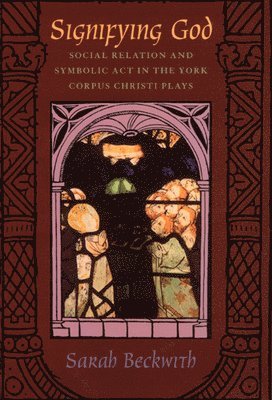
Häftad, Engelska, 2003
330 kr
Skickas inom 5-8 vardagar
In "Signifying God" Sarah Beckwith explores the most lavish, long-lasting, and complex form of collective theatrical enterprise in English history: the York Corpus Christi plays. First staged as early as 1376, the plays were performed annually until the late 1500s and involved as much as a tenth of the city in multiple performances at a dozen or more locations. Introducing a radical new understanding of these plays as "sacramental theater," Beckwith shows how organizing the plays served as a political mechanism for regulating labor, and how theater and sacrament combined in them to do important theological work. She argues, for instance, that the theology of Corpus Christi in the resurrection plays can only be understood as a theatrical exploration of eucharistic absence and presence. Beckwith frames her study with discussions of twentieth-century manifestations of sacramental theater in Barry Unsworth's novel "Morality Play" and Denys Arcand's film "Jesus of Montreal", and the connections between contemporary revivals of the York Corpus Christi plays and England's heritage culture.
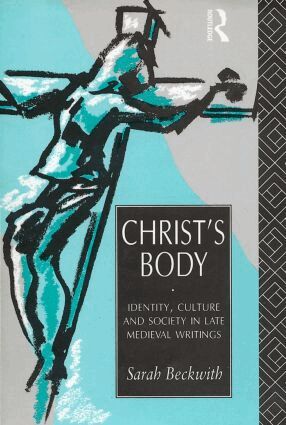
Häftad, Engelska, 1996
671 kr
Skickas inom 10-15 vardagar
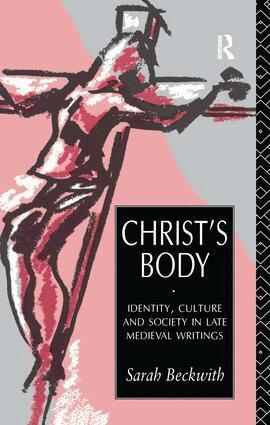
At the very heart of Christian doctrine and late medieval practice was the image of the crucified Christ. Sarah Beckwith examines the social meaning of this image across a range of key devotional English texts, using insights from anthropology and cultural studies.The image of the crucified Christ, she argues, acted as a place where the tensions between the sacred and the profane, the individual and the collective, were played out. The medieval obsession with the contours of Christ's body functioned to challenge and transform social and political relations.A fascinating and challenging book of interest not only to students of medieval literature, but also to cultural historians and women's studies specialists.
Inbunden, Engelska, 2011
986 kr
Skickas inom 10-15 vardagar
Shakespeare lived at a time when England was undergoing the revolution in ritual theory and practice we know as the English Reformation. With it came an unprecedented transformation in the language of religious life. Whereas priests had once acted as mediators between God and men through sacramental rites, Reformed theology declared the priesthood of all believers. What ensued was not the tidy replacement of one doctrine by another but a long and messy conversation about the conventions of religious life and practice. In this brilliant and strikingly original book, Sarah Beckwith traces the fortunes of this conversation in Shakespeare's theater. Beckwith focuses on the sacrament of penance, which in the Middle Ages stood as the very basis of Christian community and human relations. With the elimination of this sacrament, the words of penance and repentance—"confess," "forgive," "absolve" —no longer meant (no longer could mean) what they once did. In tracing the changing speech patterns of confession and absolution, both in Shakespeare's work and Elizabethan and Jacobean culture more broadly, Beckwith reveals Shakespeare's profound understanding of the importance of language as the fragile basis of our relations with others. In particular, she shows that the post-tragic plays, especially Pericles, Cymbeline, The Winter's Tale, and The Tempest, are explorations of the new regimes and communities of forgiveness. Drawing on the work of J. L. Austin, Ludwig Wittgenstein, and Stanley Cavell, Beckwith enables us to see these plays in an entirely new light, skillfully guiding us through some of the deepest questions that Shakespeare poses to his audiences.
Häftad, Engelska, 2013
318 kr
Skickas inom 10-15 vardagar
Shakespeare lived at a time when England was undergoing the revolution in ritual theory and practice we know as the English Reformation. With it came an unprecedented transformation in the language of religious life. Whereas priests had once acted as mediators between God and men through sacramental rites, Reformed theology declared the priesthood of all believers. What ensued was not the tidy replacement of one doctrine by another but a long and messy conversation about the conventions of religious life and practice. In this brilliant and strikingly original book, Sarah Beckwith traces the fortunes of this conversation in Shakespeare's theater. Beckwith focuses on the sacrament of penance, which in the Middle Ages stood as the very basis of Christian community and human relations. With the elimination of this sacrament, the words of penance and repentance—"confess," "forgive," "absolve" —no longer meant (no longer could mean) what they once did. In tracing the changing speech patterns of confession and absolution, both in Shakespeare's work and Elizabethan and Jacobean culture more broadly, Beckwith reveals Shakespeare's profound understanding of the importance of language as the fragile basis of our relations with others. In particular, she shows that the post-tragic plays, especially Pericles, Cymbeline, The Winter's Tale, and The Tempest, are explorations of the new regimes and communities of forgiveness. Drawing on the work of J. L. Austin, Ludwig Wittgenstein, and Stanley Cavell, Beckwith enables us to see these plays in an entirely new light, skillfully guiding us through some of the deepest questions that Shakespeare poses to his audiences.
Inbunden, Engelska, 2016
2 453 kr
Skickas inom 10-15 vardagar
At the very heart of Christian doctrine and late medieval practice was the image of the crucified Christ. Sarah Beckwith examines the social meaning of this image across a range of key devotional English texts, using insights from anthropology and cultural studies.The image of the crucified Christ, she argues, acted as a place where the tensions between the sacred and the profane, the individual and the collective, were played out. The medieval obsession with the contours of Christ's body functioned to challenge and transform social and political relations.A fascinating and challenging book of interest not only to students of medieval literature, but also to cultural historians and women's studies specialists.
Inbunden, Engelska, 2025
1 809 kr
Skickas inom 10-15 vardagar
Shakespeare and Loss explores how, in Shakespeare's late tragedies (Hamlet, King Lear, Timon of Athens, Macbeth, Coriolanus, and Antony and Cleopatra), some of the most fundamental forms of understanding and life that bind human communities together – grieving; loving; giving; acting and doing; speaking and being human; marrying, conversing, and judging – can become dangerously, even lethally obscure. These losses, Sarah Beckwith contends, shape the form, plot, and preoccupations that the late tragedies take and define them as a group, which she terms "tragedies of exile."This unprecedented and searing run of tragedies written between 1601 and 1608 features protagonists who are driven out (or drive themselves out) of family and society, finding themselves banished (or seeking exile) to the edgelands of civilization. Using philosophical insights from Ludwig Wittgenstein and Stanley Cavell, Shakespeare and Loss shows that the exile of these protagonists is ultimately linguistic. They are exiled from sense and intelligibility, stripping from them vital concepts of human bonding – loving, grieving, giving – that they realize are precious only when it is too late.
Häftad, Engelska, 2025
380 kr
Skickas inom 10-15 vardagar
Shakespeare and Loss explores how, in Shakespeare's late tragedies (Hamlet, King Lear, Timon of Athens, Macbeth, Coriolanus, and Antony and Cleopatra), some of the most fundamental forms of understanding and life that bind human communities together – grieving; loving; giving; acting and doing; speaking and being human; marrying, conversing, and judging – can become dangerously, even lethally obscure. These losses, Sarah Beckwith contends, shape the form, plot, and preoccupations that the late tragedies take and define them as a group, which she terms "tragedies of exile."This unprecedented and searing run of tragedies written between 1601 and 1608 features protagonists who are driven out (or drive themselves out) of family and society, finding themselves banished (or seeking exile) to the edgelands of civilization. Using philosophical insights from Ludwig Wittgenstein and Stanley Cavell, Shakespeare and Loss shows that the exile of these protagonists is ultimately linguistic. They are exiled from sense and intelligibility, stripping from them vital concepts of human bonding – loving, grieving, giving – that they realize are precious only when it is too late.
Inbunden, Engelska, 2001
637 kr
Tillfälligt slut
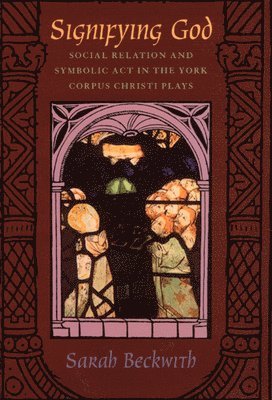
In Signifying God, Sarah Beckwith explores the most lavish, long-lasting, and complex form of collective theatrical enterprise in English history: the York Corpus Christi plays. First staged as early as 1376, the plays were performed annually until the late 1500s and involved as much as a tenth of the city in multiple performances at a dozen or more locations.Introducing a radical new understanding of these plays as "sacramental theater," Beckwith shows how organizing the plays served as a political mechanism for regulating labor, and how theater and sacrament combined in them to do important theological work. She argues, for instance, that the theology of Corpus Christi in the resurrection plays can only be understood as a theatrical exploration of eucharistic absence and presence. Beckwith frames her study with discussions of twentieth-century manifestations of sacramental theater in Barry Unsworth's novel Morality Play and Denys Arcand's film Jesus of Montreal, and the connections between contemporary revivals of the York Corpus Christi plays and England's heritage culture.