Sarah Cohen-Boulakia – författare
Visar alla böcker från författaren Sarah Cohen-Boulakia. Handla med fri frakt och snabb leverans.
3 produkter
3 produkter
E-bok
PDF, Engelska, 2008962 kr
Läs direkt efter köp
For several years now, there has been an exponential growth of the amount of life science data (e. g. , sequenced complete genomes, 3D structures, DNA chips, mass spectroscopy data), most of which are generated by high-throughput - periments. This exponentialcorpusof data is storedand made availablethrough a large number of databases and resources over the Web, but unfortunately still with a high degreeof semantic heterogeneity and varying levels of quality. These data must be combined together and processed by bioinformatics tools deployed on powerful and e?cient platforms to permit the uncovering of patterns, s- ilarities and in general to help in the process of discovery. Analyzing complex, voluminous, and heterogeneous data and guiding the analysis of data are thus of paramount importance and necessitate the involvement of data integration techniques. DILS 2008 was the ?fth in a workshop series that aims at fostering disc- sion, exchange, and innovation in research and development in the area of data integration for the life sciences. Each previous DILS workshop attracted around 100 researchers from all over the world and saw an increase of submitted - pers over the preceding one. This year was not an exception and the number of submitted papers increased to 54. The ProgramCommittee selected 18 of them. The selected papers cover a wide spectrum of theoretical and practical issues including data annotation, Semantic Web for the life sciences, and data mining on integrated biological data.
Häftad, Engelska, 2007
562 kr
Skickas inom 10-15 vardagar
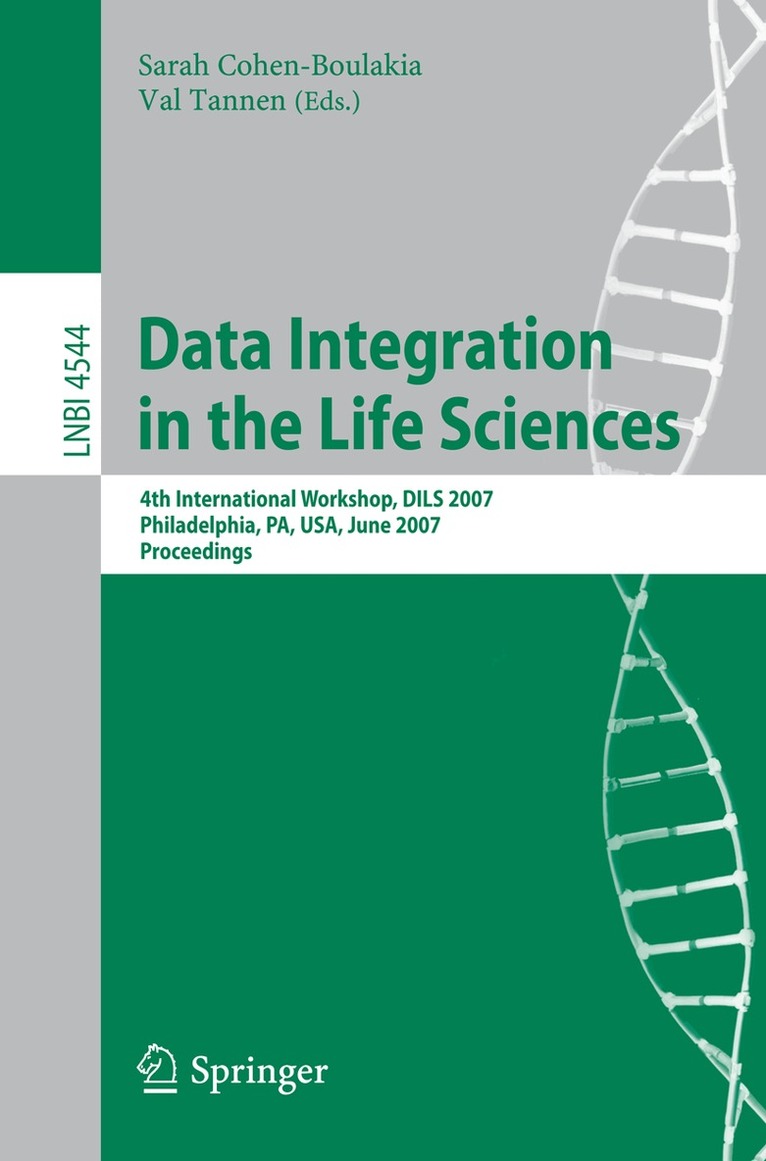
Understanding the mechanisms involved in life (e. g. , discovering the biological functionofasetofproteins,inferringtheevolutionofasetofspecies)isbecoming increasinglydependent onprogressmade inmathematics,computer science,and molecular engineering. For the past 30 years, new high-throughput technologies have been developed generating large amounts of data, distributed across many data sources on the Web, with a high degree of semantic heterogeneity and di?erentlevelsofquality. However,onesuchdatasetisnot,byitself,su?cientfor scienti?c discovery. Instead, it must be combined with other data and processed by bioinformatics tools for patterns, similarities, and unusual occurrences to be observed. Both data integration and data mining are thus of paramount importance in life science. DILS 2007 was the fourth in a workshop series that aims at fostering d- cussion, exchange, and innovation in research and development in the areas of data integration and data management for the life sciences. Each previous DILS workshop attracted around 100 researchers from all over the world. This year, the number of submitted papers again increased. The Program Committee - lected 19 papers out of 52 full submissions. The DILS 2007 papers cover a wide spectrum of theoretical and practical issues including scienti?c work?ows, - notation in data integration, mapping and matching techniques, and modeling of life science data. Among the papers, we distinguished 13 papers presenting research on new models, methods, or algorithms and 6 papers presenting imp- mentation of systems or experience with systems in practice. In addition to the presented papers, DILS 2007 featured two keynote talks by Kenneth H. Buetow, National Cancer Institute, and Junhyong Kim, University of Pennsylvania.
E-bok
PDF, Engelska, 2007712 kr
Läs direkt efter köp
Understanding the mechanisms involved in life (e. g. , discovering the biological functionofasetofproteins,inferringtheevolutionofasetofspecies)isbecoming increasinglydependent onprogressmade inmathematics,computer science,and molecular engineering. For the past 30 years, new high-throughput technologies have been developed generating large amounts of data, distributed across many data sources on the Web, with a high degree of semantic heterogeneity and di?erentlevelsofquality. However,onesuchdatasetisnot,byitself,su?cientfor scienti?c discovery. Instead, it must be combined with other data and processed by bioinformatics tools for patterns, similarities, and unusual occurrences to be observed. Both data integration and data mining are thus of paramount importance in life science. DILS 2007 was the fourth in a workshop series that aims at fostering d- cussion, exchange, and innovation in research and development in the areas of data integration and data management for the life sciences. Each previous DILS workshop attracted around 100 researchers from all over the world. This year, the number of submitted papers again increased. The Program Committee - lected 19 papers out of 52 full submissions. The DILS 2007 papers cover a wide spectrum of theoretical and practical issues including scienti?c work?ows, - notation in data integration, mapping and matching techniques, and modeling of life science data. Among the papers, we distinguished 13 papers presenting research on new models, methods, or algorithms and 6 papers presenting imp- mentation of systems or experience with systems in practice. In addition to the presented papers, DILS 2007 featured two keynote talks by Kenneth H. Buetow, National Cancer Institute, and Junhyong Kim, University of Pennsylvania.