Sarah Jack – författare
174 kr
Skickas inom 5-8 vardagar
2 558 kr
Skickas inom 10-15 vardagar
3 251 kr
Läs direkt efter köp
Family Firms (FFs) form the majority of all firms around the world and they account for an enormous percentage of the employment, the revenue, and the GDP of most capitalist countries. While MNCs have long been thought of as the main contributors to international business, it is now recognised that a substantial number of family firms are active in the international arena.
This handbook focuses on the features which make family firm internationalization unique. Chapters provide FF specific theories and cover the process of FF internationalization. It examines the role of network ties and provides an insight into the development of family firms that have grown into big multinationals. Importantly this Handbook equips you with a better understanding of specific features of family firms as they internationalize from or to Asian or emerging markets. Family firms offer a fruitful context to study internationalization through a process perspective, therefore this Handbook isan invaluable source of knowledge for students, scholars and policy makers in the areas of family business, entrepreneurship and internationalization.2 558 kr
Skickas inom 10-15 vardagar
1 784 kr
Skickas inom 3-6 vardagar
1 897 kr
Läs direkt efter köp
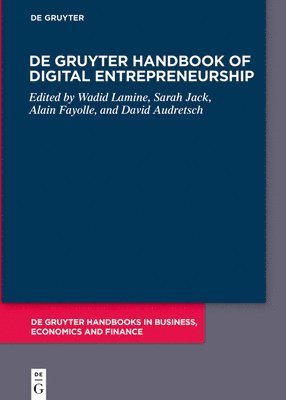
Far-reaching technological developments are making a deep impact on societies and economic environments worldwide. With the emergence of new digital infrastructures such as artificial intelligence, fintech, data analytics, robotics and nanotech, new creative industries, still in a state of flux, have arisen, while others have disappeared, at least in their traditional form. The intermixing of traditional and new technologies has led to a redrawing of boundaries and an extension of the limits of entrepreneurship out towards industries with hitherto high barriers to entry due to regulatory, technological or structural factors.
These "external enablers" have led to a democratization of entrepreneurship and a lessening of the obstacles to starting up a company by reducing (or eliminating) the difficulties inherent in the entrepreneurial phenomenon in its "classical" configuration, such as high resource intensity, uncertainty, limited time or information asymmetry. The De Gruyter Handbook of Digital Entrepreneurship examines the impact of these technological disruptions not only using the existing paradigms, but also by re-examining our very conception of the entrepreneurial phenomenon in terms of its evolving nature and shifting contours.
The contributions to this handbook promote the emergence of new theories and conceptions of the entrepreneurial opportunity and process that more fully reflect the realities of the new environment we are living in. They will benefit both academics aiming to familiarize themselves with the state of research and theory within topics and subtopics in digital entrepreneurship, as well as practicing entrepreneurs and managers aiming to acquaint themselves with leading edge practices and insights in digital entrepreneurship.
1 846 kr
Läs direkt efter köp
Far-reaching technological developments are making a deep impact on societies and economic environments worldwide. With the emergence of new digital infrastructures such as artificial intelligence, fintech, data analytics, robotics and nanotech, new creative industries, still in a state of flux, have arisen, while others have disappeared, at least in their traditional form. The intermixing of traditional and new technologies has led to a redrawing of boundaries and an extension of the limits of entrepreneurship out towards industries with hitherto high barriers to entry due to regulatory, technological or structural factors.
These "external enablers" have led to a democratization of entrepreneurship and a lessening of the obstacles to starting up a company by reducing (or eliminating) the difficulties inherent in the entrepreneurial phenomenon in its "classical" configuration, such as high resource intensity, uncertainty, limited time or information asymmetry. The De Gruyter Handbook of Digital Entrepreneurship examines the impact of these technological disruptions not only using the existing paradigms, but also by re-examining our very conception of the entrepreneurial phenomenon in terms of its evolving nature and shifting contours.
The contributions to this handbook promote the emergence of new theories and conceptions of the entrepreneurial opportunity and process that more fully reflect the realities of the new environment we are living in. They will benefit both academics aiming to familiarize themselves with the state of research and theory within topics and subtopics in digital entrepreneurship, as well as practicing entrepreneurs and managers aiming to acquaint themselves with leading edge practices and insights in digital entrepreneurship.