Sargur N Srihari - Böcker
Visar alla böcker från författaren Sargur N Srihari. Handla med fri frakt och snabb leverans.
9 produkter
9 produkter
360 kr
Skickas inom 5-8 vardagar
188 kr
Skickas inom 5-8 vardagar
300 kr
Skickas inom 3-6 vardagar
300 kr
Skickas inom 3-6 vardagar
300 kr
Skickas inom 3-6 vardagar
Computational Intelligence in Digital Forensics: Forensic Investigation and Applications
Inbunden, Engelska, 2014
1 096 kr
Skickas inom 10-15 vardagar
Computational Intelligence techniques have been widely explored in various domains including forensics. Analysis in forensic encompasses the study of pattern analysis that answer the question of interest in security, medical, legal, genetic studies and etc. However, forensic analysis is usually performed through experiments in lab which is expensive both in cost and time. Therefore, this book seeks to explore the progress and advancement of computational intelligence technique in different focus areas of forensic studies. This aims to build stronger connection between computer scientists and forensic field experts.This book, Computational Intelligence in Digital Forensics: Forensic Investigation and Applications, is the first volume in the Intelligent Systems Reference Library series. The book presents original research results and innovative applications of computational intelligence in digital forensics. This edited volume contains seventeen chapters and presents the latest state-of-the-art advancement of Computational Intelligence in Digital Forensics; in both theoretical and application papers related to novel discovery in intelligent forensics. The chapters are further organized into three sections: (1) Introduction, (2) Forensic Discovery and Investigation, which discusses the computational intelligence technologies employed in Digital Forensic, and (3) Intelligent Forensic Science Applications, which encompasses the applications of computational intelligence in Digital Forensic, such as human anthropology, human biometrics, human by products, drugs, and electronic devices.
Computational Intelligence in Digital Forensics: Forensic Investigation and Applications
Häftad, Engelska, 2016
1 096 kr
Skickas inom 10-15 vardagar
Computational Intelligence techniques have been widely explored in various domains including forensics. Analysis in forensic encompasses the study of pattern analysis that answer the question of interest in security, medical, legal, genetic studies and etc. However, forensic analysis is usually performed through experiments in lab which is expensive both in cost and time. Therefore, this book seeks to explore the progress and advancement of computational intelligence technique in different focus areas of forensic studies. This aims to build stronger connection between computer scientists and forensic field experts.This book, Computational Intelligence in Digital Forensics: Forensic Investigation and Applications, is the first volume in the Intelligent Systems Reference Library series. The book presents original research results and innovative applications of computational intelligence in digital forensics. This edited volume contains seventeen chapters and presents the latest state-of-the-art advancement of Computational Intelligence in Digital Forensics; in both theoretical and application papers related to novel discovery in intelligent forensics. The chapters are further organized into three sections: (1) Introduction, (2) Forensic Discovery and Investigation, which discusses the computational intelligence technologies employed in Digital Forensic, and (3) Intelligent Forensic Science Applications, which encompasses the applications of computational intelligence in Digital Forensic, such as human anthropology, human biometrics, human by products, drugs, and electronic devices.
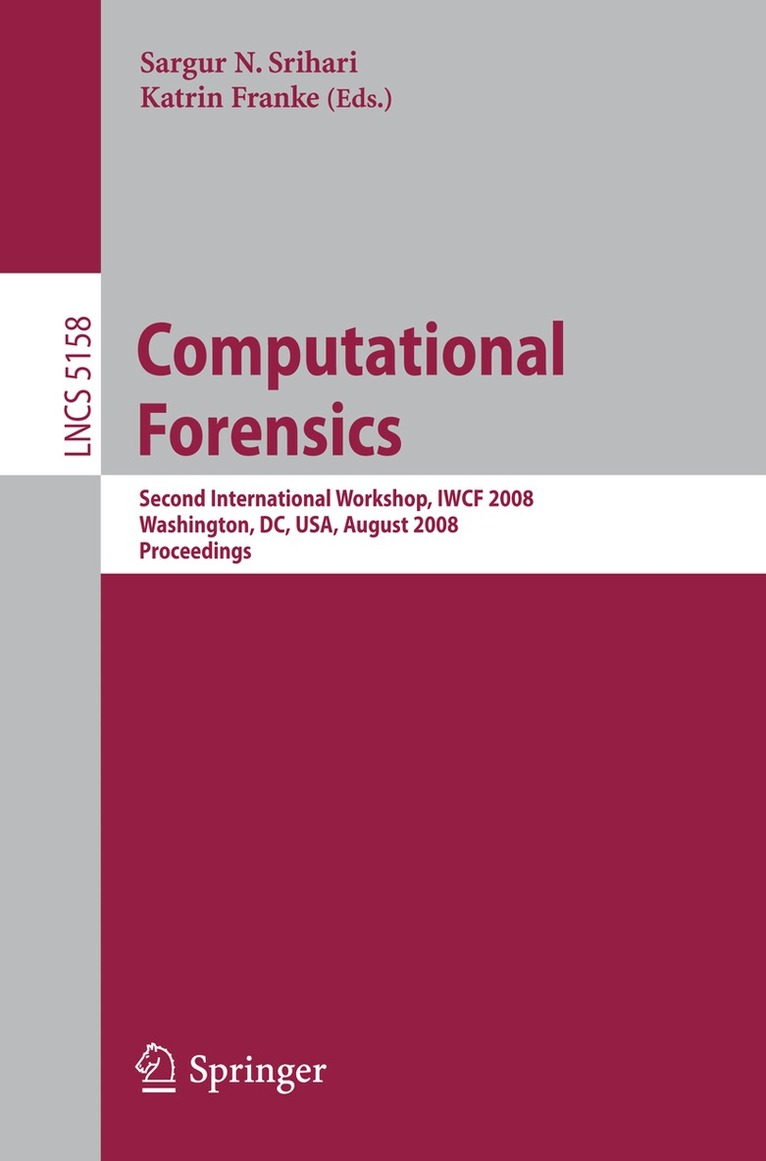
Computational Forensics
Second International Workshop, IWCF 2008, Washington, DC, USA, August 7-8, 2008, Proceedings
Häftad, Engelska, 2008
552 kr
Skickas inom 10-15 vardagar
This Lecture Notes in Computer Science (LNCS) volume contains the papers presented at the Second International Workshop on Computational Forensics (IWCF 2008), held August 7–8, 2008. It was a great honor for the organizers to host this scienti?c event at the renowned National Academy of Sciences: Keck Center in Washington, DC, USA. Computational Forensics is an emerging research domain focusing on the investigation of forensic problems using computational methods. Its primary goalis the discoveryand advancement of forensicknowledgeinvolving modeling, computer simulation, and computer-based analysis and recognition in studying and solving forensic problems. The Computational Forensics workshop series is intended as a forum for researchers and practitioners in all areas of computational and forensic sciences. This forum discusses current challenges in computer-assisted forensic investi- tions and presents recent progress and advances. IWCF addresses a broad spectrum of forensic disciplines that use computer tools for criminal investigation. This year’s edition covers presentations on c- putational methods for individuality studies, computer-based3D processing and analysis of skulls and human bodies, shoe print preprocessing and analysis, n- ural language analysis and information retrieval to support law enforcement, analysis and group visualization of speech recordings, scanner and print device forensics, and computer-based questioned document and signature analysis.
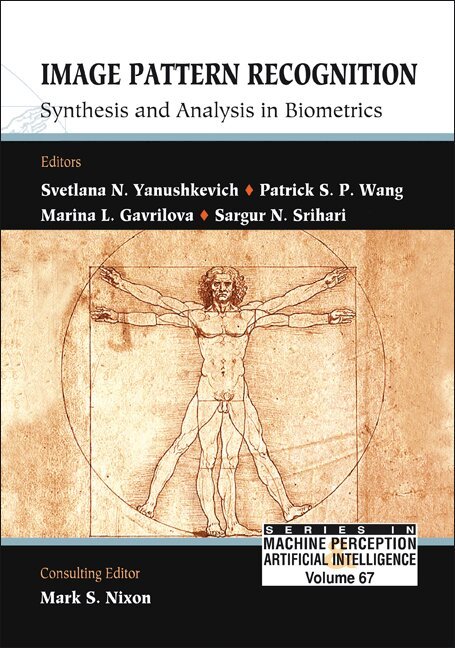
Del 67 - Series In Machine Perception And Artificial Intelligence
Image Pattern Recognition: Synthesis And Analysis In Biometrics
Inbunden, Engelska, 2007
1 908 kr
Tillfälligt slut
The field of biometrics utilizes computer models of the physical and behavioral characteristics of human beings with a view to reliable personal identification. The human characteristics of interest include visual images, speech, and indeed anything which might help to uniquely identify the individual.The other side of the biometrics coin is biometric synthesis — rendering biometric phenomena from their corresponding computer models. For example, we could generate a synthetic face from its corresponding computer model. Such a model could include muscular dynamics to model the full gamut of human emotions conveyed by facial expressions.This book is a collection of carefully selected papers presenting the fundamental theory and practice of various aspects of biometric data processing in the context of pattern recognition. The traditional task of biometric technologies — human identification by analysis of biometric data — is extended to include the new discipline of biometric synthesis.