Satoshi Murata - Böcker
Visar alla böcker från författaren Satoshi Murata. Handla med fri frakt och snabb leverans.
6 produkter
6 produkter
Del 8727 - Lecture Notes in Computer Science
DNA Computing and Molecular Programming
20th International Conference, DNA 20, Kyoto, Japan, September 22-26, 2014. Proceedings
Häftad, Engelska, 2014
432 kr
Skickas inom 10-15 vardagar
This book constitutes the refereed proceedings of the 20th International Conference on DNA Computing and Molecular Programming, DNA 20, held in Kyoto, Japan, in September 2014. The 10 full papers presented were carefully selected from 55 submissions. The papers are organized in many disciplines (including mathematics, computer science, physics, chemistry, material science and biology) to address the analysis, design, and synthesis of information-based molecular systems.
1 069 kr
Skickas inom 10-15 vardagar
It is man’s ongoing hope that a machine could somehow adapt to its environment by reorganizing itself. This is what the notion of self-organizing robots is based on. The theme of this book is to examine the feasibility of creating such robots within the limitations of current mechanical engineering. The topics comprise the following aspects of such a pursuit: the philosophy of design of self-organizing mechanical systems; self-organization in biological systems; the history of self-organizing mechanical systems; a case study of a self-assembling/self-repairing system as an autonomous distributed system; a self-organizing robot that can create its own shape and robotic motion; implementation and instrumentation of self-organizing robots; and the future of self-organizing robots. All topics are illustrated with many up-to-date examples, including those from the authors’ own work. The book does not require advanced knowledge of mathematics to be understood, and will be of great benefitto students in the robotics discipline, including in the areas of mechanics, control, electronics, and computer science. It is also an important source for researchers who wish to investigate the field of robotics or who have an interest in the application of self-organizing phenomena.
1 069 kr
Skickas inom 10-15 vardagar
It is man’s ongoing hope that a machine could somehow adapt to its environment by reorganizing itself. This is what the notion of self-organizing robots is based on. The theme of this book is to examine the feasibility of creating such robots within the limitations of current mechanical engineering. The topics comprise the following aspects of such a pursuit: the philosophy of design of self-organizing mechanical systems; self-organization in biological systems; the history of self-organizing mechanical systems; a case study of a self-assembling/self-repairing system as an autonomous distributed system; a self-organizing robot that can create its own shape and robotic motion; implementation and instrumentation of self-organizing robots; and the future of self-organizing robots. All topics are illustrated with many up-to-date examples, including those from the authors’ own work. The book does not require advanced knowledge of mathematics to be understood, and will be of great benefitto students in the robotics discipline, including in the areas of mechanics, control, electronics, and computer science. It is also an important source for researchers who wish to investigate the field of robotics or who have an interest in the application of self-organizing phenomena.
1 795 kr
Skickas inom 10-15 vardagar
In this book, researchers at the forefront of the field explain the minimum necessary background knowledge and introduce important topics in molecular robotics in an easy-to-understand manner.Molecular robotics is related to many fields, such as systems engineering, control engineering, computer science, biochemistry, biophysics, polymer chemistry, nucleic acid chemistry, molecular biology, and ethics. The whole picture of molecular robotics can be grasped only by looking at these fields from a bird's-eye view. This book has been planned in the belief that such a book is essential for students and those new to the field to understand the ongoing expansion of molecular robotics.The book consists of eight chapters: introduction, design theory of molecular robots, systemization technology, molecular nanotechnology, molecular actuators, molecular materials, medical applications, and social acceptance. In each chapter, the reader can get a general idea of the theory, underlying technology, medical applications, and social issues, and can also understand what is currently being done on the research front. In addition, there are many parts that introduce topics related to molecular robotics.
1 795 kr
Skickas inom 10-15 vardagar
In this book, researchers at the forefront of the field explain the minimum necessary background knowledge and introduce important topics in molecular robotics in an easy-to-understand manner.Molecular robotics is related to many fields, such as systems engineering, control engineering, computer science, biochemistry, biophysics, polymer chemistry, nucleic acid chemistry, molecular biology, and ethics. The whole picture of molecular robotics can be grasped only by looking at these fields from a bird's-eye view. This book has been planned in the belief that such a book is essential for students and those new to the field to understand the ongoing expansion of molecular robotics.The book consists of eight chapters: introduction, design theory of molecular robots, systemization technology, molecular nanotechnology, molecular actuators, molecular materials, medical applications, and social acceptance. In each chapter, the reader can get a general idea of the theory, underlying technology, medical applications, and social issues, and can also understand what is currently being done on the research front. In addition, there are many parts that introduce topics related to molecular robotics.
1 848 kr
Skickas inom 7-10 vardagar
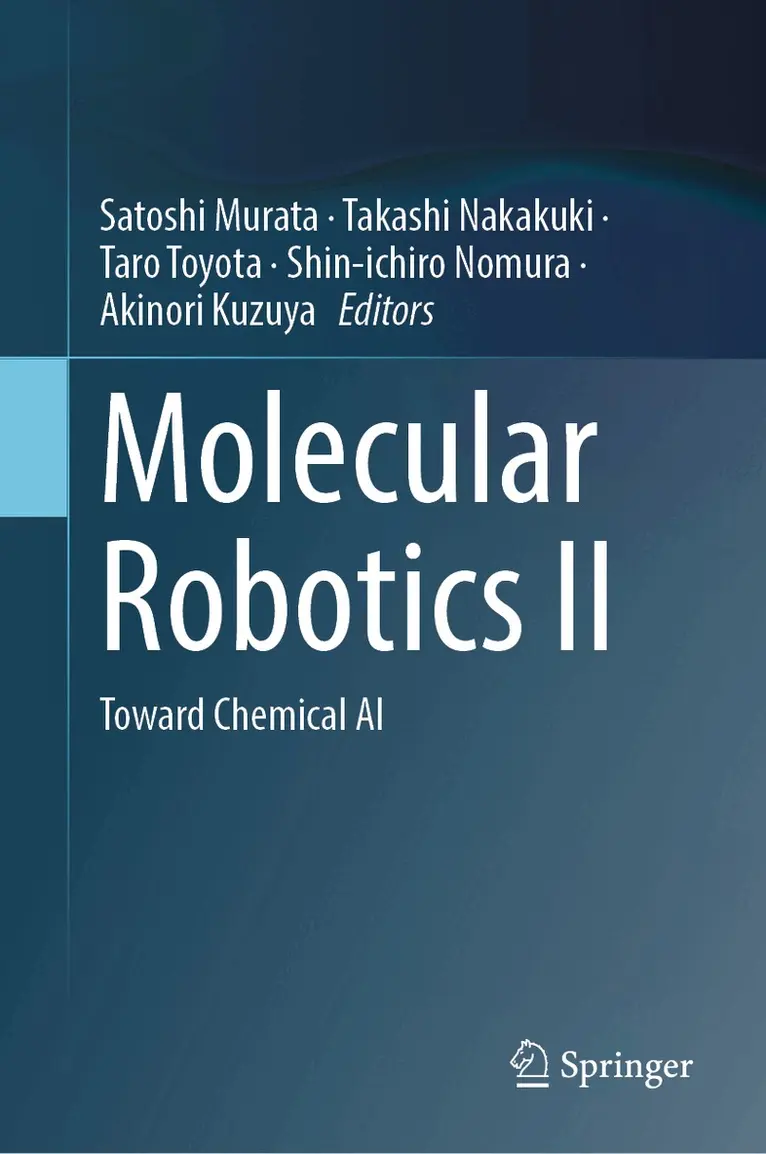
This book proposes an innovative concept of chemical AI and discusses fundamental technologies, methods, and theories used for Molecular Cybernetics. Research on so-called “chemical artificial intelligence” (CAI) is an emerging field with the aim of constructing information-processing systems with learning capabilities based on chemical methodologies. This can be regarded as an attempt to reconstruct Cybernetics using molecular based systems. Many chemical reaction systems with computational abilities are proposed, but most are fixed functions that deliver molecular output for a given molecular input. On the other hand, chemical AI is a system with learning capability; namely, the output should be variable and gradually change upon repeated molecular inputs.Toward “multicellular artificial cell systems” in Molecular Cybernetics, in this book, fundamental technologies, methods, and theories used for(1) assembling CAI systems consisting of many liposomes with different functions (Liposome Assembling Technologies),(2) achieving communication over two lipid-bilayer compartments (Molecular Communication),(3) achieving recursiveness and plasticity in chemical reaction systems (Memory and Learning circuit), and(4) reconfiguring the network topology by liposome deformation (Molecular Actuation) are accommodated.