Saul Greenberg - Böcker
Visar alla böcker från författaren Saul Greenberg. Handla med fri frakt och snabb leverans.
3 produkter
3 produkter
199 kr
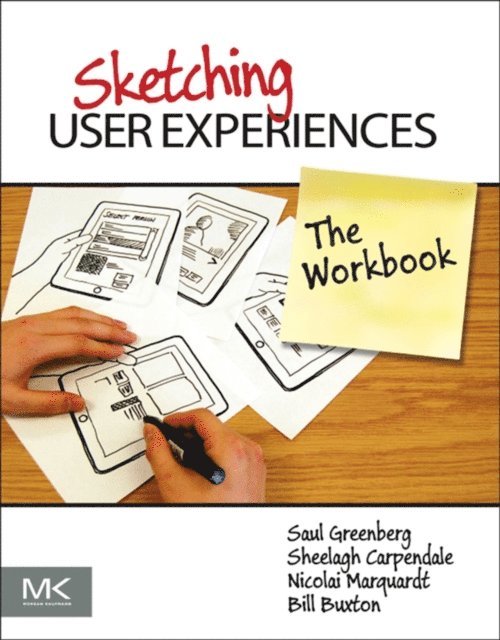
Sketching Working Experience: The Workbook provides information about the step-by-step process of the different sketching techniques. It offers methods called design thinking, as a way to think as a user, and sketching, a way to think as a designer. User-experience designers are designers who sketch based on their actions, interactions, and experiences. The book discusses the differences between the normal ways to sketch and sketching used by user-experience designers. It also describes some motivation on why a person should sketch and introduces the sketchbook. The book reviews the different sketching methods and the modules that contain a particular sketching method. It also explains how the sketching methods are used. Readers who are interested in learning, understanding, practicing, and teaching experience design, information design, interface design, and information architecture will find this book relevant. Features standalone modules detailing methods and exercises for practitioners who want to learn and develop their sketching skills
Extremely practical, with illustrated examples detailing all steps on how to do a method
Excellent for individual learning, for classrooms, and for a team that wants to develop a culture of design practice
Perfect complement to Buxton's Sketching User Experience or any UX text Author-maintained companion website at
http://grouplab.cpsc.ucalgary.ca/sketchbook/
Del 6 - Cambridge Series on Human-Computer Interaction
The Computer User as Toolsmith
The Use, Reuse and Organization of Computer-Based Tools
Inbunden, Engelska, 1993
1 038 kr
Skickas inom 7-10 vardagar
Computing environments that furnish a large set of tools (such as editors, mail programs and language processors) are difficult to use, primarily because there is no means of organizing the tools so that they are at hand when needed. Because of the dearth of knowledge of how users behave when issuing commands to general purpose computer systems, user support facilities are ad-hoc designs that do not support natural work habits. The Computer User as Toolsmith, first published in 1993, describes several empirical studies from which the author has developed a computer version of a handyman's workbench that would help users with their online activities. For the practitioner and interface designer, the guidelines and principles offered here are directly applicable to the rational design of new systems and the modernization of old ones. For the researcher and graduate student, the book offers a wealth of analysis and interpretation of data, as well as a survey of research techniques.
497 kr
Skickas inom 10-15 vardagar
In the everyday world, much of what we do as social beings is dictated by how we perceive and manage our interpersonal space. This is called proxemics. At its simplest, people naturally correlate physical distance to social distance. We believe that people’s expectations of proxemics can be exploited in interaction design to mediate their interactions with devices (phones, tablets, computers, appliances, large displays) contained within a small ubiquitous computing ecology. Just as people expect increasing engagement and intimacy as they approach others, so should they naturally expect increasing connectivity and interaction possibilities as they bring themselves and their devices in close proximity to one another. This is called Proxemic Interactions. This book concerns the design of proxemic interactions within such future proxemic-aware ecologies. It imagines a world of devices that have fine-grained knowledge of nearby people and other devices—how they move into range, their precise distance, their identity, and even their orientation—and how such knowledge can be exploited to design interaction techniques. The first part of this book concerns theory. After introducing proxemics, we operationalize proxemics for ubicomp interaction via the Proxemic Interactions framework that designers can use to mediate people’s interactions with digital devices. The framework, in part, identifies five key dimensions of proxemic measures (distance, orientation, movement, identity, and location) to consider when designing proxemic-aware ubicomp systems. The second part of this book applies this theory to practice via three case studies of proxemic-aware systems that react continuously to people’s and devices’ proxemic relationships. The case studies explore the application of proxemics in small-space ubicomp ecologies by considering first person-to-device, then device-to-device, and finally person-to-person and device-to-device proxemic relationships. We also offer a critical perspective on proxemic interactions in the form of “dark patterns,” where knowledge of proxemics may (and likely will) be easily exploited to the detriment of the user. Table of Contents: Acknowledgments / Videos / Figure Credits / Introduction / Part I / Ubicomp in Brief / Proxemic Interactions Theory / Operationalizing Proxemics for Ubicomp Interaction / Exploiting Proxemics to Address Challenges in Ubicomp Ecologies / Part II: Exploiting Proxemics in Ubicomp Ecologies / Person/Person-to-Device Proxemic Interactions / Device-to-Device Proxemic Interactions / Considering Person-to-Person and Device-to-Device Proxemics / Dark Patterns / Conclusion / References / Author Biographies