Saunders MacLane – författare
Visar alla böcker från författaren Saunders MacLane. Handla med fri frakt och snabb leverans.
7 produkter
7 produkter
Häftad, Engelska, 1992
865 kr
Skickas inom 10-15 vardagar
We dedicate this book to the memory of J. Frank Adams. His clear insights have inspired many mathematicians, including both of us. In January 1989, when the first draft of our book had been completed, we heard the sad news of his untimely death. This has cast a shadow on our subsequent work. Our views of topos theory, as presented here, have been shaped by continued study, by conferences, and by many personal contacts with friends and colleagues-including especially O. Bruno, P. Freyd, J.M.E. Hyland, P.T. Johnstone, A. Joyal, A. Kock, F.W. Lawvere, G.E. Reyes, R Solovay, R Swan, RW. Thomason, M. Tierney, and G.C. Wraith. Our presentation combines ideas and results from these people and from many others, but we have not endeavored to specify the various original sources. Moreover, a number of people have assisted in our work by pro viding helpful comments on portions of the manuscript. In this respect, we extend our hearty thanks in particular to P. Corazza, K. Edwards, J. Greenlees, G. Janelidze, G. Lewis, and S. Schanuel.
E-bok
PDF, Engelska, 20121 029 kr
Läs direkt efter köp
We dedicate this book to the memory of J. Frank Adams. His clear insights have inspired many mathematicians, including both of us. In January 1989, when the first draft of our book had been completed, we heard the sad news of his untimely death. This has cast a shadow on our subsequent work. Our views of topos theory, as presented here, have been shaped by continued study, by conferences, and by many personal contacts with friends and colleagues-including especially O. Bruno, P. Freyd, J.M.E. Hyland, P.T. Johnstone, A. Joyal, A. Kock, F.W. Lawvere, G.E. Reyes, R Solovay, R Swan, RW. Thomason, M. Tierney, and G.C. Wraith. Our presentation combines ideas and results from these people and from many others, but we have not endeavored to specify the various original sources. Moreover, a number of people have assisted in our work by pro viding helpful comments on portions of the manuscript. In this respect, we extend our hearty thanks in particular to P. Corazza, K. Edwards, J. Greenlees, G. Janelidze, G. Lewis, and S. Schanuel.
E-bok
PDF, Engelska, 20121 891 kr
Läs direkt efter köp
Häftad, Engelska, 2011
1 508 kr
Skickas inom 10-15 vardagar
This book records my efforts over the past four years to capture in words a description of the form and function of Mathematics, as a background for the Philosophy of Mathematics. My efforts have been encouraged by lec- tures that I have given at Heidelberg under the auspices of the Alexander von Humboldt Stiftung, at the University of Chicago, and at the University of Minnesota, the latter under the auspices of the Institute for Mathematics and Its Applications. Jean Benabou has carefully read the entire manuscript and has offered incisive comments. George Glauberman, Car- los Kenig, Christopher Mulvey, R. Narasimhan, and Dieter Puppe have provided similar comments on chosen chapters. Fred Linton has pointed out places requiring a more exact choice of wording. Many conversations with George Mackey have given me important insights on the nature of Mathematics. I have had similar help from Alfred Aeppli, John Gray, Jay Goldman, Peter Johnstone, Bill Lawvere, and Roger Lyndon. Over the years, I have profited from discussions of general issues with my colleagues Felix Browder and Melvin Rothenberg.Ideas from Tammo Tom Dieck, Albrecht Dold, Richard Lashof, and Ib Madsen have assisted in my study of geometry. Jerry Bona and B. L. Foster have helped with my examina- tion of mechanics. My observations about logic have been subject to con- structive scrutiny by Gert Miiller, Marian Boykan Pour-El, Ted Slaman, R. Voreadou, Volker Weispfennig, and Hugh Woodin.
E-bok
PDF, Engelska, 20131 100 kr
Läs direkt efter köp
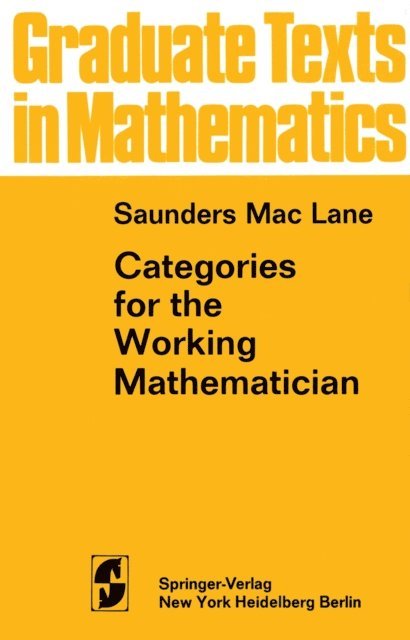
Category Theory has developed rapidly. This book aims to present those ideas and methods which can now be effectively used by Mathe maticians working in a variety of other fields of Mathematical research. This occurs at several levels. On the first level, categories provide a convenient conceptual language, based on the notions of category, functor, natural transformation, contravariance, and functor category. These notions are presented, with appropriate examples, in Chapters I and II. Next comes the fundamental idea of an adjoint pair of functors. This appears in many substantially equivalent forms: That of universal construction, that of direct and inverse limit, and that of pairs offunctors with a natural isomorphism between corresponding sets of arrows. All these forms, with their interrelations, are examined in Chapters III to V. The slogan is "Adjoint functors arise everywhere". Alternatively, the fundamental notion of category theory is that of a monoid -a set with a binary operation of multiplication which is associative and which has a unit; a category itself can be regarded as a sort of general ized monoid. Chapters VI and VII explore this notion and its generaliza tions. Its close connection to pairs of adjoint functors illuminates the ideas of universal algebra and culminates in Beck''s theorem characterizing categories of algebras; on the other hand, categories with a monoidal structure (given by a tensor product) lead inter alia to the study of more convenient categories of topological spaces.
Häftad, Engelska, 1995
597 kr
Skickas inom 10-15 vardagar
In presenting this treatment of homological algebra, it is a pleasure to acknowledge the help and encouragement which I have had from all sides. Homological algebra arose from many sources in algebra and topology. Decisive examples came from the study of group extensions and their factor sets, a subject I learned in joint work with OTTO SCHIL LING. A further development of homological ideas, with a view to their topological applications, came in my long collaboration with SAMUEL ElLENBERG; to both collaborators, especial thanks. For many years the Air Force Office of Scientific Research supported my research projects on various subjects now summarized here; it is a pleasure to acknowledge their lively understanding of basic science. Both REINHOLD BAER and JOSEF SCHMID read and commented on my entire manuscript; their advice has led to many improvements. ANDERS KOCK and JACQUES RIGUET have read the entire galley proof and caught many slips and obscurities. Among the others whose sug gestions have served me well, I note FRANK ADAMS, LOUIS AUSLANDER, WILFRED COCKCROFT, ALBRECHT DOLD, GEOFFREY HORROCKS, FRIED RICH KASCH, JOHANN LEICHT, ARUNAS LIULEVICIUS, JOHN MOORE, DIE TER PUPPE, JOSEPH YAO, and a number of my current students at the University of Chicago - not to m~ntion the auditors of my lectures at Chicago, Heidelberg, Bonn, Frankfurt, and Aarhus. My wife, DOROTHY, has cheerfully typed more versions of more chapters than she would like to count. Messrs.
E-bok
PDF, Engelska, 2012791 kr
Läs direkt efter köp
In presenting this treatment of homological algebra, it is a pleasure to acknowledge the help and encouragement which I have had from all sides. Homological algebra arose from many sources in algebra and topology. Decisive examples came from the study of group extensions and their factor sets, a subject I learned in joint work with OTTO SCHIL LING. A further development of homological ideas, with a view to their topological applications, came in my long collaboration with SAMUEL ElLENBERG; to both collaborators, especial thanks. For many years the Air Force Office of Scientific Research supported my research projects on various subjects now summarized here; it is a pleasure to acknowledge their lively understanding of basic science. Both REINHOLD BAER and JOSEF SCHMID read and commented on my entire manuscript; their advice has led to many improvements. ANDERS KOCK and JACQUES RIGUET have read the entire galley proof and caught many slips and obscurities. Among the others whose sug gestions have served me well, I note FRANK ADAMS, LOUIS AUSLANDER, WILFRED COCKCROFT, ALBRECHT DOLD, GEOFFREY HORROCKS, FRIED RICH KASCH, JOHANN LEICHT, ARUNAS LIULEVICIUS, JOHN MOORE, DIE TER PUPPE, JOSEPH YAO, and a number of my current students at the University of Chicago - not to m~ntion the auditors of my lectures at Chicago, Heidelberg, Bonn, Frankfurt, and Aarhus. My wife, DOROTHY, has cheerfully typed more versions of more chapters than she would like to count. Messrs.