
Say Young Kim – författare
Visar alla böcker från författaren Say Young Kim. Handla med fri frakt och snabb leverans.
2 produkter
2 produkter
Inbunden, Engelska, 2025
2 795 kr
Skickas inom 10-15 vardagar
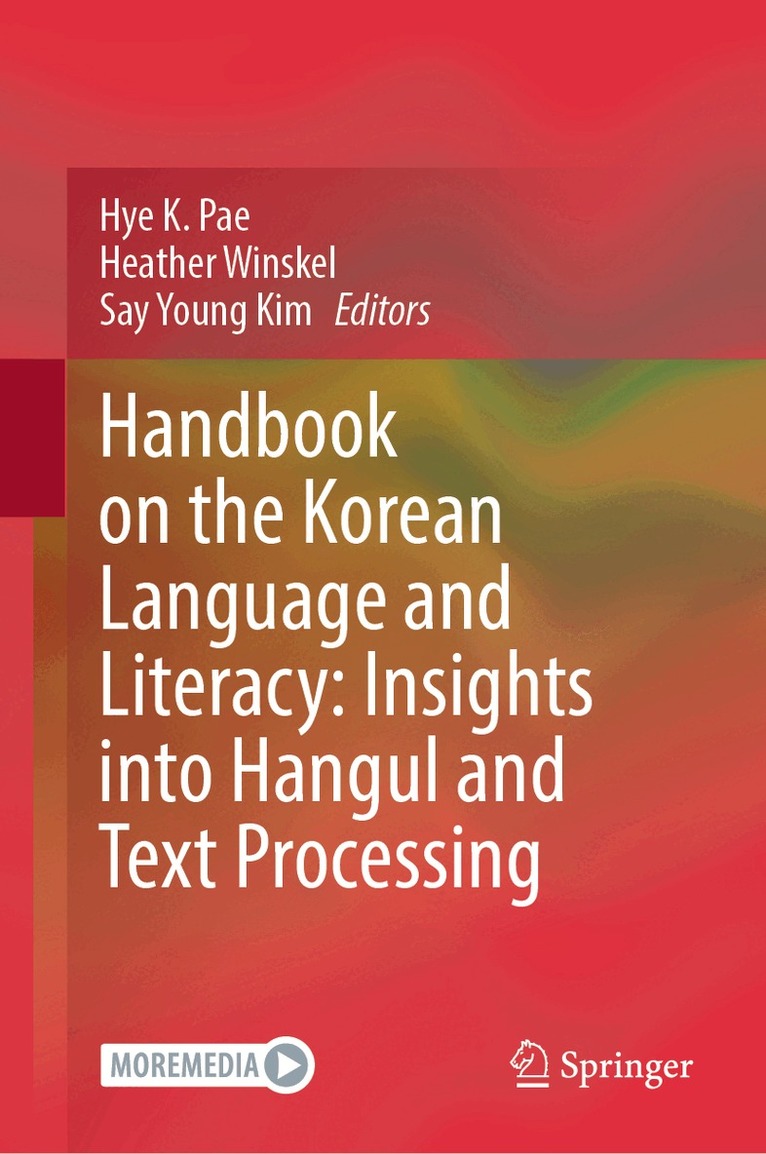
This handbook offers comprehensive insights into the language-writing nexus of the Korean alphabet, Hangul. Recognized by international linguists and historians as the most scientifically designed and efficient script, Hangul's uniqueness lies in its effective integration of the alphabetic principle into syllabic blocks. The volume challenges the dominant Eurocentric research trend by extending the body of knowledge to include Korean. The Korean alphabet is uniquely different from the Chinese and Japanese writing systems and the Latin alphabet. The state-of-the-art reflections on the Korean language, its alphabet, and its processing are organized into five parts, including (1) spoken language and written language, (2) processing at the lexical level, (3) processing at the sentential level, (4) acquisition of Korean as L1 and L2, and (5) future directions in theory, methodology, pedagogy, and more. The volume is written by leading Korean and non-Korean specialists in relevant fields across the world. It discusses Hangul-specific theories, script-specific empirical evidence, and syllable-based pedagogical practices. With the current Korean cultural wave (a.k.a., Hallyu; e.g., K-pop, K-dramas, K-movies, etc.) spreading across the world, this Handbook is timely and serves as a signpost to future research and practice. This collection of chapters serves as an authoritative vade mecum, offering scientifically grounded discussions on the complex mechanisms involved in reading and text processing while remaining accessible to students, researchers, practitioners, and policymakers.
E-bok
Engelska, 20253 451 kr
Läs direkt efter köp
This handbook offers comprehensive insights into the language-writing nexus of the Korean alphabet, Hangul. Recognized by international linguists and historians as the most scientifically designed and efficient script, Hangul's uniqueness lies in its effective integration of the alphabetic principle into syllabic blocks. The volume challenges the dominant Eurocentric research trend by extending the body of knowledge to include Korean. The Korean alphabet is uniquely different from the Chinese and Japanese writing systems and the Latin alphabet. The state-of-the-art reflections on the Korean language, its alphabet, and its processing are organized into five parts, including (1) spoken language and written language, (2) processing at the lexical level, (3) processing at the sentential level, (4) acquisition of Korean as L1 and L2, and (5) future directions in theory, methodology, pedagogy, and more. The volume is written by leading Korean and non-Korean specialists in relevant fields across the world. It discusses Hangul-specific theories, script-specific empirical evidence, and syllable-based pedagogical practices. With the current Korean cultural wave (a.k.a., Hallyu; e.g., K-pop, K-dramas, K-movies, etc.) spreading across the world, this Handbook is timely and serves as a signpost to future research and practice. This collection of chapters serves as an authoritative vade mecum, offering scientifically grounded discussions on the complex mechanisms involved in reading and text processing while remaining accessible to students, researchers, practitioners, and policymakers.